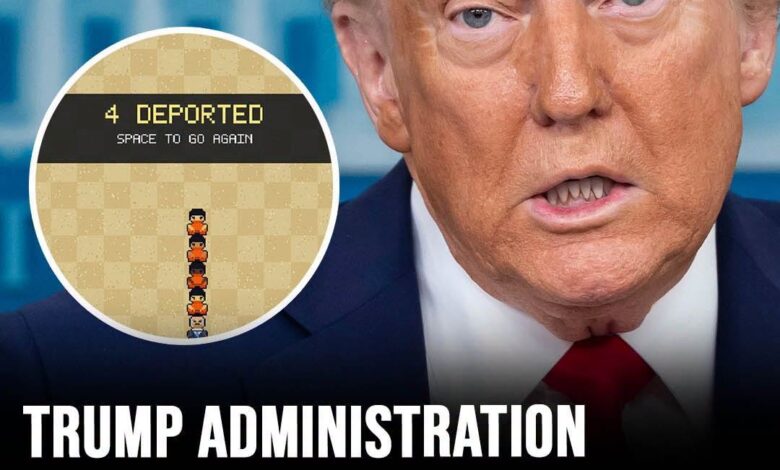
At first glance, it looks like something pulled from an old arcade.
Bright graphics. Simple controls. Points to score. A challenge to beat.
Then you realize what the game is actually about.
Immigration enforcement.
Border walls.
Deportation.
Suddenly, what might have been dismissed as another quirky piece of political messaging becomes something more revealing. When policies affecting real families and real lives are transformed into high-score mechanics and meme-ready entertainment, the argument is no longer merely about whether a government website is clever.
It becomes a question about what government believes politics is for.
The White House has embraced an increasingly playful online style, presenting politics through the language of internet culture: jokes, memes, exaggerated graphics, viral references, and content designed to travel quickly across social media.
Supporters see the approach as refreshing.
Why communicate like a traditional bureaucracy when millions of Americans spend their lives scrolling through TikTok, Instagram, X, and YouTube? Why issue another dry press release when a meme can reach more people in an hour?
In that worldview, politics should be energetic.
Provocative.
Funny.
And, above all, shareable.
The administration has framed that sensibility as a celebration of “fun and winning,” contrasting its own style with what it portrays as the joylessness of “dark socialism.”
But turning immigration policy into entertainment crosses a line for many critics because the underlying subject isn’t imaginary.
Behind every discussion about deportation is a person.
Behind every border statistic is a human journey.
Behind every enforcement operation are families, officers, communities, court proceedings, employers, taxpayers, and people facing consequences that extend far beyond a computer screen.
You can strongly support stricter immigration enforcement and still recognize that reality.
You can believe the border should be secured.
You can believe immigration laws should be enforced.
You can support deporting people who have no legal right to remain in the country.
And you can still ask whether any of that should be packaged like an arcade game.
That distinction matters because the controversy isn’t necessarily an argument about immigration policy itself.
It’s an argument about tone.
Government routinely deals with subjects that carry enormous human consequences—war, crime, illness, natural disasters, poverty, incarceration, and immigration among them.
The way officials communicate about those subjects tells citizens something about how seriously they take the people affected.
A video game changes the emotional vocabulary.
Walls become obstacles.
Enforcement becomes points.
Victory becomes a score.
Complicated human circumstances become simplified mechanics where somebody wins because somebody else loses.
For supporters, that may be exactly the appeal.
Politics has become entertainment already, they might argue. Campaigns produce memes. Candidates appear on podcasts. Governments compete for attention against influencers, celebrities, and endless algorithmic distractions.
If people are going to consume political information through entertainment anyway, why shouldn’t an administration speak that language fluently?
There is also a strategic calculation.
Outrage spreads content.
Every furious repost from an opponent puts the message in front of another audience.
Every television segment criticizing the game effectively advertises it.
Every social-media argument extends its lifespan.
Provocation isn’t necessarily a side effect.
It can be the distribution strategy.
But that strategy carries a cost.
For Americans already overwhelmed by serious problems, government-generated spectacle can feel disconnected from daily reality.
Families are watching wars unfold through relentless headlines.
People are opening medical bills they don’t know how to pay.
Rent consumes larger portions of household budgets.
Parents worry about groceries, childcare, insurance, debt, and whether an unexpected expense will destroy whatever financial cushion they have managed to build.
Against that backdrop, an official government game can land differently than its creators intended.
Instead of playful, it can feel frivolous.
Instead of confident, unserious.
Instead of “winning,” detached.
The criticism becomes especially sharp when taxpayers realize that government communication isn’t free.
Public websites require employees, contractors, designers, developers, security, maintenance, and administrative resources. Even when the cost of an individual project is relatively small within the federal budget, people inevitably ask a symbolic question:
Is this really what my government should be spending time on?
That question helps explain why the backlash has extended beyond ordinary partisan disagreement.
Social-media critics haven’t focused solely on immigration.
Some have raised questions about branding and intellectual property. Others have mocked the aesthetics. Still others have compared the spectacle to Idiocracy, the dystopian comedy in which civic seriousness has collapsed into entertainment and marketing.
Even criticism from within conservative circles is significant because it demonstrates the broader tension.
A person can support President Trump’s immigration agenda without wanting government communication to resemble a viral content studio.
A Republican can favor a border wall while thinking a game about it is juvenile.
A Democrat can oppose the underlying policies and therefore find the presentation doubly offensive.
And someone with no strong partisan allegiance can simply look at the whole thing and wonder when governing became indistinguishable from trolling.
That may be the deeper issue.
American politics has always contained theater.
Presidents stage events carefully.
Campaigns manufacture memorable moments.
Political cartoons have mocked opponents for centuries.
Television transformed elections long before social media existed.
There was never a pristine era in which politics consisted exclusively of sober adults discussing policy around mahogany tables.
But digital politics has intensified the incentives.
Attention is currency.
Anger creates engagement.
Humor creates shares.
Shock creates headlines.
And nuance rarely goes viral.
An online game fits perfectly into that ecosystem.
Government, however, is not merely another content creator competing for clicks.
It has power.
The policies being turned into jokes can determine whether someone remains in the country, whether a family is separated, where federal resources are deployed, and how communities experience law enforcement.
That doesn’t mean immigration enforcement itself is illegitimate or that every government communication must be grim.
It means the power behind the joke matters.
Imagine being directly affected by a policy and then watching the government turn that policy into entertainment.
The experience will inevitably feel different from that of someone playing from the safety of a laptop hundreds of miles away.
That gap—between the person clicking and the person living the consequences—is where much of the discomfort originates.
And it is why the debate cannot be reduced to whether the games are funny.
The larger question is what citizens should expect from institutions entrusted with enormous authority.
Should government entertain?
Certainly, sometimes.
Should it experiment with new ways of reaching younger audiences?
Probably.
Should officials understand internet culture instead of communicating as though every citizen still reads a printed newspaper over breakfast?
Absolutely.
But there is a difference between making government accessible and making human consequences into spectacle.
That boundary deserves scrutiny regardless of which party controls the White House.
Because administrations change.
The machinery remains.
A communication tactic celebrated when your side uses it can become horrifying when the opposing side inherits it.
Today, the game might involve immigration.
Tomorrow, another administration could apply the same logic to an issue entirely different voters consider sacred.
That’s why standards matter more than teams.
In the end, these games may reveal less about immigrants than they reveal about the political culture that produced them.
They suggest a presidency comfortable with collapsing the distance between governing and campaigning, policy and entertainment, official communication and internet trolling.
Supporters may call that innovation.
Critics may call it dehumanization.
Others may simply call it embarrassing.
But underneath all those arguments sits a more consequential question.
When citizens look toward their government during difficult times, what do they want to find?
A performer?
A provocateur?
A brand?
Or an institution capable of understanding that some responsibilities are too serious to be measured in likes, shares, memes, and high scores?
Politics will always contain spectacle.
Government doesn’t have to become one.