The chicken is there.
The frustrating part is that your brain may have looked directly at it several times already.
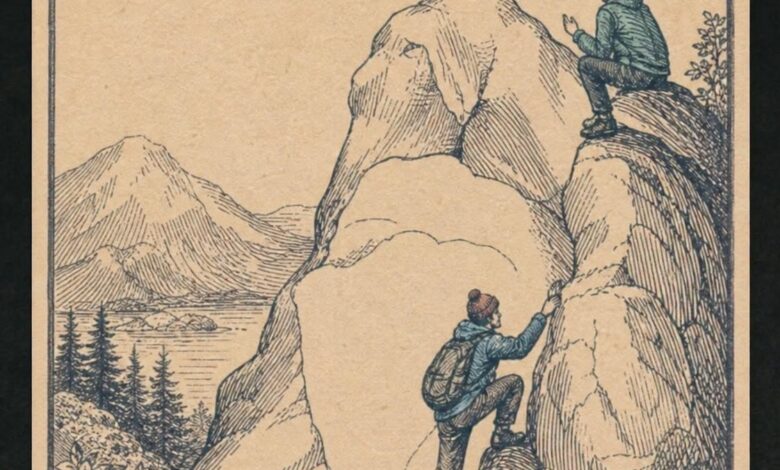
At first, the illustration seems straightforward enough. Two men dominate the scene, surrounded by rocks, shadows, and the rough contours of a cave. Your eyes immediately move toward the human figures because people are almost impossible for us to ignore.
Faces matter.
Bodies matter.
Movement matters.
So before you’ve consciously decided where to look, your attention has already been claimed.
You study the men.
Their clothing.
Their posture.
What they’re holding.
The space between them.
Then someone asks a seemingly simple question:
Can you find the chicken?
Suddenly the picture changes from an illustration into a hunt.
You inspect the obvious places first.
Maybe the chicken is between the men.
Maybe it’s near their feet.
Maybe there’s a tiny bird hidden behind an object.
You scan the center.
Nothing.
You look again.
Still nothing.
And then something particularly annoying happens.
Your eyes return to the men.
You know you’re supposed to be searching elsewhere, yet your attention keeps drifting back toward the most visually meaningful objects in the scene.
That isn’t necessarily poor eyesight.
It’s your brain doing what brains are exceptionally good at doing: deciding what deserves attention before you have time to analyze every detail.
Human beings don’t experience visual scenes as perfectly neutral collections of lines, colors, and shapes.
We prioritize.
Faces and human forms are especially powerful attention magnets. Strong contrast attracts us. Familiar objects are recognized quickly. Central elements often receive more scrutiny than peripheral ones.
Everything else risks becoming scenery.
And scenery is exactly where this illusion likes to hide.
The chicken is typically integrated into the rock formations rather than presented as an obvious little bird standing conveniently in the middle of the picture.
Its shape may emerge from the outline of stones near the cave’s edge.
A curve that appears to belong to a rock becomes part of the bird.
A patch of negative space suddenly matters.
A line your brain categorized as meaningless geology turns out to be doing two jobs at once.
That’s the trick.
The artist doesn’t necessarily hide the chicken by making it impossibly small.
The chicken disappears because the lines forming it have already been assigned another identity.
Rock.
Once your brain labels something as a rock, it has little reason to keep asking whether that same outline could also be part of an animal.
You’ve solved that portion of the image.
Or at least you think you have.
So you move on.
That is why people can stare at these puzzles for minutes and become increasingly irritated.
The harder you search, the more intensely you may repeat the same unsuccessful strategy.
Center.
Men.
Ground.
Objects.
Back to the men.
Maybe zoom in.
Center again.
Still no chicken.
At some point, someone gives you a hint.
“Stop looking in the middle.”
That helps.
You move toward the edges.
But even then, you may continue searching for a conventional chicken—a recognizable head, body, legs, and feathers presented together.
The illusion is counting on that expectation too.
Instead, try changing the way you look.
Step farther away from the image.
Tilt your head slightly.
Soften your focus.
Instead of identifying individual rocks, look at the larger contours created by several shapes together.
Don’t ask, “Which object is the chicken?”
Ask:
“What combination of lines could become one?”
Then, sometimes almost violently, the picture reorganizes itself.
There.
A curve becomes a back.
Another shape becomes a head.
What seemed like empty space starts contributing to an outline.
Several unrelated pieces suddenly cooperate.
And the chicken appears.
The reaction is usually immediate.
You’ve got to be kidding me.
Because once you’ve seen it, the puzzle seems absurdly easy.
You may wonder how you could possibly have missed something so obvious.
You look away.
Look back.
The chicken is still there.
In fact, now you may struggle to return to the original interpretation.
Those rocks don’t look quite as innocent anymore.
The hidden shape has become part of your brain’s understanding of the image.
Nothing in the illustration changed.
Not one line moved.
No new information was added.
The transformation happened entirely in perception.
That’s what makes these puzzles more interesting than simple “Where’s the hidden animal?” games.
They expose a basic feature of attention.
You don’t consciously process every available detail with equal priority.
You couldn’t.
Imagine walking into a crowded railway station and treating every shoe, advertisement, ceiling tile, suitcase zipper, facial expression, sign, reflection, and floor pattern as equally important.
You’d be overwhelmed.
Instead, the brain filters.
It chooses.
It emphasizes some information and suppresses other information.
Most of the time, this is enormously useful.
If someone suddenly calls your name across a crowded room, attention shifts.
If a car approaches while you’re crossing the street, it becomes more important than the architecture behind it.
If you’re speaking with another person, their face usually matters more than the pattern on the wall.
Attention helps turn an impossible flood of sensory information into a manageable experience.
But every filter creates blind spots.
The hidden chicken exploits one.
The two men appear meaningful, so your brain keeps investing attention in them.
The rocks appear secondary, so they receive less careful examination.
Yet the supposedly unimportant region contains exactly what you’re searching for.
There’s a broader lesson buried in that experience.
We often assume that if something is obvious, we’ll notice it.
That isn’t always true.
Something can be visible without being noticed.
Something can sit directly in front of us while our attention is occupied elsewhere.
And sometimes the harder we concentrate on the wrong area, the more invisible the answer becomes.
This doesn’t happen only with pictures.
Think about how easily it happens in everyday life.
We focus on the loudest person in a conversation and overlook the quietest.
We search for dramatic explanations while ignoring ordinary ones.
We become so committed to solving a problem one way that alternatives stop occurring to us.
We decide what matters first—and then unconsciously gather information around that decision.
Just like the rocks.
Once your brain says, “That’s background,” you stop investigating.
Once it says, “That’s irrelevant,” information can remain visible while becoming functionally invisible.
That’s why changing perspective can be so powerful.
Stepping back from the chicken puzzle isn’t magical.
Tilting your head doesn’t summon hidden ink.
Softening your gaze doesn’t physically alter the drawing.
These strategies simply interrupt the viewing pattern that has trapped you.
For a moment, the brain is forced to reconsider boundaries.
Maybe this line doesn’t belong only to that rock.
Maybe this empty space isn’t empty.
Maybe the edge matters more than the center.
And suddenly the thing that was impossible to see becomes impossible to miss.
Some people find the chicken immediately.
Others need thirty seconds.
Some need several minutes.
A few need someone to trace the outline before the image finally clicks.
None of that is a meaningful test of intelligence.
It certainly isn’t a diagnosis of visual ability.
It is simply a demonstration of how differently attention can organize the same information.
And perhaps that’s the most interesting part.
Everyone is looking at the same picture.
But not everyone is seeing the same thing.
The chicken doesn’t become real when you discover it.
It was there before you arrived.
It was there while you searched the wrong places.
It was there while you confidently decided it couldn’t possibly be hidden among those rocks.
Discovery merely changes your relationship to what was already present.
That is why these illusions can feel strangely profound for something so playful.
They remind us that certainty and perception aren’t identical.
Sometimes we don’t need more information.
We need to look differently at the information we already have.
So if you’re still searching for the chicken, stop staring harder.
Look wider.
Question the background.
Let the rocks become something other than rocks.
Because sometimes the thing you’re trying hardest to find isn’t hidden at all.
It’s sitting in plain sight, just beyond the place your attention decided was worth looking.