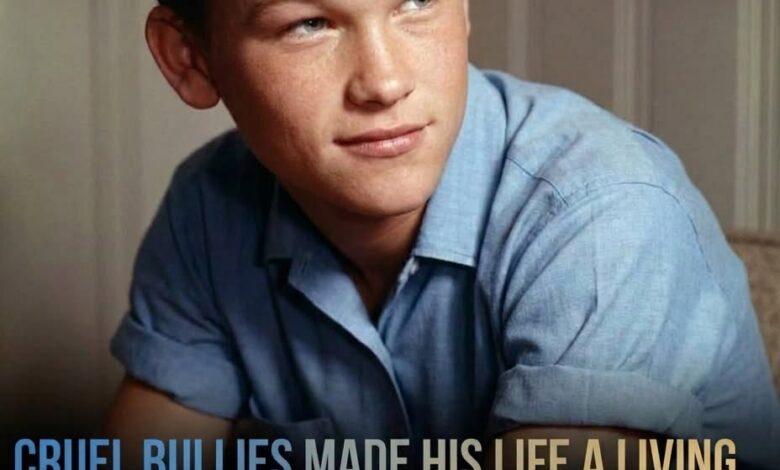
Before Patrick Swayze became the man lifting Jennifer Grey above his head in Dirty Dancing, he was a boy learning that grace could make you a target.
He grew up dancing.
For a young boy in Texas, that wasn’t always something other children understood or respected. Swayze trained seriously, influenced in no small part by his mother, Patsy, a dancer and choreographer. But outside the studio, his dedication could attract ridicule.
He learned early that doing what you loved sometimes required surviving other people’s opinions about it.
Dance demanded discipline.
So did athletics.
Swayze pursued both, developing the unusual combination that would later define him on screen: a dancer’s control inside an athlete’s body.
For a while, it seemed possible that sports might become his future.
Then injuries interfered.
A serious knee problem complicated his athletic ambitions and forced him to reconsider the direction of his life. What might have looked like the destruction of one dream eventually pushed him more deeply toward another.
Dance remained.
Acting followed.
But none of it happened overnight.
Before audiences knew his name, Swayze had to endure the ordinary humiliations of trying to build an artistic career—the auditions, uncertainty, small opportunities, financial pressure, and constant possibility that talent might never translate into stability.
Through much of that journey, one person remained extraordinarily important.
Lisa Niemi.
They met when they were young, when Lisa studied dance with Swayze’s mother. Their relationship developed long before Patrick became a movie star, which meant Lisa knew something Hollywood never could:
the person before the image.
They married in 1975.
Years later, when millions of people saw Patrick Swayze as a romantic ideal, Lisa knew the complicated human being who went home when the cameras stopped.
That distinction would matter.
Because fame arrived dramatically.
After years of work, Swayze became increasingly visible through projects including The Outsiders and the television miniseries North and South.
Then came Dirty Dancing in 1987.
Johnny Castle changed everything.
Swayze’s dance training, athleticism, charisma, and vulnerability suddenly converged in one role. The film became a phenomenon, and scenes that might have looked ordinary on a script page became permanent pieces of popular culture.
Then came Ghost.
If Dirty Dancing established him as a romantic star, Ghost showed audiences another kind of emotional presence. The image of Swayze and Demi Moore at the pottery wheel became one of cinema’s most recognizable romantic sequences.
From the outside, it looked as though the difficult climb had finally ended.
That is one of fame’s great illusions.
We assume success solves the person who achieves it.
It doesn’t.
Swayze’s life contained grief that no box-office result could touch.
His father died in 1982, a loss that affected him deeply. Other family tragedies followed, including the death of his sister Vicky in 1994.
Grief does not politely remain separate from the rest of a life.
It leaks into marriages.
Work.
Sleep.
Anger.
Habits.
Swayze later spoke openly about struggles with alcohol, and there were periods when his personal pain threatened the stability fame appeared to promise.
That reality complicates the myth without destroying it.
Patrick Swayze wasn’t resilient because suffering bounced harmlessly off him.
He was resilient because it didn’t.
He was hurt.
He struggled.
He sometimes coped badly.
And he repeatedly had to find his way back.
Back to work.
Back to discipline.
Back to the people who loved him.
Back to Lisa.
Their marriage wasn’t a fairy tale preserved untouched for decades.
No marriage is.
Longevity isn’t created by avoiding difficulty. It is built through thousands of decisions made after difficulty arrives.
Lisa had married a dancer and watched him become a global celebrity.
She saw strangers turn her husband into a fantasy.
She also saw what those strangers couldn’t.
The injuries.
The grief.
The doubts.
The consequences of pushing a body beyond what it wanted to give.
Swayze’s physicality had helped make him famous, but his body accumulated damage across decades of dancing, athletics, stunts, horseback riding, and demanding film work.
Then came the challenge no amount of training could overpower.
In early 2008, Swayze’s diagnosis of pancreatic cancer became public.
The news was devastating.
Pancreatic cancer is a formidable disease, and suddenly the man audiences associated with movement, strength, and physical control was confronting something that could not be defeated by determination alone.
Swayze understood the seriousness.
But he continued working.
During treatment, he filmed the television series The Beast.
It would be easy to turn that into a simplistic inspirational slogan:
He fought.
He refused to quit.
He was stronger than cancer.
But illness deserves more honesty than that.
People do not survive cancer because they possess superior courage, and those who die from it have not failed to fight hard enough.
Swayze’s decision to keep working mattered because it reflected how he wanted to live during the time he had.
He remained an actor.
He remained a husband.
He remained himself.
That is different from pretending he wasn’t sick.
Lisa stayed beside him.
Their relationship, which had begun before either could know what their future contained, now faced something neither could negotiate away.
There would be no perfect movie ending.
Patrick Swayze died on September 14, 2009, at the age of 57.
He and Lisa had been married for 34 years.
His death froze him in the public imagination.
Johnny Castle remains young.
Sam Wheat remains suspended in the heartbreaking romance of Ghost.
Dalton still walks into danger in Road House.
Film does that strange thing to people.
It preserves the body even after the person is gone.
Press play, and Swayze moves again.
He dances.
Smiles.
Fights.
Falls in love.
The audience knows what he does not:
time is waiting outside the frame.
Yet perhaps his most meaningful legacy cannot be captured in any single famous scene.
His life was filled with contradictions.
He was a dancer who learned toughness.
An athlete whose injuries redirected his future.
A romantic icon who experienced a real marriage complicated by real pain.
A man celebrated for physical strength whose body ultimately became vulnerable.
A star who achieved the kind of success millions dream about and discovered that fame could not protect him from grief, addiction, illness, or mortality.
That doesn’t diminish his story.
It makes it human.
We often define resilience incorrectly.
We imagine the resilient person as someone who never breaks.
Swayze’s life suggests something less glamorous and more useful.
Sometimes resilience is breaking and returning.
It is admitting that the thing you’re using to numb pain is destroying something else.
It is accepting that one dream has ended and discovering another.
It is walking back into a rehearsal room.
Returning to a marriage after difficult seasons.
Showing up for work while knowing your future has become frighteningly uncertain.
And sometimes it is simply choosing to remain present for whatever life still allows.
Patrick Swayze became famous because he could move with extraordinary grace.
But grace was never the absence of struggle.
A dancer looks effortless because the audience doesn’t see every fall, injury, repetition, and failed attempt that came before the finished movement.
Perhaps the same was true of Swayze himself.
The world remembers the lift.
The pottery wheel.
The fight scenes.
The movie-star smile.
Lisa knew everything outside the frame.
And somewhere between the boy mocked for dancing and the dying man still determined to work, Patrick Swayze built a legacy larger than any one role.
He taught millions how beautiful it could look to stay on your feet.
His life told the harder truth:
sometimes courage is simply finding a reason to stand up again.