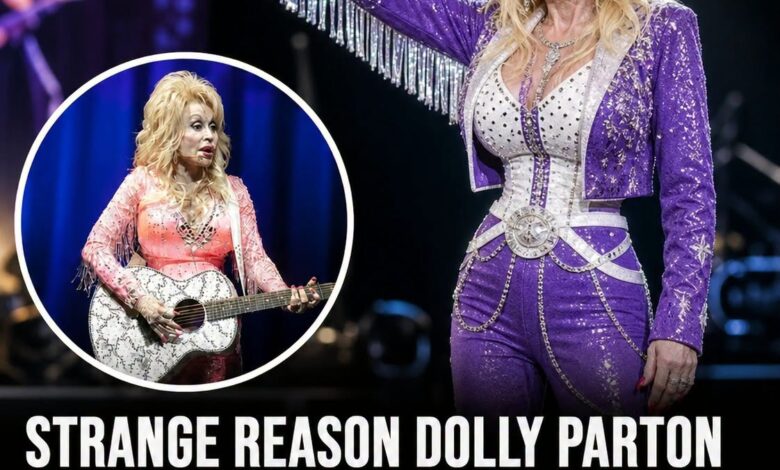
Dolly Parton has never asked anyone to believe she simply woke up looking like Dolly Parton.
That may be one of the most refreshing things about her.
The towering hair, impossible lashes, brilliant lipstick, rhinestones, fitted costumes, long sleeves, and fingerless gloves were never presented as effortless nature. They were construction—deliberate, playful, unmistakable construction.
Dolly didn’t merely dress herself.
She created herself.
And that distinction matters when discussing one of the enduring curiosities surrounding her appearance: why she so often covered her arms and hands.
For years, fans speculated.
Was she hiding tattoos?
Scars?
A medical condition?
Was there some secret beneath those sleeves and gloves?
The fascination became almost inevitable because celebrity culture has a peculiar relationship with privacy. Once someone becomes famous enough, audiences begin to assume every visible inch of that person’s life deserves an explanation—and every concealed inch must contain a mystery.
Dolly has acknowledged having tattoos, but the reality she has described is subtler than the mythology.
She has said that she developed some scar tissue and discoloration and chose to cover certain areas with delicate tattoos, including designs such as butterflies, ribbons, bows, and flowers. She has characterized them as relatively light and tasteful rather than the extensive hidden tattoo collection people sometimes imagine.
That makes the story more interesting, not less.
Because the tattoos weren’t necessarily about transforming her into someone else.
They were about deciding what to do with marks already there.
A scar says:
Something happened here.
A tattoo can say:
And I get to decide what happens next.
There is something profoundly Dolly-like about that.
Take something unwanted.
Add color.
Add imagination.
Turn it into decoration without pretending the original mark never existed.
She didn’t erase the history.
She redesigned the surface.
The same philosophy seems almost woven into her entire public image.
Dolly has spent decades in an industry that scrutinizes women’s bodies with extraordinary cruelty.
Too young-looking, and you’re accused of trying too hard.
Look your age, and people ask what happened.
Have cosmetic work, and you’re mocked for being artificial.
Don’t have it, and every wrinkle becomes a headline.
Dress modestly, and you’re disappearing.
Show skin, and you’re desperate for attention.
There is almost no correct answer because the game was never designed to let women win.
Dolly found another option.
She stopped pretending she was playing by anyone else’s rules.
Her glamour became so exaggerated that criticism almost lost its leverage.
Yes, the hair was enormous.
That was the point.
Yes, the makeup was dramatic.
She knew.
Yes, she had cosmetic procedures.
She spoke about them with humor rather than pretending some miraculous combination of sleep and mountain air had preserved her appearance.
She transformed artificiality from an accusation into authorship.
And yet openness never meant total access.
That is where the sleeves and gloves become more meaningful.
Whatever combination of style, skin coverage, personal preference, or practical reason lies behind particular outfits, Dolly never owed the public an unrestricted view of her body.
Nobody does.
Honesty does not require exposure.
You can tell the truth without opening every door.
You can be authentic while maintaining privacy.
You can laugh about your appearance while still deciding which parts of yourself remain yours.
That is a boundary celebrity culture often struggles to understand.
We confuse visibility with ownership.
Because someone performs before millions, we begin to think we’re entitled to inspect everything.
The body.
The marriage.
The medical history.
The grief.
The aging.
The scars.
The explanation behind every glove.
But a performer gives an audience a performance.
She doesn’t surrender ownership of herself.
Dolly understood that distinction remarkably well.
The public could have the rhinestones.
The songs.
The jokes.
The wigs.
The enormous personality.
The stories she chose to tell.
But she still controlled the frame.
There is power in that.
Especially when the subject is aging.
Skin changes.
Bodies accumulate evidence.
Operations leave scars.
Injuries leave marks.
Pigmentation changes.
Hands reveal years.
No amount of fame negotiates an exemption from being human.
Yet popular culture often presents aging as a failure of maintenance, particularly for women whose younger faces became famous.
Dolly’s approach offers something more interesting than either extreme.
She didn’t build her identity around appearing untouched by time.
Nor did she accept the idea that authenticity required displaying every change without intervention.
Instead, she decorated.
Covered.
Revealed.
Adjusted.
Played.
That is still authenticity because authenticity isn’t the absence of artifice.
It’s alignment between your choices and your sense of self.
A woman wearing no makeup can be authentic.
A woman wearing rhinestones, lashes, a wig, long sleeves, gloves, and carefully placed tattoos can be equally authentic.
The question isn’t how much you’ve altered.
It’s whether the person making those decisions is you.
That’s why Dolly’s image has endured when so many manufactured celebrity personas eventually feel hollow.
Beneath all the deliberate exaggeration, there has always been a wink.
She knows we’re looking.
She knows what we’re looking at.
And she knows she arranged it that way.
There is no shame in the construction.
That may be the most liberating part.
Scars don’t have to become inspirational symbols.
You don’t have to love every mark on your body.
You don’t have to display something simply to prove you’ve accepted it.
And you don’t have to hide it because someone else thinks it is ugly.
You can choose.
Cover it.
Leave it visible.
Tattoo over it.
Decorate around it.
Tell the story.
Keep the story private.
None of those decisions determines your courage.
The important thing is ownership.
Dolly’s butterflies and flowers, as she has described them, fit beautifully into that idea.
A butterfly is almost too perfect a symbol.
Transformation without denial.
The earlier form isn’t erased simply because something beautiful emerged afterward.
And perhaps that’s why the story resonates beyond celebrity fashion.
Everyone eventually carries marks.
Some can be photographed.
Others can’t.
A scar from surgery.
A changed body after childbirth.
An injury.
A wrinkle.
A memory.
A humiliation.
A grief that nobody can see.
Life writes on people.
We don’t always get to choose what leaves the mark.
But sometimes we get to choose what we place around it.
A flower.
A sleeve.
A joke.
A song.
A boundary.
A new interpretation.
That isn’t deception.
It’s authorship.
Maybe that is what Dolly Parton’s carefully constructed glamour has been telling us all along.
She never promised the world an untouched woman.
She gave it a woman who understood that self-expression and privacy could coexist.
She could admit to changing things without apologizing.
She could cover something without being ashamed of it.
She could reveal vulnerability without surrendering ownership of it.
The rhinestones weren’t lies.
The sleeves weren’t confessions.
The gloves weren’t invitations to investigate.
They were choices.
And after decades beneath lights bright enough to expose every imperfection, Dolly Parton continued making the same quiet declaration:
The world may look.
But she decides what it gets to see.
Life left its marks on her.
She simply picked up the brush and finished the picture herself.