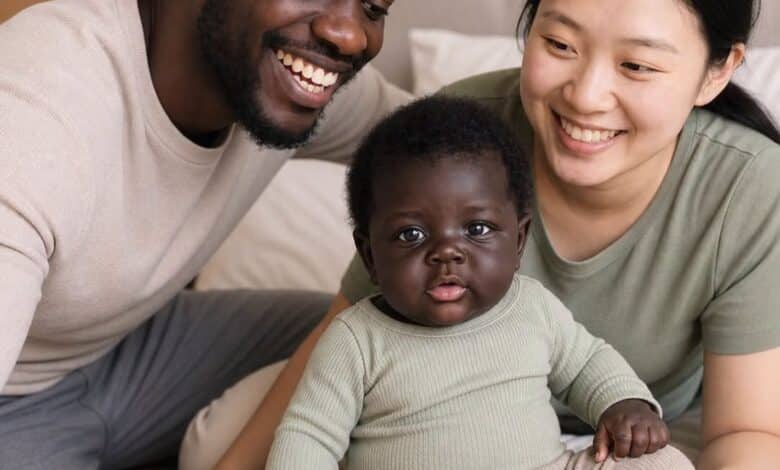
The baby was supposedly already here.
Born in China.
Engineered in secret.
Part human, part artificial intelligence, resistant to disease, intellectually enhanced, and potentially the first member of a new generation that would change humanity forever.
There was just one problem.
There was no credible evidence the baby existed.
The viral story of China’s alleged “AI superbaby” had many of the ingredients of a scientific bombshell, but almost none of the things genuine scientific breakthroughs leave behind.
No identifiable research team.
No verifiable institution announcing the achievement.
No peer-reviewed paper describing what had actually been done.
No methodology that other scientists could examine.
No credible clinical documentation.
Instead, there were dramatic posts, recycled images, anonymous claims, screenshots detached from their original context, and scientific-sounding phrases impressive enough to discourage casual readers from asking the simplest question:
What does any of this actually mean?
That question matters because “AI superbaby” isn’t a scientific category.
Artificial intelligence and genetic engineering are real fields, and both are advancing rapidly. AI can help researchers analyze biological data, identify patterns, model proteins, assist medical research, and explore enormous datasets faster than humans could manually.
Genetic technologies can also alter biological material in specific contexts.
But using AI to study biology is radically different from somehow installing “artificial intelligence” inside a developing human being.
The viral story blurred that distinction until the boundary almost disappeared.
Terms such as “integrated AI,” “enhanced intelligence,” and “total immunity” were presented as though they described established technologies.
They didn’t explain a mechanism.
They created an atmosphere.
That is one of the oldest tricks in misinformation.
Use enough technical vocabulary and an unsupported claim can begin to feel like something the reader simply isn’t educated enough to understand.
Real science works in the opposite direction.
Extraordinary research creates questions.
What exactly was changed?
How?
At what developmental stage?
What evidence demonstrates the claimed result?
What are the limitations?
What risks were observed?
Who conducted the work?
Where?
Under what ethical and regulatory oversight?
Can qualified independent experts inspect the evidence?
Those aren’t annoying technicalities standing between the public and an exciting story.
They are the architecture that separates scientific evidence from science fiction.
The supposed photographs offered no rescue.
Images presented as leaked evidence can feel particularly persuasive because seeing is psychologically powerful. A laboratory photograph, medical equipment, a newborn, researchers in protective clothing—combine them with a dramatic caption and the brain begins constructing a narrative before provenance has even been established.
But an image does not prove the caption attached to it.
Old photographs can be recirculated.
Stock images can be stripped of context.
Screenshots can remove the information needed to identify an original source.
AI-generated or manipulated imagery adds another layer of difficulty.
The proper question isn’t merely:
Does this photograph look convincing?
It is:
Where did it come from?
Can the original be located?
Was it published before the alleged event?
Who took it?
What did its original caption say?
Does a reputable institution independently connect that image with the extraordinary claim being made?
Without provenance, visual drama is not evidence.
Yet the story spread because evidence wasn’t really what made it attractive.
Fear was.
The “AI superbaby” compressed several modern anxieties into one irresistible headline.
Fear of artificial intelligence.
Fear of genetic engineering.
Fear of governments conducting secret experiments.
Fear that another country has achieved a technological breakthrough nobody else understands.
Fear that human beings are approaching a boundary that, once crossed, cannot be uncrossed.
Add a baby and the emotional stakes become even higher.
Now the story isn’t merely about technology.
It’s about what counts as human.
That combination is almost engineered for virality.
And misinformation does not need everyone to believe it completely.
It only needs enough people to think:
What if it’s true?
That uncertainty is enough to earn a share.
“I’m not saying this is real, but this is terrifying.”
“Why isn’t the media covering this?”
“Share before they delete it.”
Those phrases can move an unsupported claim through millions of screens while allowing each participant to feel they are merely asking questions.
But sharing is distribution.
A question mark doesn’t neutralize misinformation when the rest of the post is designed to make the claim feel credible.
Experts examining such narratives have emphasized the enormous gap between current science and the fantastical idea of embedding functional artificial intelligence into a human baby.
There are genuine debates around embryo research, gene editing, reproductive technologies, AI in medicine, and human enhancement.
Those debates deserve serious attention precisely because the technologies involved are real.
Inventing imaginary breakthroughs doesn’t make that discussion more urgent.
It makes it less informed.
And history gives us a useful reason not to dismiss every shocking biotechnology story automatically.
In 2018, Chinese scientist He Jiankui announced the births of gene-edited babies after altering embryos using CRISPR, provoking international condemnation and intense ethical scrutiny.
That event was real.
It also illustrates what a real scientific scandal looks like.
There was an identifiable scientist.
An identifiable technology.
Specific claims that experts could analyze.
Institutional and governmental responses.
A worldwide scientific and ethical debate.
Documentation accumulated.
People could investigate.
Reality leaves tracks.
A vague post claiming an anonymous laboratory has created a baby with “AI integrated into its DNA” is not made more credible simply because genuine scientific controversies have occurred before.
If anything, the comparison should make us more demanding about evidence.
The most revealing part of the superbaby hoax, then, isn’t what it says about biotechnology.
It’s what it says about us.
We live in an information environment where emotional plausibility can outrun factual plausibility.
A story feels true because it resembles something we’re already afraid might happen.
AI is advancing quickly.
Therefore an AI baby feels imaginable.
China invests heavily in technology.
Therefore a secret Chinese laboratory feels plausible.
Genetic engineering exists.
Therefore “total immunity” sounds just scientific enough to slip past skepticism.
Each real fact becomes a stepping stone toward an unsupported conclusion.
That is why media literacy increasingly requires more than recognizing obviously ridiculous stories.
The most effective misinformation often contains pieces of reality.
It borrows legitimate terminology.
Uses genuine photographs in false contexts.
References actual scientific fields.
Wraps speculation around real geopolitical tension.
Then it asks the audience to cross the final bridge without noticing that the bridge is missing.
The defense is not cynicism.
It is verification.
Before sharing the next miraculous scientific breakthrough, look for the research institution.
Look for the scientists’ names.
Search for the original paper rather than screenshots describing it.
Check whether independent experts are discussing the work.
Distinguish a preprint from peer-reviewed research.
Distinguish laboratory experiments from animal studies, and animal studies from demonstrated human outcomes.
Watch for claims of absolute results such as “total immunity,” “perfect intelligence,” or “no side effects.”
Science is rarely that tidy.
And be especially cautious when a post explains criticism by claiming that every missing piece of evidence proves a cover-up.
That creates a belief system that cannot be disproved.
No paper?
“They suppressed it.”
No scientist?
“The scientist is being protected.”
Old photograph?
“They replaced the original.”
No credible news coverage?
“The media won’t tell you.”
Once absence of evidence becomes evidence of conspiracy, verification becomes impossible by design.
The fictional superbaby is frightening.
But the more immediate danger is considerably less futuristic.
It is millions of ordinary people carrying extraordinary claims from screen to screen faster than anyone checks whether they are true.
No secret laboratory is required.
No genetic engineering.
No artificial intelligence implanted into a child.
Just a dramatic headline, an alarming image, scientific vocabulary, and one human impulse misinformation has always understood perfectly:
the desire to tell someone else before stopping to ask whether there is anything real to tell.
The “AI superbaby” never needed to exist.
The story only needed us to share it.