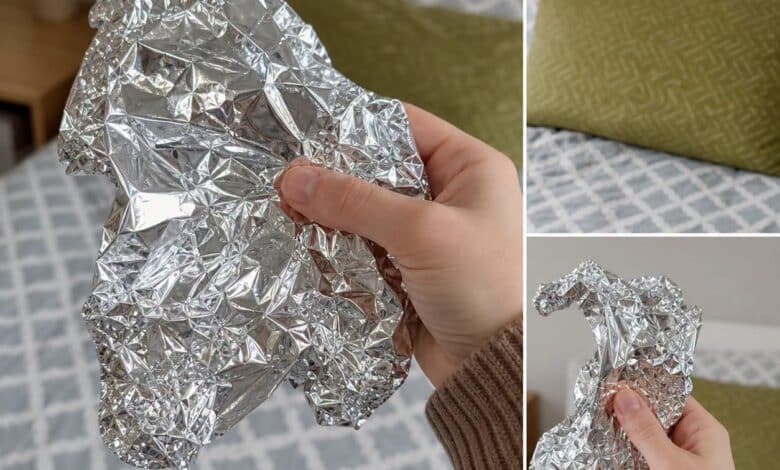
It sounds like the kind of advice that could only have been invented at two in the morning.
Take a sheet of aluminum foil.
Fold it.
Slide it beneath your pillow.
Go to sleep.
By morning, depending on which social media post you encounter, you may supposedly sleep more deeply, wake feeling restored, block mysterious electromagnetic interference, calm your nervous system, or discover some forgotten household secret that modern medicine somehow overlooked.
It’s an irresistible story.
It’s also one that deserves a distinction between ritual and evidence.
There is no good scientific reason to believe that putting ordinary aluminum foil under your pillow directly improves sleep, “detoxifies” the body, resets the nervous system, or creates a meaningful protective shield against everyday wireless signals.
A piece of foil beneath a pillow is not a sleep treatment.
But that doesn’t make the trend entirely uninteresting.
In fact, the most fascinating thing about it may have nothing to do with aluminum.
It may have everything to do with us.
We are tired.
Not merely sleepy.
Tired in the broader, stranger sense of living in a world that rarely seems to switch off.
The phone beside the bed lights up.
A watch vibrates.
A charger glows.
Messages arrive from people who are themselves lying awake somewhere else.
News never closes.
Work can follow us into the bedroom.
Entertainment is available indefinitely.
Algorithms have no bedtime.
Then, into this complicated landscape of stress, screens, schedules, caffeine, anxiety, light exposure and disrupted routines comes an extraordinarily simple instruction:
Put this under your pillow.
People love instructions like that.
Not necessarily because they are gullible, but because simplicity is comforting when the problem feels complicated.
Insomnia can be complicated.
Poor sleep can have many contributors, including stress, inconsistent schedules, environmental conditions, medications, substances, pain, sleep disorders and other health issues.
The idea that one household object could bypass all of that is enormously appealing.
No appointment.
No complicated routine.
No expensive equipment.
No waiting.
Just foil.
And once someone tries it, something interesting can happen.
They may genuinely sleep better.
That does not prove the aluminum produced a physiological effect.
Human beings respond to expectations and rituals.
If placing foil beneath the pillow becomes part of a deliberate bedtime routine—put the phone away, dim the lights, prepare the room, perform the strange little ritual, lie down expecting rest—the surrounding behavior may help create a psychological transition from daytime vigilance to nighttime quiet.
The ritual can become a signal.
We’re finished now.
Nothing else needs to happen tonight.
Rest.
That is where the idea of a placebo becomes more nuanced than simply saying, “It’s fake.”
Expectations can influence subjective experiences.
Rituals can change how people interpret sensations.
A repeated bedtime routine can become associated with sleepiness and relaxation.
But those possibilities shouldn’t be converted into proof that the object itself possesses a special sleep-enhancing property.
If someone sleeps beautifully with foil under the pillow, the sleep is real.
The explanation may simply be different from the one promised by a viral video.
There is another reason the foil story feels perfectly designed for our era.
It looks like protection.
Aluminum has legitimate uses in shielding and electronics under specific engineered conditions, which makes exaggerated claims sound just scientific enough to travel.
From there, it is easy for an internet explanation to leap from “metals can interact with electromagnetic fields” to “a sheet under your pillow protects your brain from Wi-Fi.”
Those statements are not equivalent.
Effective electromagnetic shielding depends on factors such as frequency, geometry, continuity, materials and the configuration of the source and shield.
A loose sheet of kitchen foil hidden under a pillow is not a magical barrier separating a sleeper from the modern wireless world.
And if your concern is the phone itself, there is a much simpler intervention available.
Move it away from the bed.
Not because the device is secretly poisoning your dreams, but because phones are extraordinarily good at keeping humans awake.
Light.
Notifications.
Late-night scrolling.
Videos.
Messages.
The temptation to check one more thing.
Those are much more practical sleep concerns than whether your pillow needs metallic armor.
That may be the deeper irony of the foil trend.
We keep searching for objects that will protect us from technologies we are reluctant to put down.
We want something underneath the pillow to solve what is sitting on the nightstand.
Still, I understand why the ritual appeals to people.
There is something almost ancient about it.
Humans have always created bedtime rituals.
We lock doors.
Close curtains.
Arrange blankets.
Say prayers.
Drink tea.
Read.
Check on children.
Turn the pillow to the cool side.
Performing these actions can create a boundary between the exposed world of daytime and the vulnerable state of sleep.
Sleep requires surrender.
For hours, we agree not to monitor the world.
That can be surprisingly difficult when modern life trains us to monitor everything.
Perhaps aluminum foil becomes compelling because it feels like a homemade shield.
A thin silver line between you and whatever invisible thing you’re worried about.
That symbolism can be comforting.
But symbolism becomes dangerous when it replaces appropriate care.
Persistent sleep problems shouldn’t automatically be dismissed as something a household hack will fix. Loud snoring accompanied by choking or gasping, significant daytime sleepiness, persistent insomnia, or other concerning symptoms can deserve professional evaluation.
And putting foil beneath your pillow should not become a substitute for addressing the basics.
A reasonably consistent sleep schedule.
A comfortable, dark environment.
Less stimulation near bedtime.
Thoughtful caffeine and alcohol habits.
Managing stress where possible.
And seeking medical guidance when sleep problems persist or substantially affect daily life.
Those interventions are less exciting than a viral trick.
That’s precisely why viral tricks spread.
“Improve your sleep habits over time” is not mysterious.
“Put aluminum foil under your pillow tonight and see what happens” practically writes its own headline.
The important thing is not to confuse curiosity with evidence.
If someone enjoys the ritual and it poses no practical problem, they don’t need to be mocked for it.
Maybe the foil reminds them to stop scrolling.
Maybe the act marks the end of the day.
Maybe believing that bedtime has begun helps them settle.
Fine.
Just don’t give the aluminum credit for powers we haven’t established.
Because perhaps the real lesson hiding beneath the pillow isn’t about metal at all.
It’s about how desperately people want permission to disconnect.
We want the bedroom to become private again.
We want the buzzing world to remain outside.
We want one small ritual that says nothing more is required of us tonight.
That desire is real, even when the science behind the trend isn’t.
So if a crinkled sheet of foil feels like a shield, remember what you’re actually trying to protect.
Not your pillow from invisible forces.
Your attention from interruption.
Your evening from endless input.
Your sleep from a world that has forgotten how to stop asking for you.
The foil itself may do very little.
The decision to finally switch everything else off can do considerably more.