Twenty-five years later, the message still lasts only seconds.
There is no dramatic music behind it. No narrator explaining what is happening. No polished final speech written with the benefit of hindsight.
There is simply the voice of a husband who knows he may never see his wife again.
On September 11, 2001, Brian Sweeney was aboard United Airlines Flight 175 when hijackers seized the plane. Before it struck the South Tower of the World Trade Center, the 38-year-old former Navy pilot managed to use an onboard telephone.
He called home.
His wife, Julie, wasn’t there.
So Brian left a voicemail.
He told her the plane had been hijacked. He told her the situation looked bad. Most importantly, he told her he loved her completely. He wanted her to live, to have good times, and to pass his love along to his parents and everyone else he cared about.
Then the message ended.
For Julie, those words would become one of the most painful and precious things Brian left behind.
She had been teaching that Tuesday morning when she was pulled away from her classroom. The news waiting for her was almost impossible to absorb: Brian was on a hijacked aircraft.
At that point, September 11 had not yet become “9/11.”
There were no memorial pools.
No museum.
No anniversary ceremonies.
No familiar images replayed across decades.
There was only confusion unfolding in real time and families desperately trying to understand where the people they loved were.
When Julie eventually returned home, Brian’s voice was waiting.
It is difficult to imagine what pressing play must have required.
The recording could not save him.
It could not explain everything that had happened.
It could not give her another conversation.
But it answered one question grief can otherwise leave unanswered forever.
What was he thinking about?
Her.
Brian’s final message became powerful partly because of what it lacked.
There was no grand declaration about heroism.
No attempt to turn himself into a symbol.
He was a husband speaking to his wife.
That mattered because Brian had already lived a life people could easily describe in heroic language.
He had served as a U.S. Navy pilot and was a veteran of the Gulf War. Julie remembered him as physically imposing and extraordinarily confident—the kind of man who could seem almost indestructible to people who loved him.
She once described him as seeming “invincible.”
They had met in Philadelphia.
Julie noticed him because he stood apart from the other men around him. While others were dressed more conventionally, Brian was wearing a cap and denim shirt.
She reportedly turned to a friend and said he looked like the kind of man she would marry.
Eventually, she did.
They married on Cape Cod and built a life there. Brian later worked for a defense contractor, which allowed him to spend considerable time working from home.
Those details are important.
Because history has a habit of flattening people.
September 11 is remembered through enormous numbers: nearly 3,000 people killed, four hijacked aircraft, two towers destroyed, thousands of families permanently changed.
Numbers help us understand scale.
They cannot explain loss.
Brian wasn’t one of “nearly 3,000” to Julie.
He was Brian.
The man she had noticed across a Philadelphia bar.
The husband whose physical presence could fill a room.
The former military pilot she believed could handle almost anything.
The person whose affection existed alongside his toughness.
That is why the voicemail remains so affecting.
The supposedly invincible man did not spend his final recorded moments pretending he was invincible.
He loved.
He reassured.
And, remarkably, he gave permission.
Go live.
That did not make Julie’s grief easy.
Nothing could.
“Moving forward” after catastrophic loss is sometimes described as though it means leaving the dead behind. But grief rarely works that neatly.
People do not simply close one chapter and begin another untouched.
They carry things.
A voice.
A photograph.
A habit.
A phrase.
A recording.
Julie eventually remarried and became a mother to two children. Her life expanded beyond the terrible morning that had divided it into before and after.
That did not erase Brian.
Nor did loving life again betray him.
In a painful way, it fulfilled what he had asked of her.
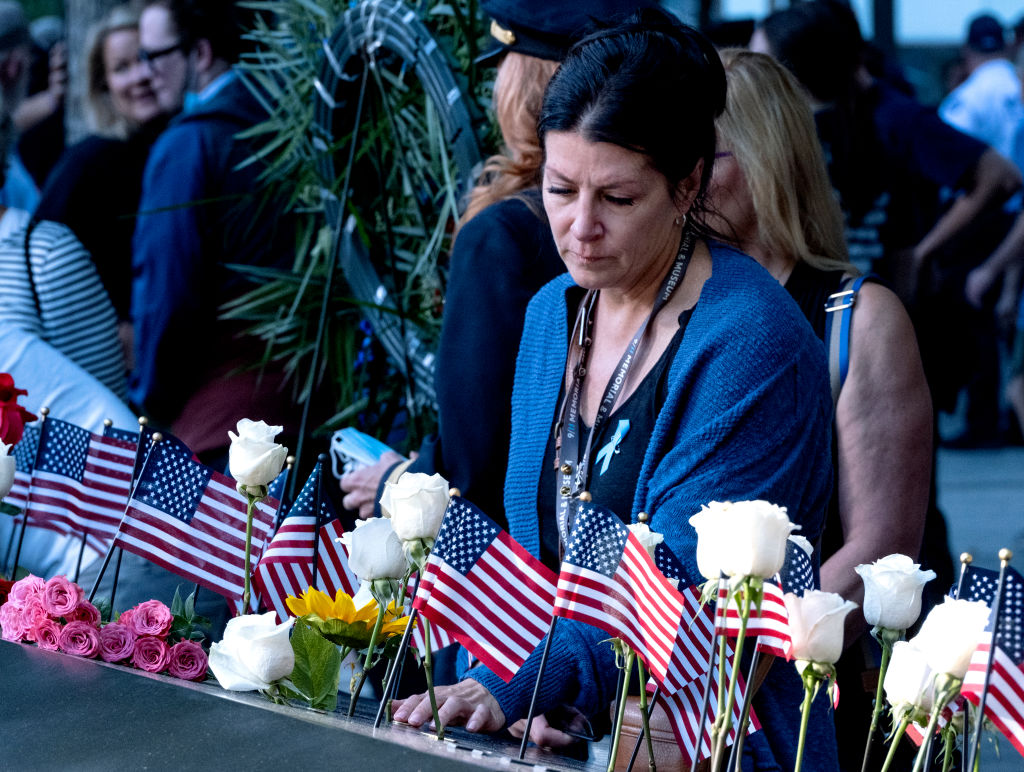
Over the years, Julie remained involved with preserving the memory of September 11 and the people who were killed. Brian’s voicemail became part of the collection of the National September 11 Memorial & Museum in New York.
There, it exists among thousands of objects, recordings, photographs, testimonies, and fragments that return individuality to an event almost too large to comprehend.
Visiting the museum can make September 11 feel different from the version preserved in textbooks and television retrospectives.
You encounter names.
Shoes.
Wallets.
Identification cards.
Recorded voices.
Objects that belonged to people who woke that morning expecting an ordinary Tuesday.
That is where remembrance becomes personal.
“Never forget” can sound like a national slogan after twenty-five years of repetition.
For families, it has never been abstract.
It means remembering who someone was before the world knew how they died.
Brian Sweeney was not born a passenger on Flight 175.
He had a childhood.
A military career.
Friends.
Parents.
A marriage.
Private jokes.
Plans for days that never arrived.
September 11 became the final fact of his life, but it was never the whole of it.
Julie has spoken about being grateful that she received his message at all.
Grateful is a complicated word in circumstances like these.
She wasn’t grateful for the reason it existed.
She was grateful for the certainty it gave her.
She knew what Brian wanted her to know.
She knew where his mind had gone when the future narrowed to minutes.
And she remembered something else.
His voice was calm.
That calmness brought comfort.
Perhaps that is one reason the recording continues to affect people who never knew either of them.
We imagine final moments as places where people discover some enormous truth.
Brian’s message suggests something simpler.
At the edge of catastrophe, what mattered was what had mattered before it.
Love.
Family.
The person waiting at home.
Twenty-five years after September 11, an entire generation has grown up with no memory of that morning.
For them, the attacks are history.
For survivors and families, history remains populated by voices.
That is why places like the 9/11 Memorial & Museum matter when they are at their best. They do more than preserve the architecture of catastrophe.
They preserve people.
And Brian’s voicemail does exactly that.
It does not tell us everything about him.
No final message could.
But for a few seconds, history falls away.
There is no quarter-century anniversary.
No museum exhibition.
No national mythology.
There is Brian.
There is Julie.
And there is one human being, facing the unimaginable, using the little time he believes he has left to make sure the woman he loves never has to wonder whether she was in his heart.
Twenty-five years later, she doesn’t have to wonder.
His life ended that morning.
His message didn’t.
And perhaps that is one of the deepest meanings of “never forget”: not endlessly returning to the moment people were taken from us, but continuing to remember the love that existed before they were gone.