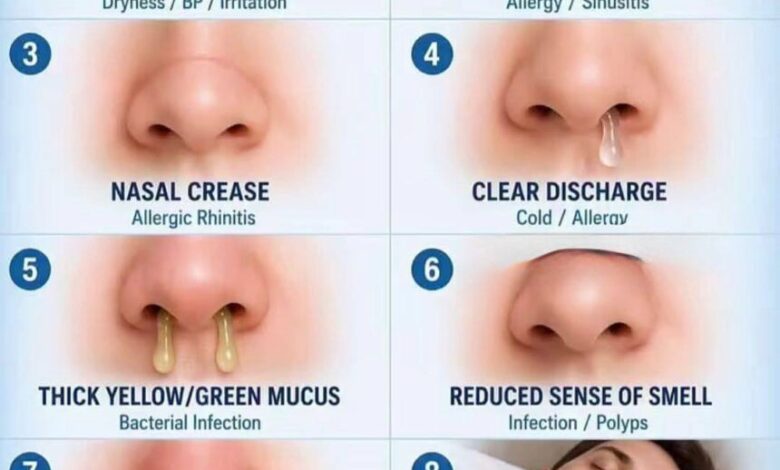
Your nose does far more than hold up your glasses and tell you when dinner is burning.
Every day, it filters the air you breathe, helps detect an extraordinary range of odors, contributes to your sense of taste, and can even trigger memories you haven’t thought about in years.
But there’s another reason doctors pay attention to it.
Changes inside or around the nose can sometimes provide useful clues about what’s happening elsewhere in the body.
That doesn’t mean you can diagnose yourself by looking in the mirror. Many nasal symptoms have several possible explanations, and some popular claims about what the nose supposedly reveals are far less reliable than they sound.
Still, there are certain changes worth noticing.
It starts with what doctors see inside your nose.
During an examination, a physician may look at the nasal lining, sometimes called the nasal mucosa. Healthy tissue generally has a pink appearance, while changes in color, swelling, discharge, and irritation can provide clues about inflammation or other problems.
For example, pale or bluish, swollen nasal tissue can sometimes be associated with allergic rhinitis.
That’s the familiar combination many people experience during allergy season:
Sneezing.
Congestion.
Runny nose.
Itching.
Watery eyes.
The nasal passages can become inflamed as the immune system responds to substances such as pollen, dust mites, mold, or animal dander.
Redness, meanwhile, may accompany irritation or infection, although color alone cannot tell a doctor exactly what’s happening.
Symptoms matter too.
Facial pressure, nasal congestion, discharge, fever, and tenderness around the sinus area can sometimes occur with sinus infections. However, not every case of sinus pressure or colored mucus means a bacterial infection requiring antibiotics.
That’s an important distinction because another widely repeated nose myth involves mucus.
Most people have heard some version of this rule:
Clear mucus means you’re healthy.
Yellow or green mucus means you have a bacterial infection.
Reality isn’t quite that simple.
Healthy nasal mucus is generally clear, but it can change color when you’re sick. Immune cells and substances released during the body’s response to infection can contribute to yellow or green coloration.
But color alone doesn’t reliably reveal whether an illness is viral or bacterial.
In other words, green mucus isn’t automatically a reason to panic—or a guarantee that antibiotics are needed.
Duration, severity, fever, pain, and other symptoms provide much more useful context.
Then there are nosebleeds.
Seeing blood suddenly running from your nose can be frightening, but most nosebleeds aren’t caused by a dangerous underlying disease.
The inside of the nose contains many delicate blood vessels close to the surface.
Dry air can irritate them.
Frequent nose blowing can damage them.
Picking or scratching the nose can cause bleeding.
Colds, allergies, injuries, and certain medications may also contribute.
Frequent, unusually heavy, or difficult-to-stop nosebleeds deserve medical attention, particularly when they occur alongside other unexplained bleeding or bruising. But an occasional minor nosebleed is extremely common.
The outside of your nose can provide clues too, although this is where misleading assumptions become especially common.
Take a persistently red nose.
For generations, popular culture has associated a red nose with heavy drinking.
But looking at someone’s nose cannot tell you whether they’re an alcoholic.
Persistent facial redness can have numerous explanations, including rosacea, temperature changes, irritation, sun exposure, allergies, and other skin or medical conditions.
Alcohol can trigger or worsen facial flushing in some people, but redness alone proves nothing about someone’s drinking habits.
That old stereotype can therefore be both medically unreliable and unfair.
Your sense of smell may actually provide more interesting information.
Smell depends on a complicated interaction between the nose and nervous system.
That’s why losing your sense of smell can happen when congestion physically prevents odors from reaching the appropriate receptors.
But sometimes smell changes occur without an obviously blocked nose.
A reduced sense of smell can have many causes, ranging from respiratory infections and nasal conditions to aging, medications, head injuries, and neurological disorders.
Researchers have also studied reduced smell as a possible early feature associated with neurological diseases, including Alzheimer’s and Parkinson’s disease.
That doesn’t mean forgetting what coffee smells like automatically means someone is developing dementia.
Far from it.
Loss of smell is common and has many possible explanations.
But a persistent, unexplained change is worth discussing with a healthcare professional.
Researchers have even investigated whether cells obtained from inside the nose could someday help scientists understand psychiatric illnesses such as schizophrenia.
Because certain nasal tissues can provide accessible biological material connected to processes researchers want to study, scientists have explored gene expression and cellular differences in nasal samples.
It’s fascinating research.
But there’s an enormous difference between an experimental research technique and a routine diagnostic test.
You cannot currently look at someone’s nose and determine whether they have schizophrenia.
Nor should experimental findings be presented as though a simple nasal biopsy has replaced comprehensive psychiatric assessment.
Some studies have explored even stranger associations.
Researchers have investigated relationships between bacteria living in the nose and throat and characteristics such as body mass index.
Other researchers have examined how the proportions and positioning of the nose influence perceptions of facial attractiveness.
These studies can generate intriguing hypotheses about human biology, evolution, and social perception.
But they shouldn’t be stretched into claims that your nose can reliably reveal whether you’re thin, healthy, attractive, or a “high-quality mate.”
Human health is considerably more complicated than that.
The same applies to nose shape.
Researchers studying facial symmetry and attractiveness have found that altering the position or proportions of individual facial features can influence how people rate a face.
That’s interesting from a psychology and evolutionary-biology perspective.
It doesn’t establish an objective hierarchy of “good” and “bad” noses.
Beauty standards vary between people, cultures, and periods of history.
And cosmetic surgery is a personal decision—not medical evidence that one nose shape is inherently superior to another.
So what can your nose genuinely tell you?
More than you might expect, but less than viral health claims sometimes promise.
Persistent congestion could point toward allergies or another nasal condition.
Changes in smell deserve attention when they’re unexplained or don’t resolve.
Recurring nosebleeds may warrant investigation.
Unusual swelling, persistent pain, sores that don’t heal, or other lasting changes should also be evaluated rather than repeatedly ignored.
And mucus can provide some information about what’s happening during an illness, even though its color cannot diagnose the exact cause by itself.
The key word is persistent.
Bodies change constantly.
One morning of congestion isn’t necessarily meaningful.
A temporary loss of smell during a cold isn’t surprising.
A small nosebleed during a dry winter isn’t automatically alarming.
Medicine looks at patterns.
How long has this been happening?
Is it getting worse?
Are there other symptoms?
Is something noticeably different from your normal baseline?
Those questions matter far more than any single color, shape, or photograph.
So yes, pay attention to your nose.
Notice unexplained changes.
Mention persistent symptoms during medical appointments.
And seek professional advice when something concerns you.
Just don’t expect your nose to function as a crystal ball.
It can provide clues.
Interpreting those clues correctly is where medicine begins.