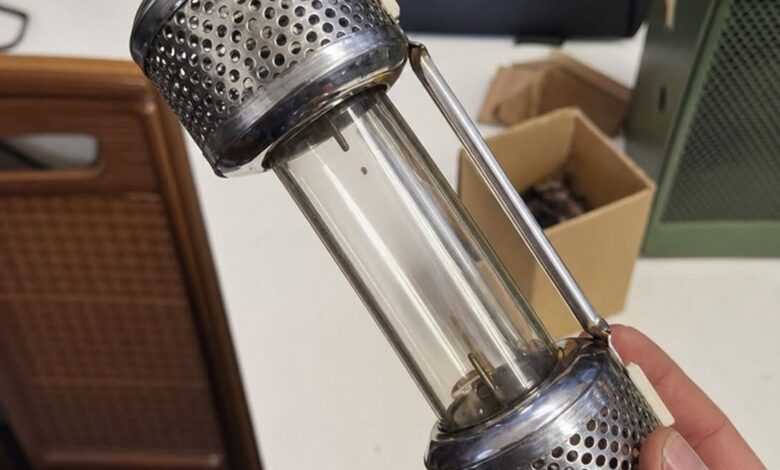
There was a time when families could bring a little piece of summer into the living room, plug it into the wall, and switch it on.
At least, that was the promise.
In the optimistic years after the war, when Americans were becoming increasingly fascinated by what science and electricity might do for everyday life, the Sperti sunlamp seemed almost magical. It wasn’t merely another household appliance competing for space beside the radio or vacuum cleaner. To the people who believed in it, the lamp represented something much larger.
It suggested that perhaps even winter could be engineered away.
Imagine a gray afternoon when daylight seemed to disappear before dinner. Snow pressed against the windows. The sky had been colorless for days, and everyone in the house seemed slower because of it.
Then someone switched on the Sperti.
A strange blue-white glow filled the room.
The machine hummed.
Chairs were pulled closer.
And for a few minutes, a corner of an ordinary house became something between a doctor’s office, a beach, and a futuristic laboratory.
That was part of its appeal.
The Sperti sunlamp belonged to an era when technological progress felt deeply personal. Science wasn’t only launching rockets, building highways, or transforming industry. It was entering kitchens, bedrooms, bathrooms, and living rooms.
Electricity could wash your clothes.
New appliances could preserve your food.
Television could bring the outside world into your home.
And now, apparently, a machine could bring you sunshine.
The concept was irresistible.
The lamp’s ultraviolet rays were associated with the benefits people traditionally connected with sunlight. Advertisements and popular enthusiasm helped reinforce the idea that carefully controlled exposure could offer something the winter sky could not.
For families enduring long stretches of cold weather, the proposition must have sounded wonderfully simple.
No vacation required.
No waiting for spring.
Just sit down, turn on the lamp, and let technology imitate the sun.
People arranged themselves around its glow with an almost ritualistic quality.
Someone might sit with sleeves rolled up.
Another person might close their eyes and tilt their face toward the warmth and brightness.
Children could watch curiously from nearby, fascinated by the unusual machine that seemed far more dramatic than its practical purpose suggested.
The lamp looked serious enough to inspire confidence.
Metal.
Glass.
Perforations.
Bulbs glowing with an unnatural intensity.
It didn’t look like a toy.
It looked scientific.
And in those years, “scientific” carried enormous cultural power.
If something had been engineered, tested, electrified, and packaged for the modern home, people were often inclined to believe that it represented progress.
That trust is easy to judge from the future.
It is harder—and more interesting—to understand it from inside the moment.
The people sitting beneath those lamps were not foolish.
They were living during an extraordinary transformation.
Within a relatively short span of history, medicine had conquered or controlled diseases that had terrified earlier generations. Household technology had eliminated hours of exhausting labor. Transportation was changing. Communication was changing. Space itself was becoming a frontier humans believed they could reach.
Why shouldn’t science improve winter too?
That optimism gave the Sperti something no technical specification could fully explain.
Emotion.
On a dark January evening, the lamp wasn’t simply producing ultraviolet radiation.
It was producing possibility.
Perhaps you would feel better.
Perhaps winter would seem shorter.
Perhaps the fatigue would lift.
Perhaps this glowing machine really could provide some of what the absent sun normally supplied.
For a few minutes, the room changed.
That may be why memories of devices like the Sperti can feel surprisingly affectionate.
People rarely become nostalgic for technical specifications.
They become nostalgic for rituals.
A parent adjusting the lamp.
A chair pulled into position.
The hum of the machine beginning.
Someone saying, “Okay, that’s enough.”
The strange brightness lingering in your vision afterward.
These tiny domestic scenes become attached to childhood, family, and seasons long gone.
Of course, our understanding of ultraviolet exposure has changed considerably.
Today, people are far more conscious of the damage excessive ultraviolet radiation can cause. The relationship between UV exposure, skin aging, eye injury, and skin cancer is taken seriously, and modern health advice treats artificial ultraviolet exposure with much greater caution than the enthusiasm surrounding many earlier consumer devices might suggest.
That knowledge changes how the old lamps look to us.
An object that once appeared reassuring can now seem slightly ominous.
Find one at an estate sale today and you might stop simply because it looks so unusual.
Its metal housing can appear almost industrial.
The glass and perforated surfaces seem theatrical.
The entire device looks like a prop from an old science-fiction film—a machine someone might have imagined could cure melancholy, communicate with Mars, or power a suburban laboratory.
You might wonder who owned it.
Where did they place it?
Did the whole family use it?
Was it brought out every winter?
Did someone genuinely look forward to sitting beneath that blue-white glow?
Objects become fascinating when their original certainty disappears.
Once, the purpose of the lamp felt obvious.
Now it raises questions.
But knowing more about ultraviolet risks does not require us to mock the people who believed in devices like this.
If anything, the lamp becomes more interesting when viewed with compassion.
It reveals what people hoped technology would become.
Not merely faster.
Not merely more profitable.
Helpful.
Almost tender.
The dream was that science would notice ordinary human discomfort and solve it.
Cold?
Build better heating.
Housework exhausting?
Automate it.
Food spoiling?
Refrigerate it.
Winter too dark?
Make another sun.
There is something wonderfully ambitious about that worldview.
And something deeply human.
We have always tried to negotiate with darkness.
Before electricity, we gathered around fires.
Then fireplaces.
Then lamps.
Then glowing screens.
The Sperti occupied its own peculiar place in that tradition because it promised more than illumination.
It promised the sensation—or at least the suggestion—of sunlight itself.
That distinction mattered.
A normal lamp helped you see the room.
A sunlamp invited you to imagine that the season outside had temporarily lost its authority.
Snow might still be piled against the house.
The trees might still be bare.
The real sun might already have disappeared below the horizon.
But inside, something bright was humming.
For a few minutes, winter had competition.
Eventually, technology moved forward, medical understanding evolved, and the old machines began disappearing from ordinary homes.
Some were thrown away.
Others were pushed into basements or attics.
A few survived long enough to appear at flea markets and estate sales, sitting silently among rotary telephones, old radios, and appliances whose original owners once considered them modern.
Now they are artifacts.
But artifacts carry emotions machines were never designed to store.
Look at an old Sperti sunlamp and you are not merely looking at metal, glass, wiring, and bulbs.
You are looking at confidence.
At a generation’s belief that science might steadily make everyday life healthier, easier, brighter.
You are looking at families gathered around a machine because someone believed a little artificial sunlight might help them through February.
Maybe the lamp delivered everything they hoped.
Maybe it didn’t.
Memory is rarely interested in technical verdicts.
It remembers the room.
The faces.
The peculiar glow.
The hum.
And the comforting feeling that, for a few bright minutes, someone had found a switch for winter.
That may be the Sperti’s most enduring legacy.
Not that it conquered darkness.
But that people once gathered around it and believed darkness could be conquered.
And beneath that artificial sunrise, while the real winter waited beyond the windows, perhaps belief itself provided a little warmth.