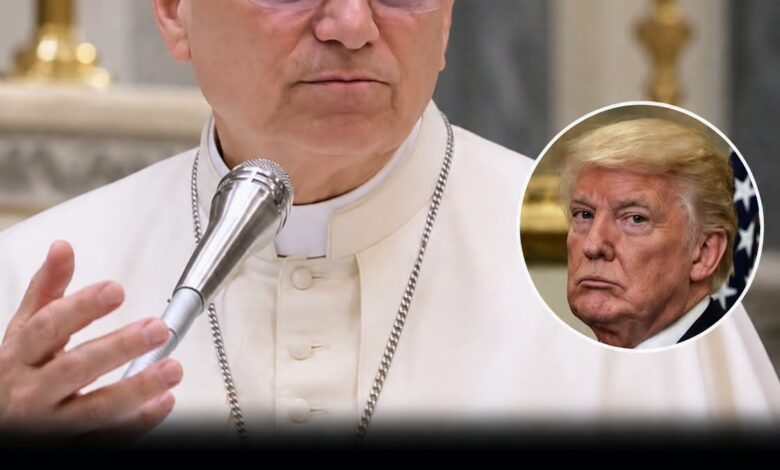
The answer was one word.
“Many.”
No speech.
No carefully polished list.
No ranking of America’s failures from most urgent to least offensive.
Just one word—and suddenly people wanted to know exactly what Pope Leo XIV meant.
That reaction may reveal more about American politics than the answer itself.
We have become accustomed to demanding instant classification from public figures.
Which side are you on?
Which problem matters most?
Whom do you blame?
Which slogan will you repeat?
Which outrage deserves today’s attention?
And, perhaps most importantly, can your answer be clipped into ten seconds and circulated online as evidence that you belong to one tribe or the other?
“Many” refuses to cooperate with that system.
If Leo XIV was being asked to identify America’s greatest problem, the answer did something politically inconvenient: it rejected the premise that a country this complicated can be morally diagnosed with a single partisan complaint.
Because America does not have one wound.
It has many.
Poverty can exist beside extraordinary wealth.
Racial injustice can persist alongside genuine social progress.
Migrants can become symbols in political arguments while remaining actual human beings with families, fears, hopes, and complicated circumstances.
Communities can demand protection from violence while disagreeing fiercely over policing, guns, punishment, prevention, and responsibility.
Workers can struggle to support families while politicians celebrate economic statistics.
Unborn life can become a moral battleground while children already born encounter hunger, instability, abuse, or neglect.
Loneliness can deepen in a country more technologically connected than any previous generation.
People can possess unprecedented access to information and still feel spiritually exhausted, politically homeless, or unable to trust their neighbors.
Which one is the problem?
“Many.”
The word is unsatisfying if what you want is ammunition.
It becomes more interesting if what you want is examination.
That distinction may be central to understanding the public role Leo XIV appears willing to occupy.
An American pope inevitably arrives carrying expectations that would not attach themselves in quite the same way to a pontiff from elsewhere.
Americans want to know where he fits.
Conservative?
Progressive?
Anti-Trump?
Friendly to Trump?
Traditionalist?
Reformer?
Culture warrior?
Peacemaker?
Everyone wants the label because labels make people easier to process.
Once someone has been placed into a political category, we no longer have to listen carefully.
We already know which parts to applaud and which parts to condemn.
Catholic social teaching has always complicated that instinct.
It doesn’t fit comfortably inside the American two-party system.
A consistent concern for human dignity can lead directly into arguments that different political coalitions would prefer to keep separate.
The dignity of migrants.
The dignity of workers.
The dignity of the unborn.
The dignity of the poor.
The dignity of prisoners.
The dignity of the elderly.
The dignity of people facing discrimination.
The dignity of families struggling economically.
The dignity of people society finds inconvenient, expensive, unfamiliar, politically useful, or easy to ignore.
Once dignity becomes the starting point, partisan consistency becomes much harder.
A person may applaud the pope on Monday and feel challenged by him on Tuesday.
That isn’t necessarily a contradiction.
It may be the point.
Leo’s past public positions and comments have already given different ideological camps reasons both to embrace and resist him.
His concerns about nationalism, migration, poverty, and the treatment of vulnerable people can sound deeply uncomfortable to parts of the political right.
At the same time, Catholic teaching on abortion, family, human life, and other moral questions resists being neatly absorbed into the modern progressive platform.
Labor adds another complication.
Catholic social thought has long defended the dignity of work, the rights of workers, just wages, and responsibilities that accompany economic power.
None of this produces an easy campaign slogan.
It produces tension.
And tension is exactly what American political culture often tries to eliminate.
Politics increasingly rewards certainty.
Religious leadership, at its best, sometimes demands conscience.
Those are not the same thing.
Politics asks:
What is wrong with them?
Conscience asks:
What is required of me?
That second question is far more dangerous.
It doesn’t allow the conservative to identify every moral failure with progressives.
It doesn’t allow the progressive to locate every injustice among conservatives.
It doesn’t let wealthy people discuss poverty only as government policy.
It doesn’t let comfortable citizens discuss migration without remembering migrants are people.
It doesn’t let advocates for unborn life forget mothers and children after birth.
And it doesn’t let advocates for social justice conveniently decide that human dignity applies only to lives their political coalition has prioritized.
“Many,” then, can function almost like a mirror.
What problem did you immediately assume he meant?
That answer may say something about you.
If your first thought was immigration, why?
If it was racism, why?
If it was abortion, why?
If it was inequality, gun violence, political extremism, loneliness, consumerism, nationalism, family breakdown, healthcare, homelessness, or loss of faith—why?
What experiences taught you to see that wound first?
And which wounds have you trained yourself not to notice?
That is a much more demanding conversation than arguing over whether a pope is secretly on your team.
It is also why ambiguity isn’t automatically cowardice.
Sometimes ambiguity is evasive.
Leaders can hide behind vague language because they don’t want consequences.
There are moments when moral clarity requires specificity.
But brevity can also prevent an important question from being reduced to an ideological performance.
A detailed answer might have produced a headline.
One problem would have been elevated above another.
Political operatives could have extracted the sentence they wanted.
Supporters would post it.
Opponents would attack it.
Within hours, the discussion would become less about America’s moral condition and more about which party had been insulted.
“Many” leaves everyone slightly dissatisfied.
There may be wisdom in that.
A pope’s job is not to provide either American political party with ecclesiastical campaign material.
Nor should the papacy become another account in the endless social-media argument.
Its moral influence depends partly on maintaining enough independence to challenge whichever coalition finds itself comfortable.
That doesn’t mean refusing politics altogether.
Questions of poverty, war, migration, labor, human life, economic justice, family, and peace inevitably have political consequences.
But moral teaching and partisan loyalty are different things.
One asks whether a position helps your side win.
The other asks what the position does to human beings.
America could use more of the second question.
The country is extraordinarily skilled at turning suffering into teams.
A tragedy happens and people immediately anticipate the argument.
Who was responsible?
Which policy does this prove?
Which side will exploit it?
Which facts help us?
Which facts should we emphasize less?
Even compassion becomes tribal.
We mourn selectively.
We become suspicious when the suffering person belongs to the wrong category.
We measure principles against whether applying them consistently would inconvenience our preferred coalition.
A moral voice should disturb that arrangement.
Not by pretending all political positions are equally wise or every disagreement has two identical sides.
They aren’t, and they don’t.
But by refusing the more corrosive idea that moral truth must always align perfectly with partisan identity.
Perhaps that is the potential significance of Leo XIV’s papacy.
Not that he will remain vague.
He won’t be able to.
Popes issue documents, give speeches, answer questions, make appointments, meet political leaders, and address specific crises.
Eventually, positions become clearer.
Some people who celebrate him now will become angry.
Some who distrust him now may unexpectedly find themselves agreeing with him.
That is almost inevitable.
The more interesting question is whether Americans will allow themselves to be challenged by him when he says something their own side would rather not hear.
Because that is the real test.
It is easy to admire a religious leader who condemns your opponents.
It is considerably harder when he interrupts your certainty.
A meaningful moral voice does not merely point across the political aisle.
Sometimes it turns the finger around.
That is what made one word potentially more powerful than a speech.
Asked to compress a country’s moral crisis into something politically usable, Leo XIV declined.
He left the answer open.
Many problems.
Many wounds.
Many responsibilities.
And therefore, perhaps, many consciences with work to do.
America wanted a diagnosis it could turn into a headline.
Instead, it received something far less comfortable:
a mirror.