A Busy Sidewalk Moment Changes After a Dog Draws Attention to a Situation That Needed Immediate Care

The city moved too fast to notice suffering.
That was the first thing Evelyn Carter thought when she later tried explaining why nobody stopped.
Downtown at noon was a living current of noise and motion:
heels striking pavement,
coffee cups rattling,
crosswalk signals chirping impatiently,
phones glowing in distracted hands while conversations dissolved into traffic and construction noise.
People moved with practiced urgency.
Eyes forward.
Schedules tight.
Attention fragmented into notifications, deadlines, and destination points.
In cities like that, hesitation feels almost unnatural.
And in the middle of all that movement, beside a newspaper bin and a dented silver trash can, a golden retriever stood completely still.
At first glance, nothing about the dog looked dramatic.
No frantic barking.
No aggression.
No chaos.
Just stillness.
The retriever stood rigidly beside a clear plastic bag resting against the curb, its amber eyes fixed not on the traffic or passing crowds but on the people themselves — studying them one by one as they hurried past.
Waiting.
Inside the bag, three tiny puppies struggled weakly against the plastic.
From a distance, the bundle could easily be mistaken for discarded garbage:
a loosely tied bag shifting slightly whenever wind pushed through the street.
That assumption saved everyone time.
And nearly cost three animals their lives.
A woman in running shoes glanced down briefly while sipping iced coffee.
A businessman adjusted his path slightly to avoid stepping too close.
Two teenagers looked over, frowned vaguely, then continued walking without removing their headphones.
Nobody stopped long enough to understand what they were seeing.
The retriever lowered its head and nudged the bag carefully with its nose.
One puppy moved weakly inside.
The dog whined softly.
Not loudly enough to interrupt the city.
Just enough to express distress.
Still, the crowd flowed onward.
The golden retriever circled the bag anxiously now, pressing closer, then looking back toward pedestrians with growing urgency. Its tail stayed low. Its body trembled slightly beneath sunlit fur.
It barked once.
Sharp.
Desperate.
A cyclist cursed while swerving around it.
An older man muttered something irritated under his breath.
Still no one truly looked.
That was the terrible thing later:
everyone technically saw the scene.
Almost nobody processed it.
The retriever barked again — louder now — then trotted quickly toward a woman carrying shopping bags and gently tugged at the hem of her coat.
Startled, she jerked backward immediately.
“Hey!”
The dog released her instantly and returned to the plastic bag.
Again and again it repeated the pattern:
approach,
plead,
return.
As though trying to communicate something urgent in a language humans had forgotten how to hear.
The puppies inside the bag moved less now.
The top remained loosely twisted closed, trapping heat and limiting air while exhaust fumes drifted across the sidewalk from stalled traffic nearby.
Minutes mattered.
The retriever seemed to understand that instinctively.
The people passing by did not.
Then came the man with the white cane.
He moved differently from everyone else.
Slower.
More deliberate.
While crowds surged around him impatiently, he navigated carefully through sound rather than sight, dark sunglasses shielding his eyes while the cane tapped rhythmically across uneven pavement.
His name was Daniel Mercer.
And unlike everyone else that afternoon, Daniel wasn’t distracted by what he could see.
The golden retriever noticed him immediately.
Something about the dog changed then.
Its movements became calmer.
Focused.
No barking this time.
The retriever approached Daniel carefully and touched its nose lightly against his leg.
Daniel stopped instantly.
Not annoyed.
Not startled.
Just attentive.
People with sight often miss things because their attention scatters visually across too much information at once.
Daniel listened differently.
He tilted his head slightly.
The dog touched him again gently.
Then moved away a few steps.
Paused.
Waited.
Daniel understood enough to follow.
Around them, pedestrians continued rushing past while the retriever guided him carefully toward the curbside bag.
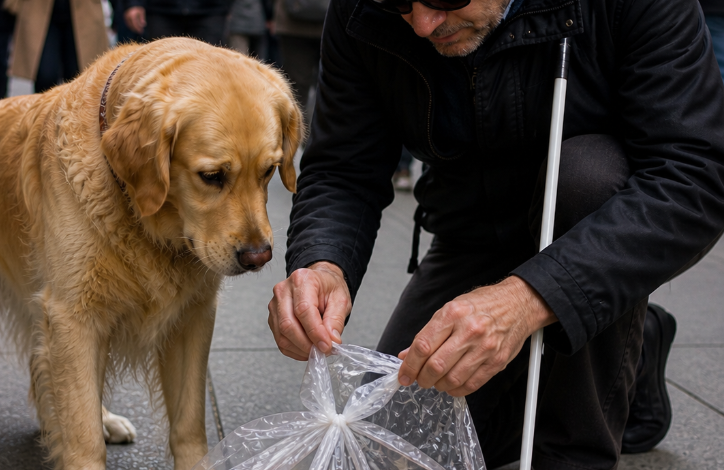
When the dog stopped beside it, Daniel lowered himself slowly onto one knee.
His fingers extended cautiously across the pavement until they brushed cool plastic.
He frowned slightly.
The bag moved.
Very faintly.
Daniel touched it again more carefully now, fingertips tracing the shifting shape beneath the plastic surface.
Then he heard it:
a tiny scratching sound from inside.
His expression changed instantly.
“Oh God,” he whispered.
The retriever stood frozen beside him watching intensely.
Daniel’s hands moved quickly now but never carelessly. He found the twisted knot at the top of the bag and began loosening it by touch alone, fingers working steadily despite the traffic noise swelling around him.
The plastic loosened.
Fresh air entered immediately.
Inside, the puppies stirred harder now.
One tiny paw emerged first through the opening.
Then a wet nose.
Then weak little cries finally escaped into open air.
The retriever lowered its head instantly and nudged the puppies gently as though checking each one individually.
Relief transformed the dog’s entire posture.
Its rigid muscles softened.
Its tail moved cautiously for the first time.
Daniel pulled the bag fully open and carefully folded the plastic downward so the puppies could crawl free without obstruction.
One by one they stumbled shakily onto the warm sidewalk.
Tiny.
Confused.
Alive.
A small crowd had started gathering now.
Not because anyone noticed the suffering originally —
but because humans often notice one another noticing.
Phones emerged.
People slowed.
Voices shifted.
“What happened?”
“Were they abandoned?”
“That dog found them?”
Questions multiplied rapidly around the little scene near the curb.
But the crucial part had already happened before the crowd formed.
Someone finally stopped long enough to understand.
A young woman stepped forward offering water.
Another called animal rescue services.
Someone removed a sweatshirt and placed it gently beneath the puppies so they wouldn’t remain directly on the hot concrete.
Meanwhile Daniel stayed kneeling beside them quietly, one hand resting lightly against the retriever’s shoulder.
“You knew they were there, didn’t you?” he murmured softly toward the dog.
The retriever leaned gently against him.
Not seeking praise.
Just calmer now.
As if its responsibility had finally transferred safely into someone else’s hands.
Animal rescue officers arrived less than fifteen minutes later.
They examined the puppies carefully:
dehydration,
heat exposure,
mild respiratory distress —
but alive.
One officer scanned the retriever for identification while another wrapped the puppies in clean blankets.
“No microchip,” she announced quietly.
No owner.
No collar.
Nothing.
The golden retriever simply watched silently while the puppies were lifted carefully into a rescue carrier.
Then something unexpected happened.
When officers prepared guiding the retriever toward the van, the dog refused to move until Daniel stood too.
The leash tightened once.
Twice.
Still the retriever stayed beside him.
Daniel laughed softly beneath his breath.
“Well,” he said, reaching carefully toward the dog’s head, “I think we became partners today.”
Several people nearby wiped tears discreetly.
Not because the moment was dramatic.
Because it felt painfully simple.
An animal refused to abandon vulnerable lives.
A blind man noticed distress everyone else overlooked.
A crowd rediscovered attention only after compassion interrupted routine.
The city resumed its rhythm quickly afterward.
Traffic moved.
Phones rang.
Meetings resumed.
People disappeared back into schedules and noise.
But witnesses carried the image with them long after:
the golden retriever standing guard beside a plastic bag while hundreds passed without seeing;
the blind man kneeling alone on hot pavement opening the knot carefully by touch.
News stations later framed it as irony.
The blind man who saw what others could not.
But Daniel rejected that interpretation during a local interview days later.
“I’m not the remarkable part,” he explained quietly. “That dog asked for help over and over. People just weren’t listening yet.”
Animal rescue workers eventually named the puppies Hope, Lucky, and Scout.
The retriever became known around the shelter as Guardian.
And though several families offered adoption applications immediately after the story spread online, one detail quietly complicated everything:
Guardian refused to leave Daniel’s side during every subsequent visit.
Weeks later, when Daniel finally signed adoption papers for both the retriever and the smallest puppy, shelter staff applauded softly while Guardian pressed happily against his leg.
For Daniel, the decision felt obvious.
“She found me first,” he said simply.
Years later, people still remembered the story downtown.
Not because it exposed cruelty —
cities already contained enough of that.
But because it revealed something gentler and more unsettling at once:
attention is often the difference between tragedy and rescue.
Hundreds of people possessed eyesight that afternoon.
Yet the one who truly recognized distress was the man trained to listen carefully to what others ignored.
And somewhere beneath all the noise and movement of the city, that truth lingered long after the sidewalk emptied:
sometimes compassion begins the moment someone finally stops rushing long enough to understand what’s right in front of them.