After Our Divorce, I Secretly Carried His Child Until the Day I Went Into Labor and the Doctor Lowered His Mask..

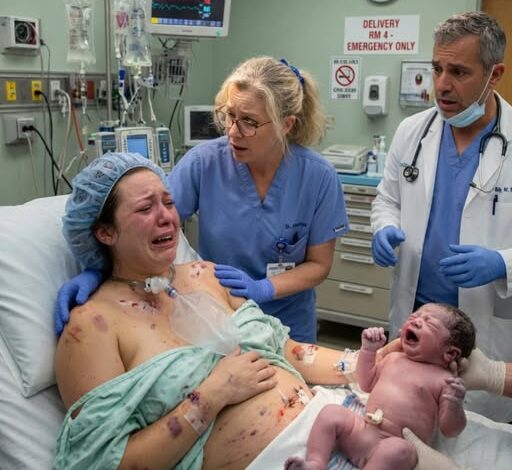
The maternity ward smelled like antiseptic, warm blankets, and exhaustion.
Not dramatic exhaustion.
Not cinematic suffering.
The quieter kind.
The kind that settles into a woman’s bones after nineteen hours of labor, months of fear, and an entire pregnancy carried inside silence so heavy it sometimes felt physical.
Outside the hospital windows, rain streaked the Hartford skyline in blurred silver lines while monitors beeped steadily in nearby rooms where other families celebrated births wrapped in balloons, flowers, visitors, and photographs sent joyfully into group chats.
But inside room 314, Chloe sat upright in the hospital bed holding her newborn daughter against her chest while the world she thought she had buried months ago stood silently beside the doorway wearing blue scrubs and a physician’s badge.
Ethan Chen.
Her ex-husband.
The father who discovered his child existed only because he lowered a surgical mask during labor and looked directly into the face of the woman he left behind.
The room itself still carried traces of what had happened hours earlier.
A disposable water cup overturned near the sink.
Wrinkled hospital blankets tangled at the foot of the bed.
A fetal monitor printout curled loosely over the counter edge like physical evidence of panic.
And beneath everything lingered the emotional shock no one in the room had fully processed yet.
Because childbirth changes people even under ideal circumstances.
Under these circumstances, it detonated buried truths all at once.
Chloe adjusted the baby carefully against her chest while the newborn made tiny restless sounds beneath the striped hospital blanket. Every few seconds the child’s fingers flexed instinctively against Chloe’s skin, impossibly small and impossibly alive.
Life beginning.
Marriage ending.
Fatherhood arriving too late to witness pregnancy but just in time to expose what absence had cost.
The contradictions in the room felt unbearable.
Linda Kowalski, the night nurse who had guided Chloe through labor, moved quietly near the monitor station documenting post-delivery vitals with the calm professionalism nurses develop after witnessing thousands of human crises. Yet even she carried a different expression now — one shaped not by medical concern, but by emotional awareness.
Because everyone in the room understood something irreversible had happened the moment Ethan recognized the timeline.
The divorce.
The dates.
The baby.
All the math added up instantly.
And suddenly what had looked like routine labor became a collision between abandonment, parenthood, guilt, and survival.
Ethan remained near the doorway exactly where Chloe told him to stay.
Not beside her.
Not touching her.
Not pretending proximity had been earned.
That mattered more than he probably realized.
For months, Chloe had carried this pregnancy alone because somewhere deep inside, she stopped believing Ethan would protect her if protecting her required disappointing his mother. That realization did not arrive all at once. It accumulated gradually:
through dismissed boundaries,
through silence,
through compromise that always somehow required her discomfort instead of his courage.
People often imagine betrayal as explosive.
Sometimes it is quieter.
Sometimes betrayal is simply watching the person you love repeatedly choose easier loyalties over harder truths.
And in Chloe’s marriage, Ethan’s mother occupied every unguarded doorway.
The memory still lived inside her body vividly:
the bowl of vanilla frosting,
the lemon scent turning nauseating in her throat,
the divorce papers beside the half-finished birthday cake she baked for the woman slowly helping dismantle her marriage.
Even now, lying in the hospital bed with stitches pulling painfully every time she shifted, Chloe could still see Ethan standing in the kitchen that day with his sleeves rolled to his forearms and his eyes lowered in the practiced posture of a man trying to feel gentle while causing damage.
“It’s cleaner this way,” he had said.
Cleaner.
As though marriages were stains to remove once conflict became inconvenient.
As though her request for one boundary —
no surprise visits,
no spare key,
no decisions filtered through his mother —
had somehow become unreasonable enough to justify dissolving a six-year marriage.
At the time, Chloe believed the divorce itself was the deepest wound.
She did not yet know she was already carrying his child.
That discovery came two weeks later beneath fluorescent bathroom light while she sat numb on cold tile holding a positive pregnancy test in trembling hands.
Her first instinct had been to call him.
That detail haunted her afterward.
Because despite everything, love remained alive for a little while longer inside the ruins.
Her thumb hovered over Ethan’s name.
Then she remembered the envelope beside the frosting bowl and placed the phone face down.
That was how the silence began.
Not revenge.
Not strategy.
Just grief learning how to survive without reaching toward the person who caused it.
Now, months later, Ethan stood inside the consequences of that silence looking at the child he never knew existed until the moment she entered the world screaming.
And perhaps the cruelest part was that Chloe could see instantly how deeply the realization shattered him.
Not because he deserved sympathy automatically.
Not because tears erase abandonment.
But because she once knew him well enough to recognize genuine devastation when she saw it.
His eyes never stopped returning to the baby. Not greedily. Not possessively.
Almost reverently.
As if he could not fully comprehend that this tiny human had existed through entire seasons of his life while he argued about legal paperwork and avoided difficult conversations.
The supervising physician finished final notes quietly before exiting with the remaining nurses, leaving only Linda behind to monitor recovery checks. The room settled into softer sounds:
monitor beeps,
newborn breathing,
rain tapping the windows.
Human silence filled the spaces between.
Finally Ethan spoke again.
“I should have come back,” he whispered.
Chloe looked down at the baby instead of him.
“Yes.”
No shouting.
No dramatic accusation.
Just truth.
Sometimes calm honesty wounds more deeply than rage because it leaves nowhere for defensiveness to hide.
Ethan swallowed hard.
“I thought you hated me.”
Chloe almost laughed from exhaustion.
“Hating you would have been easier.”
That landed visibly.
People often assume indifference follows divorce automatically. In reality, emotional severance usually happens unevenly. One person leaves physically while the other continues carrying conversations internally for months afterward:
what they should have said,
what they wish someone had chosen differently,
whether love might have survived if courage had arrived sooner.
Chloe had spent her pregnancy trapped partly inside that emotional aftershock. Every ultrasound happened against the backdrop of absence. Every prenatal form asking for emergency contacts or father information reopened emotional bruises paperwork itself could not acknowledge.
On the Hartford Memorial intake forms, she wrote “none” beneath emergency contact because technically there was no one she trusted enough emotionally anymore. The nurse noticed. Hesitated. Then wisely did not ask questions Chloe lacked strength to answer.
That loneliness followed her through the entire pregnancy.
Packing the hospital bag alone at thirty-four weeks.
Driving herself to appointments.
Feeling the baby kick during sleepless nights while wondering whether Ethan would have become a different man if parenthood arrived before divorce instead of after it.
But grief eventually reshaped itself into practicality.
That was survival too.
By the time labor began during the rainy Tuesday evening, Chloe no longer fantasized about reconciliation. She simply wanted safety, stability, and enough emotional distance to protect herself from further disappointment.
That is why the birth plan listed:
No visitors without consent.
No father listed.
The sentence looked colder on paper than it felt emotionally.
But after months of abandonment, control over access became the only thing she trusted fully.
And now Ethan stood inside the room confronting what his absence had produced.
Not revenge.
Reality.
The baby stirred suddenly against Chloe’s chest, making small squeaking sounds before settling again. Ethan instinctively stepped forward half a pace before catching himself and stopping immediately.
The hesitation hurt Chloe unexpectedly.
Because once, he would have crossed the room without fear.
Now even proximity required permission.
Linda checked Chloe’s blood pressure quietly while pretending not to listen to the emotional wreckage unfolding around her. Nurses become witnesses to extraordinary human moments constantly:
birth,
death,
betrayal,
reconciliation.
Yet the intimacy of witnessing someone meet their child for the first time inside the ruins of a failed marriage carried its own gravity.
“Would you like me to take the baby for a moment while you rest?” Linda asked gently.
Chloe shook her head instantly.
“No.”
The answer came too fast, too sharp.
Protective.
Linda nodded without offense.
Again, professionalism became kindness.
Ethan noticed too.
“She thinks I’ll disappear again,” he said quietly.
Chloe closed her eyes briefly.
Because the painful thing was:
she didn’t know.
Not truly.
And uncertainty changes love into something exhausting.
“You left once already,” she answered.
The room fell silent again.
Outside, thunder rolled faintly through the storm clouds.
Ethan sat slowly in the chair nearest the door — far enough to respect her request, close enough to remain present. He looked exhausted now too, though in a different way than Chloe.
She had survived physical labor.
He had just survived moral recognition.
Both leave people altered.
“I kept waiting for you to call,” he admitted finally.
That startled her enough to look at him directly.
“Why would I call someone who handed me divorce papers because his mother disliked boundaries?”
His face tightened painfully.
“When you say it out loud, it sounds…” He stopped.
“Pathetic?”
He nodded once.
There it was again:
honesty arriving only after collapse.
But honesty still mattered.
Especially because Ethan was finally beginning to understand something essential:
the pregnancy was not hidden from him maliciously.
Chloe hid herself because the marriage taught her she was emotionally unsafe when conflict required him to choose sides.
That distinction changed everything.
“I didn’t know how to trust you anymore,” she said softly.
The baby yawned suddenly between them, tiny mouth opening impossibly wide before relaxing again.
Both parents watched instinctively.
For one strange suspended moment, they looked united by awe rather than divided by pain.
Then reality settled back over the room.
Ethan’s phone buzzed in his pocket.
He ignored it.
A minute later it buzzed again.
And again.
Chloe did not need to ask who it was.
His mother.
Of course.
The old pattern arriving right on schedule.
Ethan stared at the phone for several long seconds.
Then, without answering, he turned it completely off and placed it face down on the counter beside the sink.
The gesture was small.
But Chloe felt something inside her shift slightly anyway.
Because boundaries mean little during peaceful moments.
Boundaries matter when pressure returns.
And pressure had returned.
Linda noticed too, though she said nothing while recording medication times on the chart.
Eventually the social worker arrived to discuss documentation, visitor restrictions, paternity acknowledgment forms, and discharge planning. Hartford Memorial handled the situation with clinical neutrality:
conflict disclosure forms,
consent verification,
updated contact permissions.
Paperwork again.
So much of adult heartbreak eventually becomes paperwork.
Yet this time, Ethan behaved differently than he had during the divorce. He did not dominate conversations or assume automatic authority. He read every line carefully beside Chloe rather than over her shoulder. When she hesitated reviewing custody language, he stepped back immediately.
“Your pace,” he said quietly.
That sentence stayed with her afterward.
Because once upon a time, Ethan rushed conflict toward whatever solution restored comfort fastest — usually his own comfort, or his mother’s.
Now he was finally learning restraint.
Not heroic transformation.
Not redemption.
Just accountability beginning slowly.
And perhaps accountability always begins there:
not through grand speeches,
but through smaller corrected behaviors repeated consistently over time.
The following morning, Ethan’s mother called the maternity ward directly.
Linda answered first.
“Family member requesting transfer,” she said carefully while glancing toward Chloe.
Before Chloe could even respond, Ethan spoke from beside the window.
“No.”
The firmness surprised everyone slightly.
Including him.
“She is not approved for visitation.”
No debate followed.
No emotional justification.
No attempt to pressure Chloe into compromise for the sake of peace.
Just:
No.
Simple boundaries.
Finally enforced.
Chloe watched him quietly afterward while he stood beside the rain-streaked hospital window looking older somehow than he had only days earlier.
Fatherhood had arrived for him not wrapped in celebration, but in exposure.
He saw clearly now what his passivity had cost:
a missed pregnancy,
empty ultrasound appointments,
nineteen hours of labor he almost never witnessed,
a daughter who entered the world while her mother still believed emotional protection required distance from him.
Some losses cannot be dramatized properly because they unfold internally.
The grief Ethan carried was not only about missed milestones.
It was about recognizing he helped create the conditions that made secrecy feel safer than partnership.
That realization changes a person if they allow it to.
When Chloe and the baby were discharged two days later, they did not leave as a reunited family. Real life rarely resolves itself that neatly.
They left separately.
With lawyers involved.
With temporary custody agreements.
With supervised visits.
With caution layered over every interaction.
But they also left with something else:
clarity.
The old marriage had failed because love alone proved weaker than avoidance, family pressure, and emotional cowardice.
Now a child existed at the center of that truth.
Which meant whatever came next would require more than apologies.
It would require sustained change.
Months later, people occasionally asked Chloe why she never told Ethan about the pregnancy sooner.
She never answered fully.
She did not describe the divorce papers beside frosting.
Or the intake forms listing “none.”
Or the delivery room silence after Ethan lowered his mask and saw the life his absence almost missed entirely.
She simply said:
“I stopped asking him to choose me. That’s when he finally understood what losing me actually meant.”
And maybe that was the hardest truth of all.
Not that Ethan failed once.
Not that Chloe stayed silent.
But that real love cannot survive indefinitely inside relationships where one person keeps begging to matter enough to be protected.
The next birthday cake Chloe baked months later was small and uneven with too much frosting spread clumsily across the top while the baby slept nearby in a portable bassinet.
The kitchen smelled like sugar and lemon again.
But this time there were no divorce papers waiting beside the mixing bowl.
Only silence.
Peaceful silence.
The kind that no longer felt like abandonment.
The kind that finally belonged to her.