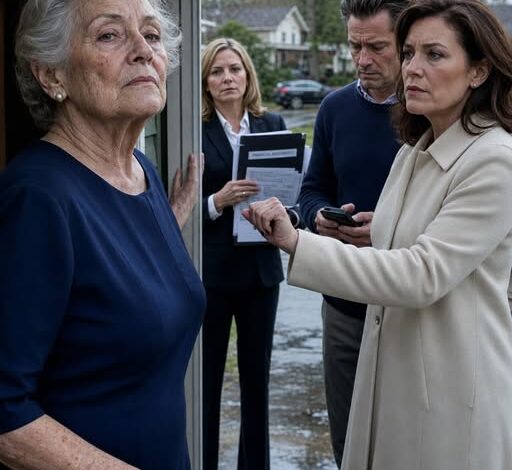
The rain had slowed to a thin silver drizzle by the time I opened the front door again.
My granddaughter stood at the edge of the porch clutching her little backpack against her chest so tightly the straps bent beneath her fingers. Behind her, Serena remained frozen beside the car, one hand still gripping the passenger door, her face pale beneath the porch light. Wesley stood several feet away near the mailbox, soaked shoulders hunched slightly forward, looking less like a husband or father in that moment and more like a man who had just watched the floor disappear beneath his own life.
But my eyes stayed on the child.
Always the child first.
That was the difference between me and them.
Children had never been leverage to me.
Never bargaining chips.
Never emotional shields to hide behind when consequences finally arrived.
My granddaughter looked frightened, but not confused.
That was what hurt most.
Children always know more than adults think they do. They may not understand mortgage drafts, trust accounts, hidden business withdrawals, or the slow corrosion of entitlement, but they understand tension. They understand sharp voices, cold silences, slammed doors, and the frightening moment when the adults who built their world suddenly stop behaving like safe people.
“Grandma?” she asked softly.
Her voice trembled only at the very end.
I stepped aside immediately.
“Come inside, sweetheart.”
She ran to me then.
Not dramatically.
Not crying.
Just fast.
Her small body collided against my coat with the desperate force of a child trying not to fall apart in public. I wrapped both arms around her automatically while rainwater soaked into my sleeves from her damp hair.
Behind us, no one spoke.
Serena looked away first.
That mattered too.
Because people can tolerate hurting other adults far more easily than witnessing where that hurt finally lands.
I guided my granddaughter gently into the warmth of the hallway while Lydia quietly closed the front door behind us. The house suddenly felt smaller with a child inside it again — warmer somehow, despite everything that had just shattered there.
“Do you want hot chocolate?” I asked softly.
She nodded against my sweater.
Children cling to ordinary comforts during emotional chaos:
warm drinks,
blankets,
routine questions.
Small things that prove the world still contains recognizable pieces.
“I’ll make some,” Lydia offered quietly from the kitchen doorway.
I gave her a grateful glance.
My granddaughter slipped off her wet shoes carefully beside the mat while I hung up her tiny raincoat. The little unicorn patch sewn near the sleeve was beginning to fray at one corner. I made a mental note immediately to fix it later.
That is what motherhood and grandmotherhood do to a woman.
Even while your own heart is breaking, you still notice loose stitching.
Behind the front door, shadows shifted through the glass.
Wesley remained outside.
Waiting.
Serena paced near the driveway with her phone pressed tightly to her ear now, speaking rapidly to someone I could not hear. Probably damage control. Probably explanations. Maybe lawyers. Maybe accountants. Maybe just panic dressed up as planning.
For years, I would have rushed outside by instinct.
Smoothed things over.
Protected everyone from discomfort.
Turned my own pain into something manageable so the family could keep functioning around it.
But exhaustion changes a person eventually.
Not sudden dramatic exhaustion.
Slow exhaustion.
The kind built from decades of being useful instead of loved properly.
My granddaughter climbed onto the sofa while Lydia disappeared into the kitchen. The grandfather clock ticked steadily beside the bookshelf, filling the silence with old familiar rhythm.
She looked around the sitting room quietly.
“Are you mad at Daddy?” she asked finally.
Children ask direct questions because they have not yet learned the adult art of circling around truth.
I sat beside her slowly.
“I’m hurt,” I said carefully.
She considered that.
Then:
“Mom said you ruined everything.”
There it was.
The sentence.
Sharp and ugly coming from a child’s mouth because children repeat adult language without understanding the weight attached to it.
My chest tightened painfully.
Not anger at Serena.
Not even surprise.
Just grief.
Because somewhere in the middle of financial collapse and exposed lies, my granddaughter had become emotional debris caught between adults.
“No, sweetheart,” I said gently. “The grown-ups made mistakes. Big ones. But none of this is your fault.”
Her eyes filled instantly.
“I heard them yelling.”
I pulled her closer immediately.
“Sometimes adults yell when they’re scared.”
“Are you scared?”
The question landed so softly I almost missed it.
Was I?
Yes.
Terrified, actually.
Not of poverty.
Not of loneliness.
Of finally seeing my family clearly after spending years convincing myself love could survive disrespect indefinitely.
But children do not need the full weight of adult truth all at once.
“I’m sad,” I answered honestly. “But I’m okay.”
She leaned her head against my shoulder then, small and warm and heartbreakingly trusting.
From the kitchen came the soft clink of mugs and spoons while Lydia prepared hot chocolate with the kind of quiet competence only older women seem to master fully. She moved through my kitchen like someone who understood instinctively that emotional emergencies are survived through ordinary rituals.
Warm drinks.
Gentle voices.
Lights left on.
Outside, thunder rolled faintly in the distance.
Then came a knock at the door.
Not loud.
Wesley.
Of course.
My granddaughter stiffened slightly against me.
That decided it.
I stood slowly and crossed the hallway alone.
When I opened the door, Wesley looked wrecked.
Rain darkened his sweater completely now. His hair clung damply against his forehead, and his eyes carried the stunned emptiness of someone who has spent hours watching consequences arrive faster than excuses can outrun them.
For several seconds, neither of us spoke.
Then he looked past me toward the living room.
“She came inside?”
“She’s my granddaughter.”
His jaw tightened briefly.
“I wasn’t going to leave her standing in the rain.”
“I know.”
The words sounded small.
Ashamed.
For the first time all evening, he no longer looked angry at me.
He looked angry at himself.
That was different.
Behind me, I heard my granddaughter laugh faintly at something Lydia said in the kitchen. The sound cut through the tension like light through cracked curtains.
Wesley heard it too.
His eyes closed briefly.
“She shouldn’t hear us fighting.”
“No,” I agreed quietly. “She shouldn’t.”
The porch light cast pale shadows across his face. Up close, he looked exhausted in a way that went beyond one bad evening. Something inside him had started collapsing long before tonight.
Maybe years ago.
“I didn’t think…” he started, then stopped.
I waited.
He rubbed both hands over his face roughly.
“I didn’t think it would become this.”
And there it was again:
the truth hidden beneath everything else.
Not that he regretted using my money initially.
Not that he regretted the lies themselves.
He regretted consequences.
That realization hurt more than shouting ever could.
“You built a life assuming I would absorb every cost quietly,” I said.
His eyes lifted toward mine.
“I know that now.”
“Do you?”
He flinched slightly.
Rainwater dripped steadily from the porch roof beside us.
Inside the house, my granddaughter laughed again — softer this time.
Wesley looked toward the sound instinctively.
“She loves you,” he whispered.
Tears rose suddenly and violently behind my eyes.
Because despite everything, I loved him too.
That was the unbearable part.
People imagine betrayal destroys love instantly.
Usually it doesn’t.
Usually love survives far longer than dignity should allow.
“Yes,” I said quietly. “And I love her enough not to let her grow up thinking this is what family looks like.”
Something in his face broke then.
Not dramatically.
Just quietly.
Like a structure finally admitting it cannot hold its own weight anymore.
Behind him, Serena remained inside the car now, motionless in the passenger seat with her face illuminated faintly by her phone screen.
“She’s furious,” he admitted.
“I imagine she is.”
“She says you humiliated us.”
I almost laughed again.
Not from cruelty.
From sheer exhaustion.
Humiliation.
Such an interesting word.
People rarely use it when they are quietly benefiting from someone else’s silence. Only when exposure arrives.
“She humiliated herself,” I said calmly. “I simply stopped funding it.”
Wesley looked down at the porch boards.
“She didn’t know how much came from you.”
“No,” I said softly. “Because you made sure she didn’t.”
That landed hard.
I watched it happen.
His shoulders lowered slightly beneath the weight of truth he could no longer redirect anywhere else.
“You lied to her too.”
“Yes.”
The admission came almost inaudibly.
“And to me.”
“Yes.”
“And yourself.”
He swallowed hard.
Long pause.
Then finally:
“Yes.”
The honesty mattered.
Not enough to repair anything overnight.
Not enough to erase years.
But real honesty always sounds quieter than manipulation.
It does not defend itself endlessly.
It simply arrives and sits there.
Behind me, Lydia appeared briefly in the hallway holding two mugs topped with melting marshmallows.
“She’s coloring now,” she whispered gently.
I nodded gratefully.
When Lydia disappeared again, Wesley stared after her.
“She hates me.”
“No,” I said. “She’s protecting me.”
Another silence stretched between us.
Then:
“Can I see my daughter?”
The question carried fear beneath it now.
Not authority.
Fear.
I thought carefully before answering.
“She’s safe here tonight.”
His eyes widened slightly.
“Tonight?”
“She needs calm more than explanations right now.”
“That’s my child.”
“And you used her school account while hiding business expenses from your wife.”
The words landed like open water in winter.
He looked physically sick.
Good.
Not because I wanted revenge.
Because for once, discomfort was finally reaching the correct address.
“You don’t understand how fast things spiraled,” he whispered.
“No,” I said quietly. “I understand exactly. That’s why Lydia found nearly a hundred thousand dollars missing.”
His face drained again.
“I was trying to keep everything afloat.”
“At whose expense?”
He had no answer left.
That silence answered enough.
Inside the living room, my granddaughter began singing softly to herself while coloring. The sound floated down the hallway painfully innocent against the destruction surrounding it.
Children continue being children even while adults implode around them.
That resilience feels miraculous and tragic at the same time.
Wesley looked toward the sound again, eyes shining now.
“I never meant to hurt her.”
“I believe you.”
That surprised him.
“But intention doesn’t erase damage.”
A tear slid down his cheek then. He wiped it away instantly, embarrassed.
For one brief moment, I saw the little boy with the broken kite again.
The child who once cried because wind had torn apart something he loved.
But adulthood reveals character through repetition, not grief.
And Wesley had repeated this pattern for years:
taking,
avoiding,
assuming,
depending,
lying.
Love without boundaries had helped create that man.
I finally understood that now.
“You need help,” I said softly.
He frowned slightly.
“With money?”
“With honesty.”
That hit deeper than anything else.
His shoulders sagged fully then.
Not defensive anymore.
Just tired.
“What happens now?”
The question sounded almost childlike.
I looked past him into the wet darkness beyond the porch.
What happens now?
Such a terrifying thing to ask when old systems collapse.
“We start telling the truth,” I said finally. “All of it.”
Inside the house, the clock continued ticking steadily.
Not rushing.
Not pausing.
Just moving forward.
Like life always does eventually, whether people are ready or not.
Wesley nodded once slowly.
Then he stepped backward off the porch.
“I’ll call tomorrow,” he whispered.
“You may.”
I began closing the door gently.
Then he stopped me one last time.
“Mom?”
“Yes?”
His voice cracked.
“I did love you.”
The sentence almost destroyed me.
Because I believed him.
That was the tragedy.
Love had existed here.
Real love.
Just buried beneath entitlement, weakness, avoidance, and years of confusing dependence for devotion.
“I know,” I whispered.
Then I closed the door.
This time, I locked it.
Not out of hatred.
Out of necessity.
When I returned to the sitting room, my granddaughter looked up from her coloring book immediately.
“Is Daddy okay?”
I sat beside her and smoothed damp hair gently from her forehead.
“He’s learning.”
She frowned thoughtfully.
“Learning what?”
How to be accountable.
How to survive without using people.
How to love someone without turning them into a resource.
But children deserve gentler truths first.
“He’s learning how to fix mistakes.”
She nodded slowly, accepting that.
Then she held up her drawing proudly.
It showed our house beneath a huge yellow sun.
Three stick figures stood on the porch holding hands.
One of them had gray hair.
I stared at the picture until my vision blurred completely.
“Do you like it?” she asked softly.
I pulled her carefully into my arms.
“Yes,” I whispered against her hair. “Very much.”
Outside, the rain finally stopped.
And for the first time in years, the silence inside my house no longer felt lonely.
It felt honest.