What began as a series of immigration enforcement operations in predominantly Latino neighborhoods quickly evolved into something much larger than the arrests themselves.
At first, the images seemed familiar.
Federal agents conducting raids.
Protesters gathering outside detention facilities.
Community leaders demanding answers.
Families searching for information.
Activists organizing demonstrations.
The scenes echoed debates that have surfaced repeatedly throughout modern American history whenever immigration enforcement becomes highly visible.
Yet within days, it became clear that Los Angeles was no longer simply arguing about immigration policy.
The city had become the center of a much broader confrontation.
A confrontation about power.
Authority.
Identity.
Citizenship.
Civil liberties.
And ultimately, about who gets to define safety in a democratic society.
For many residents, the raids represented far more than a law-enforcement action.
They felt like a direct challenge to the social fabric of entire communities.
In neighborhoods where immigrant families had lived, worked, and raised children for generations, fear spread quickly.
Parents worried about school pickups.
Workers worried about commutes.
Business owners worried about employees disappearing overnight.
Churches opened their doors.
Community organizations mobilized.
Legal aid groups extended their hours.
Phone hotlines lit up with calls.
What federal officials described as targeted enforcement operations felt, to many residents, like something far more personal.
The question was no longer simply whether immigration laws should be enforced.
The question became who would bear the consequences.
And who would feel secure while that enforcement unfolded.
As demonstrations grew, the focus shifted.
People came into the streets not only to oppose specific arrests but to challenge deeper assumptions about belonging and power.
Marchers carried signs demanding transparency.
Others called for reform.
Some demanded an immediate halt to the operations.
Many simply wanted reassurance that their communities would not become zones of perpetual uncertainty.
The crowds reflected a remarkable range of motivations.
Immigrant-rights activists marched beside labor organizers.
Students marched beside clergy.
Longtime residents marched beside recent arrivals.
What united them was not always agreement on policy.
It was a shared belief that the events unfolding around them deserved public scrutiny.
As tensions increased, the protests themselves became part of the story.
Large gatherings filled intersections.
Demonstrators occupied public spaces.
Chants echoed through streets normally dominated by traffic noise.
Helicopters hovered overhead.
News cameras arrived.
National attention followed.
And then the federal response expanded.
That expansion transformed the debate entirely.
The arrival of National Guard personnel marked a turning point.
For supporters of the deployment, the move represented a practical response to growing unrest.
Officials argued that maintaining public order required additional resources.
They pointed to property damage, clashes between demonstrators and law enforcement, and concerns about escalating violence.
In their view, federal intervention was both lawful and necessary.
The government, they argued, had a responsibility to protect public safety and ensure that lawful operations could continue.
But for critics, the deployment signaled something more troubling.
The presence of military personnel in the context of domestic demonstrations immediately raised alarms.
Historical memories resurfaced.
Images from earlier periods of American unrest re-entered public discussion.
Questions that had once seemed largely academic suddenly became urgent.
How much force is appropriate when responding to civil protest?
When does maintaining order become suppressing dissent?
What distinguishes public safety from intimidation?
Those questions only intensified when additional military personnel, including Marines in supporting capacities, entered the picture.
Although officials emphasized that these forces were not engaged in traditional policing activities, their presence carried enormous symbolic weight.
Military uniforms have a unique power in democratic societies.
They represent national strength.
Protection.
Security.
But they can also evoke concerns about coercion and centralized authority.
Much depends on context.
And context was precisely what Americans were arguing about.
As television broadcasts showed demonstrations unfolding against a backdrop of military personnel and federal law enforcement, the political conflict escalated.
The dispute quickly moved beyond Los Angeles.
Soon it was dominating national conversation.
At the center stood two powerful figures offering fundamentally different interpretations of what was happening.
Governor Gavin Newsom framed the federal actions as an overreach.
He argued that California remained capable of managing public order through its own institutions and accused federal authorities of unnecessarily inflaming tensions.
His statements emphasized state sovereignty, local accountability, and the importance of preserving trust between communities and government.
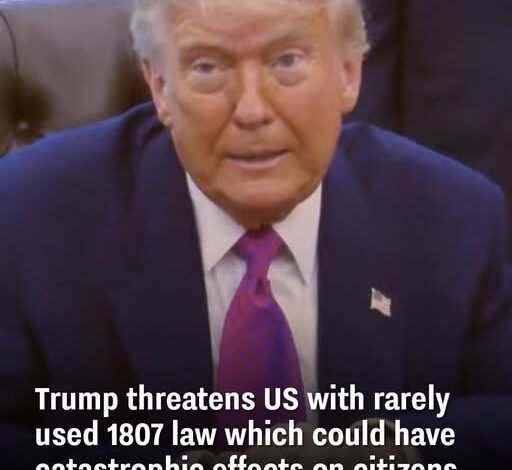
President Donald Trump offered a sharply different perspective.
His administration argued that federal action was necessary precisely because local authorities had failed to maintain adequate control.
Officials described the deployments as a responsible effort to restore stability, protect property, and ensure the enforcement of federal law.
What might once have been a disagreement over tactics evolved into a direct public confrontation over authority itself.
Who was truly in charge?
The governor?
The president?
State officials?
Federal agencies?
The debate exposed longstanding tensions embedded within the American system.
The United States has always balanced competing centers of power.
Federal authority.
State authority.
Local authority.
The system was designed that way intentionally.
Yet moments of crisis often reveal how complicated those arrangements can become.
Especially when different leaders interpret events in dramatically different ways.
As political arguments intensified, legal scholars entered the conversation.
Constitutional questions suddenly occupied center stage.
Commentators dissected legal precedents.
Law professors appeared on television panels.
Former judges offered analyses.
Academic journals published rapid responses.
The discussion moved beyond politics and into the realm of constitutional law.
One statute appeared repeatedly in those conversations:
The Posse Comitatus Act.
Enacted in the nineteenth century, the law generally limits the use of federal military forces in domestic law enforcement activities.
For generations, it has served as an important boundary between military power and civilian governance.
Yet the law contains exceptions.
And those exceptions became the focus of intense scrutiny.
Experts debated what military personnel could legally do.
What they could not do.
How supporting roles should be interpreted.
Where assistance ends and enforcement begins.
The legal distinctions mattered enormously.
Another piece of legislation cast an even larger shadow over the debate:
The Insurrection Act.
Unlike the Posse Comitatus Act, the Insurrection Act grants presidents significant authority under certain circumstances to deploy military forces domestically.
Historically, it has been invoked during moments of extraordinary unrest or resistance to federal authority.
Its existence raises difficult questions precisely because it grants powers most Americans hope will rarely be needed.
The act remained at the center of speculation.
Could it be invoked?
Should it be invoked?
Would current conditions justify such action?
Even discussing those possibilities revealed how serious the situation had become.
For many legal scholars, the events unfolding in Los Angeles represented more than a political controversy.
They represented a constitutional stress test.
A real-world examination of how legal frameworks function when public order, civil liberties, and competing government authorities collide simultaneously.
Meanwhile, ordinary residents continued living through the consequences.
For people on the ground, abstract constitutional debates often felt distant.
What mattered were immediate realities.
Traffic disruptions.
Business closures.
School concerns.
Police lines.
Protest routes.
Community meetings.
Neighborhood tensions.
The experience of living through unrest is rarely identical to the experience of analyzing it.
Residents often find themselves caught between competing narratives.
One side describes necessary enforcement.
Another describes government overreach.
One side emphasizes security.
Another emphasizes rights.
Yet daily life continues regardless.
People still go to work.
Parents still care for children.
Businesses still attempt to operate.
Communities still seek stability.
That reality often gets lost amid political spectacle.
Supporters of the federal response continue arguing that governments cannot allow disorder to spread unchecked.
They point to examples where delayed responses contributed to greater damage.
They emphasize the responsibility of public officials to maintain safety.
In their view, strength prevents escalation.
Critics continue warning that excessive force can create exactly the instability it seeks to prevent.
They argue that militarized responses risk transforming political disagreements into crises of legitimacy.
Trust, they contend, is easier to lose than to rebuild.
And public trust remains the foundation upon which democratic institutions depend.
Both perspectives draw from genuine concerns.
Both claim to defend public well-being.
And both reflect deeper disagreements about the nature of authority in modern America.
That is why Los Angeles has become something larger than a local story.
The city now serves as a national test case.
A place where multiple debates intersect simultaneously.
Immigration policy.
Federal power.
State sovereignty.
Civil liberties.
Public safety.
Military involvement.
Democratic accountability.
Each issue carries enormous significance on its own.
Together, they create a conflict that extends far beyond any single protest or enforcement operation.
What happens next remains uncertain.
Court challenges may reshape the legal landscape.
Political negotiations may alter policy.
Public opinion may shift.
Events on the ground may evolve in unexpected ways.
History offers examples supporting many different outcomes.
Yet one reality has already become clear.
The demonstrations are no longer merely about immigration raids.
They have become a referendum on how power is exercised in a democracy.
How authority is justified.
How dissent is managed.
And how competing institutions share responsibility during moments of unrest.
In the months and years ahead, legal scholars will likely study these events closely.
Politicians will cite them.
Activists will reference them.
Future debates about federal-state relations may return repeatedly to the precedents established here.
But beyond the legal arguments and political strategies lies a simpler challenge.
Can a nation confront unrest without undermining civil liberties?
Can governments maintain order without eroding trust?
Can federal and state leaders navigate conflict without transforming disagreement into institutional crisis?
Those questions matter far beyond Los Angeles.
They matter because every democracy eventually faces moments when security, freedom, and authority pull in different directions.
How those tensions are managed often determines not only the outcome of a specific conflict, but the public’s confidence in the system itself.
For now, Los Angeles stands at the center of that struggle.
Its streets have become a stage upon which larger national questions are being asked.
Questions about power.
Questions about rights.
Questions about belonging.
Questions about trust.
And until those questions find convincing answers, the significance of what is happening there will extend far beyond the city limits.
Because the ultimate test is not whether order can be restored.
It is whether order, liberty, and legitimacy can survive together.