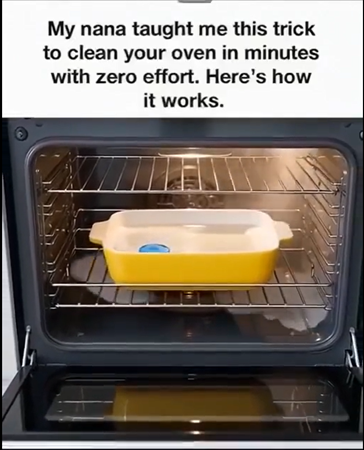
Few household chores inspire procrastination quite like cleaning the oven.
Most people know the routine all too well. You open the oven door, take one look at the baked-on grease, charred food splatters, and stubborn black residue clinging to the walls, then quietly decide to deal with it another day.
That “other day” often turns into weeks.
Sometimes months.
The reason is simple: cleaning an oven is usually messy, time-consuming, and unpleasant.
Traditional oven cleaners promise quick results, but they often come with a price. Harsh chemicals fill the kitchen with overpowering fumes. Gloves become mandatory. Windows need to be opened. The lingering smell can hang in the air long after the cleaning is finished.
For households with children, pets, or people sensitive to strong chemicals, the process can feel even more daunting.
But according to a simple household trick passed down through generations, there may be a far easier way.
No toxic sprays.
No hours of scrubbing.
No burning eyes or chemical odors.
Just a dishwashing pod, a casserole dish, and some water.
At first glance, the method sounds almost too simple to work.
Yet thousands of people swear by it, and the science behind it is surprisingly logical.
The secret lies in combining gentle steam with the grease-fighting enzymes already found inside modern dishwashing pods.
Together, they create a cleaning process that does much of the hard work for you.
Instead of attacking grime with force, the method softens and loosens it until it can be wiped away with minimal effort.
It’s the kind of practical kitchen wisdom many grandparents perfected long before shelves became crowded with specialty cleaning products.
The process begins with a low oven temperature.
Start by preheating your oven to 200°F (93°C).
This moderate heat is important.
It’s warm enough to activate the cleaning ingredients inside the dishwashing pod without creating excessive heat or causing water to evaporate too quickly.
While the oven is warming, find a heatproof casserole dish.
Glass or ceramic dishes designed for oven use work best.
Fill the dish with two to three cups of water and place a single dishwashing pod into the water.
As the pod begins dissolving, it releases powerful cleaning agents designed specifically to break down grease, oils, food particles, and stubborn residue.
Most people think of dishwashing pods as simple detergent.
In reality, they’re carefully formulated cleaning systems packed with enzymes and surfactants that target exactly the types of messes commonly found inside ovens.
Once the solution is prepared, place the dish on the center rack of the oven.
Close the door.
Then walk away.
This is where the magic begins.
As the water heats, steam gradually fills the oven cavity.
The warm vapor circulates into corners, around racks, beneath the door, and across surfaces that are often difficult to reach manually.
Unlike aggressive chemical cleaners that strip grime through harsh reactions, the steam works gently.
Layer by layer, it softens baked-on grease and loosens hardened food particles.
Meanwhile, the cleaning agents from the dissolved pod become part of the process, helping break down stubborn residue even further.
For the next hour, the oven essentially cleans itself.
No scrubbing.
No scraping.
No harsh fumes filling your kitchen.
Just heat, steam, and time.
Many people are surprised by how much grime begins loosening during this stage alone.
Residue that once seemed permanently attached gradually softens and lifts from surfaces.
Grease becomes easier to remove.
Burnt spills lose their grip.
Even areas that normally require intense effort become noticeably cleaner.
For ovens with years of buildup, extending the steaming process to ninety minutes can provide even better results.
Some homeowners also repeat the method over consecutive days when tackling especially neglected ovens.
The beauty of the technique lies in its patience.
Rather than forcing dirt off surfaces, it encourages grime to release naturally.
Once the steaming process is complete, allow the oven to cool slightly.
Safety is important.
The dish and interior surfaces will still be hot.
Use oven mitts or heat-resistant gloves before removing the casserole dish.
Dispose of the water carefully and let the oven cool until it is comfortable to touch.
Then comes the most satisfying part.
Take a damp cloth or sponge and begin wiping the interior.
For many people, the first swipe feels almost unbelievable.
Grease that once seemed impossible to remove often comes away effortlessly.
Dark stains loosen.
Sticky residue lifts.
Areas that previously required vigorous scrubbing suddenly need only gentle pressure.
If a few stubborn spots remain, a soft-bristled brush usually finishes the job.
No metal scrapers.
No abrasive pads.
No damaged surfaces.
Just simple cleaning.
The oven door, side panels, and racks can all benefit from the treatment.
And because the steam reaches into difficult corners, the results often feel more thorough than traditional spot-cleaning methods.
The reason this trick continues to gain popularity is simple.
It works.
But its effectiveness isn’t the only advantage.
It’s also remarkably safe.
Traditional oven cleaners often contain ingredients that require careful handling. Some release fumes capable of irritating the eyes, skin, and respiratory system.
The dishwashing pod method eliminates many of those concerns.
Instead of relying on harsh chemical reactions, it harnesses heat and moisture.
For families seeking more environmentally friendly cleaning solutions, that can make a significant difference.
There’s also the convenience factor.
Most households already have everything needed.
No special products.
No extra shopping trip.
No expensive cleaning supplies.
Just everyday items already sitting in the kitchen.
Many people who try the method once end up incorporating it into a regular cleaning routine.
Running the process once a month helps prevent major buildup from forming in the first place.
Instead of facing a dreaded deep-cleaning session every few months, routine maintenance keeps the oven consistently manageable.
A few additional tips can make the process even more effective.
For particularly greasy areas, lightly sprinkling baking soda before steaming can provide an extra cleaning boost.
Wiping up fresh spills after cooking also prevents future buildup.
And always ensure the dish you use is designed to withstand prolonged oven heat.
Small preventative habits combined with regular steaming can dramatically reduce the effort required to maintain a clean oven.
Perhaps the most appealing part of this method is its simplicity.
In a world where countless cleaning products promise revolutionary results, this approach relies on basic principles that have stood the test of time.
Heat softens.
Steam loosens.
Cleaning agents break down grease.
The combination works because it doesn’t fight against grime—it works with the natural process of dissolving and releasing it.
What once seemed like one of the kitchen’s most dreaded tasks becomes surprisingly manageable.
Even satisfying.
So the next time you open your oven and feel tempted to postpone cleaning it yet again, remember this simple trick.
A dishwashing pod.
A casserole dish.
A little water.
And an hour of patience.
Sometimes the best solutions aren’t the most expensive or complicated.
Sometimes they’re the ones sitting quietly in your kitchen all along, waiting to make life a little easier.
And when the process is finished, you’ll be left with something every homeowner appreciates—a sparkling clean oven achieved with far less effort than you ever thought possible.