At first glance, the dispute appeared to be about a name.
A sign.
A building.
A collection of letters attached to one of America’s most recognizable cultural institutions.
But as the legal battle unfolded, it became increasingly clear that the controversy was never merely about what appeared above an entrance.
It was about something much larger.
Authority.
History.
Power.
And the question of who gets to shape the symbols through which a nation remembers itself.
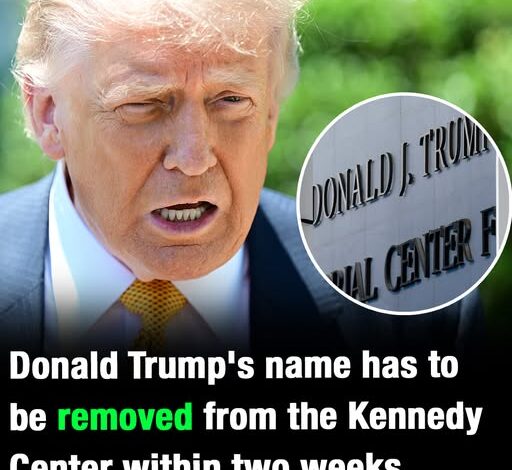
When Judge Christopher Cooper issued his ruling, the immediate consequence was straightforward: the attempt to permanently attach Donald Trump’s name to the Kennedy Center could not stand under the law.
Yet the decision carried significance far beyond the practical matter of replacing signs and revising official materials.
For supporters of the challenge, the ruling represented a reaffirmation of constitutional process.
For critics of the rebranding effort, it served as a reminder that even highly visible institutions remain governed by legal frameworks rather than political preferences.
And for many observers, it reopened an enduring American debate about legacy itself.
Who owns history?
Who gets remembered?
And who has the authority to decide?
The Kennedy Center occupies a unique place in American public life.
Unlike many government buildings, it functions simultaneously as a cultural institution, a national monument, and a living memorial.
Its very existence is tied to memory.
The center was established to honor President John F. Kennedy, whose assassination left an indelible mark on the nation’s history.
For generations, the building has represented more than architecture.
It has symbolized public service.
Artistic achievement.
National culture.
And remembrance.
Names attached to such institutions carry weight.
They become part of a broader narrative.
A statement not merely about the present but about how future generations will interpret the past.
That is why efforts to alter those names often provoke intense reactions.
People understand instinctively that symbols matter.
Monuments matter.
Memory matters.
The dispute surrounding the Kennedy Center emerged from precisely that tension.
Supporters of the rebranding effort argued that honoring Trump reflected his influence on modern American politics and culture.
Critics viewed the move differently.
They questioned not only the symbolism but the process itself.
Their objections extended beyond personal opinions about Trump.
They focused on authority.
Specifically, who possessed the legal authority to rename a federally established institution.
As the controversy intensified, accusations flew from every direction.
Supporters described opposition as partisan resistance.
Critics described the rebranding as political overreach.
Public debate grew increasingly heated.
Yet beneath the rhetoric remained a simpler legal question.
Did the individuals responsible for the name change actually possess the power to make that decision?
Judge Cooper’s ruling answered that question directly.
According to the court, the answer was no.
The authority to rename the Kennedy Center belonged to Congress.
Not administrators.
Not political allies.
Not private actors.
Congress.
That conclusion transformed the case from a symbolic dispute into a constitutional one.
The court’s reasoning emphasized a principle deeply embedded within American governance.
Institutions created through legislation remain subject to legislative authority.
Political influence alone cannot substitute for legal process.
Even overwhelming support from powerful individuals does not eliminate procedural requirements.
The law still matters.
The ruling therefore carried implications extending well beyond the Kennedy Center itself.
At its core, the decision reaffirmed a simple but significant idea.
Public institutions are not personal property.
They do not belong to presidents.
Former presidents.
Political movements.
Or temporary majorities.
They belong to the public.
And decisions affecting their identity must occur through lawful channels.
That principle may sound technical.
Yet its consequences are profound.
Because history contains countless examples of leaders seeking to leave permanent marks upon public spaces.
Monuments.
Buildings.
Airports.
Parks.
Schools.
Naming rights have long functioned as instruments of legacy.
The desire is understandable.
Political careers are temporary.
Symbols endure.
Attaching one’s name to a landmark offers a form of permanence that elections cannot provide.
Which is precisely why rules governing such decisions matter.
Without them, public memory becomes vulnerable to whoever happens to hold influence at a particular moment.
The Kennedy Center case highlighted that concern dramatically.
Supporters of the challenge argued that the issue was never solely about Trump.
It was about precedent.
If one administration could effectively rename a major national institution through procedural maneuvering, what would prevent future administrations from doing the same?
Would every political shift trigger another symbolic rewrite?
Would public monuments become battlegrounds constantly reshaped by changing power dynamics?
The court’s ruling attempted to establish a clear boundary.
Some decisions require congressional action.
Some symbols belong to broader national processes.
Some institutions cannot be redefined unilaterally.
Representative Joyce Beatty emerged as a central figure in advancing that argument.
When she initially challenged the rebranding effort, many observers viewed the dispute through a partisan lens.
Supporters of Trump dismissed the challenge as political theater.
Opponents viewed it as a necessary defense of institutional norms.
The legal outcome altered those perceptions considerably.
What some critics had characterized as symbolic resistance ultimately received validation in federal court.
That validation carried both political and legal significance.
Because court rulings possess a unique power.
They move debates beyond opinion.
Beyond speculation.
Beyond political messaging.
They impose consequences grounded in legal interpretation.
For Beatty and others who opposed the rebranding, the decision represented more than victory.
It represented confirmation that their objections were rooted in law rather than preference.
For supporters of the Kennedy family’s legacy, the ruling carried emotional significance as well.
The Kennedy name has occupied a unique place in American public life for decades.
Admired by some.
Criticized by others.
Yet undeniably intertwined with national history.
The Kennedy Center itself functions as one of the most visible manifestations of that legacy.
Preserving its identity therefore felt, to many supporters, like preserving a piece of historical continuity.
Not because institutions should remain frozen forever.
But because changes to national symbols deserve deliberate processes rather than improvised ones.
The reaction among Trump allies was predictably different.
Many viewed the decision as another example of institutional resistance directed toward the former president.
Some argued that the legal reasoning reflected broader political tensions.
Others criticized the court’s interpretation of authority.
Still others expressed frustration that symbolic recognition associated with Trump continued facing obstacles long after his presidency.
Those reactions underscore a larger reality about modern American politics.
Increasingly, disputes over symbols generate emotions nearly as intense as disputes over policy.
Names.
Statues.
Memorials.
Buildings.
Each becomes a proxy for larger debates about identity and national memory.
The Kennedy Center controversy fit squarely within that pattern.
What made the case particularly notable, however, was the clarity of the legal question involved.
The ruling did not evaluate Trump’s political legacy.
It did not assess his accomplishments.
It did not determine whether he deserved recognition.
Instead, it focused on authority.
Who possessed it.
And who did not.
That distinction matters.
Because courts generally avoid acting as arbiters of historical worthiness.
Their role centers on legality.
Procedure.
Jurisdiction.
The Kennedy Center ruling reflected that approach.
The question was not whether Trump should be honored.
The question was whether the rebranding occurred lawfully.
According to the court, it did not.
As a result, practical consequences now follow.
Workers will remove signage.
Official materials will require revision.
References to the rebranding effort will gradually disappear from institutional branding.
The physical evidence of the change will fade.
Yet the broader debate will likely continue.
Because controversies involving national symbols rarely end entirely.
They evolve.
Become part of larger conversations about memory, power, and public identity.
In many ways, the ruling serves as a reminder of how American institutions are designed to function.
Power exists.
But it is constrained.
Influence matters.
But it has limits.
Political victories create opportunities.
They do not automatically rewrite legal structures.
The founders built systems specifically intended to prevent any single individual from exercising unlimited authority over public institutions.
That framework can be frustrating.
Slow.
Complicated.
Yet moments like this illustrate its purpose.
The rules remain even when personalities change.
The processes remain even when administrations come and go.
The institutions endure.
That endurance is often invisible until challenged.
Then suddenly it becomes the central issue.
As the Kennedy Center returns to its original identity, many observers see more than the restoration of a name.
They see the restoration of a process.
A reaffirmation that public symbols belong to more than the individuals who seek to shape them.
A reminder that history cannot simply be revised through influence alone.
And perhaps most importantly, a reminder that monuments carry responsibilities as well as meanings.
They tell stories.
Preserve memories.
Reflect values.
But they also belong to future generations.
Which is why decisions about them matter so deeply.
In the end, the Kennedy Center controversy may be remembered less for the name briefly attached to it than for the principle ultimately affirmed.
That in a nation governed by laws rather than personalities, even the most powerful figures encounter limits.
Not because they lack influence.
Because influence and authority are not the same thing.
And when those two concepts collide, it is the law—not legacy, popularity, or ambition—that determines what remains standing when the argument ends.
For now, the building’s original name remains.
The signs will change.
The paperwork will be updated.
The legal battle has spoken.
And the Kennedy Center returns to the identity it carried for generations—a reminder that history may be contested, but it cannot simply be rewritten by will alone.