If you spot a rubber band on your front door handle, you need to know the sick thing it means

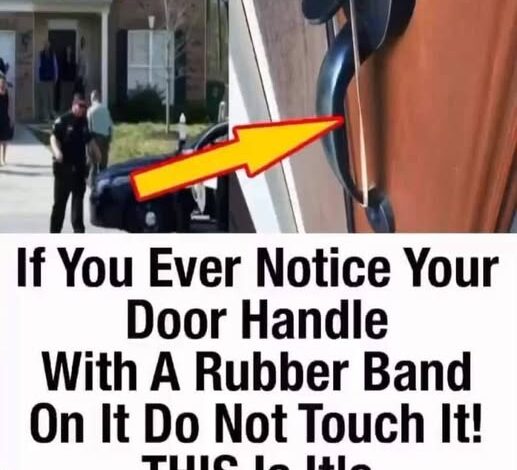
Most people would never think twice about a rubber band.
It’s one of the most ordinary objects imaginable.
You find them in kitchen drawers, office supplies, junk bins, and the bottom of purses. They hold newspapers together, keep envelopes closed, and disappear into corners of the house where nobody remembers putting them.
Because they’re so common, they rarely attract attention.
Which is precisely why they can be unsettling when they appear somewhere unexpected.
Imagine returning home after a normal day.
You carry groceries inside.
Check the mail.
Unlock the front door.
Then something catches your eye.
A simple rubber band wrapped around the exterior door handle.
Nothing dramatic.
Nothing obviously threatening.
Just a small loop of stretched rubber sitting where you know it wasn’t before.
Most people would remove it without a second thought.
Some might assume it was left accidentally.
Others might think neighborhood children were playing a harmless prank.
A few would toss it into the trash and immediately forget about it.
But security experts and law enforcement officials have occasionally warned that unusual objects placed around homes can sometimes serve a different purpose entirely.
Not always.
Not automatically.
But sometimes.
And that possibility is what makes such discoveries worth paying attention to.
The idea sounds almost too simple.
Why would someone use a rubber band to gather information?
Why not rely on cameras, technology, or direct observation?
The answer lies in something criminals often value above all else.
Low risk.
The less attention they attract, the better.
The fewer chances they take, the safer they remain.
A rubber band costs almost nothing.
It attracts little notice.
And under certain circumstances, it can provide information.
Not because the object itself is sophisticated.
Because human routines are remarkably predictable.
Many crimes begin long before anyone attempts a break-in.
Long before a door is opened.
Long before property is stolen.
Successful criminals often spend time observing.
Studying.
Learning.
They look for patterns.
Weaknesses.
Opportunities.
Information that helps them decide whether a target appears attractive or risky.
The process resembles research more than most people realize.
Criminals may observe who leaves early for work.
Who returns late.
Which homes remain dark for extended periods.
Which properties appear occupied.
Which ones appear neglected.
The more information they gather, the fewer surprises they encounter later.
And surprises are something criminals generally try to avoid.
Within that context, small markers sometimes become useful.
Various reports over the years have described situations where objects were left near homes, mailboxes, fences, gates, driveways, or doorways as a way of monitoring activity.
The concept is straightforward.
Place something subtle.
Return later.
See whether it has moved.
If it remains untouched, that may suggest the property receives little attention.
If it disappears quickly, that may indicate occupants are actively present and observant.
Again, such objects do not automatically signal criminal intent.
Many innocent explanations exist.
Yet awareness remains valuable.
Because unusual details occasionally matter.
The concern surrounding rubber bands specifically stems from the possibility that they can serve multiple purposes.
In some reported cases, a band placed around a door handle might help indicate whether the door is regularly used.
If the band shifts position, disappears, or shows signs of disturbance, it reveals information about activity at the residence.
The object itself does not provide definitive answers.
But combined with other observations, it may contribute to a broader picture.
For someone studying routines, even small clues can become useful.
A package sitting untouched for several days.
Lights remaining off night after night.
Mail accumulating.
Vehicles absent from the driveway.
A marker left in place.
Individually, these details may mean very little.
Together, they can suggest patterns.
Patterns are exactly what opportunistic criminals seek.
What makes these situations particularly unsettling is their simplicity.
People often imagine criminal planning involving advanced technology, elaborate schemes, or highly sophisticated methods.
In reality, many offenses rely on observation.
Patience.
Timing.
The ability to notice ordinary behavior.
That reality means homeowners benefit from paying attention as well.
Not becoming fearful.
Not becoming paranoid.
Simply remaining aware.
Awareness is one of the most effective security tools available.
When something unusual appears around a home, it deserves consideration.
Not panic.
Consideration.
Suppose you discover a rubber band attached to your door handle.
What should you do?
The first step is simple.
Remove it.
Do not leave it in place.
If it was harmless, removing it causes no problem.
If it served another purpose, removing it interrupts that purpose immediately.
Next, take a few moments to inspect your property.
Check doors.
Check windows.
Verify locks.
Look for anything else that appears out of place.
Most of the time, nothing unusual will be found.
That outcome is reassuring.
Yet conducting a quick inspection costs very little and may provide peace of mind.
Exterior lighting also deserves attention.
Well-lit properties generally present fewer opportunities for criminal activity.
Darkness offers concealment.
Light reduces it.
Motion-activated lighting can be particularly effective because it draws attention to movement around entrances, driveways, and pathways.
Technology provides additional options.
Security cameras have become increasingly accessible and affordable.
Visible cameras often function as deterrents regardless of whether they capture evidence.
The knowledge that activity may be recorded encourages many would-be offenders to move elsewhere.
Motion sensors, smart doorbells, and security systems create similar advantages.
Their greatest value often lies not in responding to crime after it occurs but in discouraging crime before it begins.
Neighborhood awareness remains equally important.
Criminals frequently rely upon isolation.
The less communication exists between neighbors, the easier it becomes to operate unnoticed.
Sharing concerns strengthens community awareness.
If one household discovers something unusual, nearby residents may notice similar activity.
Patterns that seem insignificant individually sometimes become meaningful collectively.
A conversation over a fence.
A message in a neighborhood group.
A quick discussion with nearby homeowners.
These simple actions can help identify whether an incident appears isolated or part of a larger pattern.
Perhaps the most overlooked security tool, however, is instinct.
People often sense when something feels unusual before they can explain why.
A misplaced object.
An unfamiliar vehicle repeatedly appearing nearby.
Someone lingering without obvious purpose.
Details that seem minor yet continue attracting attention.
Instinct should not replace evidence.
But neither should it be ignored.
Human intuition frequently draws upon observations the conscious mind has not fully processed.
When something feels genuinely wrong, paying attention is usually wise.
In situations involving repeated suspicious activity, contacting local authorities may be appropriate.
Law enforcement agencies often prefer receiving information before a serious incident occurs rather than afterward.
What seems insignificant to one homeowner may fit a larger pattern known to investigators.
Reporting concerns creates opportunities for awareness and prevention.
Of course, it is equally important to maintain perspective.
Not every strange object signals criminal activity.
Not every unusual occurrence represents a threat.
People accidentally leave items behind.
Children play games.
Weather moves objects into unexpected places.
Coincidences happen constantly.
The goal is not to interpret every mystery as danger.
The goal is to remain observant enough to recognize when attention is warranted.
Fear and awareness are not the same thing.
Fear exaggerates.
Awareness informs.
Fear assumes the worst.
Awareness gathers information.
The healthiest approach balances caution with common sense.
What makes stories like these resonate is not the rubber band itself.
It is the reminder hidden within them.
Security often depends upon noticing small details.
The things people overlook.
The things they dismiss.
The things that seem too ordinary to matter.
Many significant discoveries begin exactly that way.
A strange sound.
An unfamiliar face.
An object slightly out of place.
A detail that prompts someone to pause and ask questions.
Most of the time, the explanation turns out to be harmless.
Sometimes it does not.
Either way, attention provides options.
And options create preparedness.
In a world where people spend much of their lives rushing from one obligation to the next, it becomes easy to stop noticing surroundings.
Easy to overlook subtle changes.
Easy to assume that unusual details are meaningless.
Yet awareness remains one of the simplest and most powerful forms of protection available.
So if you ever find a rubber band wrapped around your front door handle, remove it.
Check your property.
Talk to your neighbors.
Review your security measures.
Trust your instincts.
And remember that preparedness rarely begins with dramatic warnings.
More often, it begins with noticing something small.
Something strange.
Something ordinary enough to ignore.
And deciding not to ignore it.