Sometimes the smallest actions reveal the most about who we are.
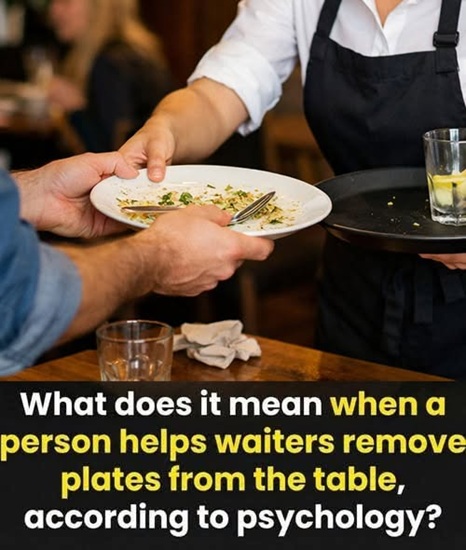
In a crowded restaurant, surrounded by conversation, clattering dishes, and the constant movement of servers rushing from table to table, a customer quietly gathers empty glasses. Another stacks plates neatly at the edge of the table. Someone wipes crumbs into a small pile or organizes utensils before the bill arrives.
Most people barely notice these gestures.
They take only a few seconds.
They attract no attention.
Yet psychologists suggest that these simple actions may reveal something surprisingly meaningful about human nature.
Because what looks like ordinary politeness is often something deeper.
It is awareness.
Empathy.
A quiet recognition that someone else’s work matters.
Restaurants are environments built on constant motion. Servers juggle multiple tables, carry heavy trays, remember complicated orders, solve problems, and maintain a friendly demeanor even during stressful shifts. Customers often see only brief moments of that effort, but those who pay close attention quickly recognize how demanding the job can be.
When someone chooses to make a server’s task slightly easier, they are doing more than moving a plate.
They are acknowledging another person’s workload.
That acknowledgment is powerful.
Psychologists often describe these behaviors as micro-acts of kindness.
Unlike grand gestures, micro-kindness requires no planning, no audience, and no expectation of reward. It happens naturally. A person notices a need and responds to it without being asked.
The act itself may be small.
The mindset behind it is not.
Research on empathy suggests that people who engage in these spontaneous acts tend to be highly attuned to the experiences of others. They notice details many people overlook. They recognize signs of stress, fatigue, or pressure without needing anyone to explain them.
Instead of asking, “What is my responsibility here?”
They instinctively ask, “How can I help?”
Often, the answer takes the form of a tiny gesture.
A stacked plate.
A gathered napkin.
A cleared space.
To outsiders, these actions may seem insignificant.
To the person receiving the help, they can mean much more.
Empathy plays a central role in this behavior. Psychologists define empathy as the ability to understand or share another person’s feelings and experiences. It serves as the foundation for what researchers call prosocial behavior—actions intended to benefit others without personal gain.
In a restaurant, prosocial behavior appears in simple forms.
A customer moves dishes closer to the edge of the table.
Someone organizes glasses to prevent spills.
A family gathers empty plates together before the server arrives.
These actions do not dramatically change someone’s day.
But they communicate something important:
“I see your effort.”
Many people who display these habits have personal experience working in service industries themselves.
Former servers often continue organizing tables years after leaving restaurant jobs. The behavior becomes automatic because they remember what it felt like to carry heavy trays, clean crowded tables, and navigate busy dining rooms under constant time pressure.
They remember the exhaustion.
The pace.
The small frustrations.
And they remember how much even minor assistance could help.
Because of those experiences, helping a server often feels less like a conscious decision and more like instinct.
But personal experience is not the only factor.
Some individuals develop these habits simply because they are highly observant. They pay attention to their surroundings. They notice when someone is overwhelmed. They recognize effort that others may overlook.
Their awareness naturally turns into action.
Not because they want praise.
Because it feels right.
Interestingly, not everyone interprets these behaviors the same way.
Some people see helping a server as a thoughtful gesture.
Others view it as unnecessary.
In certain cultures and social settings, customers are expected to remain entirely separate from staff responsibilities. Some believe organizing dishes interferes with professional routines or creates additional complications rather than reducing them.
These differing opinions reflect how social norms shape behavior.
What one person sees as helpful, another may see as unusual.
Yet regardless of interpretation, the intention behind these actions is usually the same.
Consideration.
Respect.
Awareness.
In psychological terms, that intention matters.
Studies on prosocial behavior consistently show that people who frequently engage in small acts of kindness tend to demonstrate greater sensitivity to social cues. They are often quicker to recognize when someone is struggling or under pressure.
This awareness helps create smoother interactions and stronger social connections.
Even brief moments of consideration can improve the emotional atmosphere of an environment.
For service workers, those moments can be especially meaningful.
Restaurant employees spend much of their day managing the needs of others. They solve problems, maintain composure under stress, and often absorb frustrations that have nothing to do with them.
In that context, unexpected kindness stands out.
A neatly organized table saves time.
A stack of plates reduces effort.
A simple gesture communicates appreciation.
And appreciation is something many service workers do not receive often enough.
These acts do not solve larger issues like wages, staffing shortages, or workplace stress.
But they can offer a brief moment of relief.
A reminder that their work is noticed.
A reminder that someone cares.
Research also suggests that kindness benefits the person giving it.
People who regularly engage in helpful behaviors often report higher levels of well-being, stronger social connections, and greater life satisfaction. Acts of kindness trigger positive emotional responses and reinforce feelings of purpose and belonging.
Remarkably, the benefits do not depend on the size of the gesture.
Holding a door.
Helping a stranger.
Organizing a table.
The scale is less important than the intention.
Small actions performed consistently can shape both personal happiness and community culture.
Perhaps that is why these moments matter.
In a world increasingly dominated by screens, algorithms, and digital interactions, face-to-face kindness carries unusual weight. It feels genuine because it is immediate. There is no audience. No performance. No opportunity for validation.
Just one person noticing another.
And responding.
The customer who stacks plates before leaving a restaurant may never think twice about it.
The server may forget the face by the end of the shift.
Yet the interaction still matters.
Because it reflects something fundamental about human nature.
The ability to recognize effort.
The willingness to ease another person’s burden.
The quiet understanding that kindness does not need to be dramatic to be meaningful.
Ultimately, these small gestures remind us that compassion often appears in ordinary places.
Not in headlines.
Not in grand speeches.
But in everyday moments that most people overlook.
A busy restaurant.
A crowded table.
A few stacked plates.
And a simple act that says, without words:
“I see you.”