The morning began so peacefully that it almost felt staged.
Sunlight spilled across the apartment floor in long golden strips, soft and warm enough to make the whole place feel gentler than usual. Outside, the city was only beginning to wake. A few cars murmured along the street below. Somewhere nearby, a balcony door slid open. From another apartment came the faint clink of dishes and the low hum of a radio.
It was the kind of quiet weekend morning that asks nothing from you.
Still half-asleep, I wandered into the kitchen and made coffee on autopilot. I barely looked at what I was doing. Scoop, water, mug, button. The familiar motions carried me while my mind slowly caught up with the day.
A few minutes later, mug in hand, I slid open the balcony door.
That was supposed to be the best part of the morning.
My balcony is not impressive. It is small, with cracked concrete tiles, two aging chairs, and a handful of plants that have survived mostly through stubbornness rather than my gardening skills. Still, it is mine. A quiet little square of air and sunlight where I can sit before the day becomes noisy.
But the moment I stepped toward the doorway, I stopped.
Something was sitting near the corner of the railing.
At first, my brain refused to understand it.
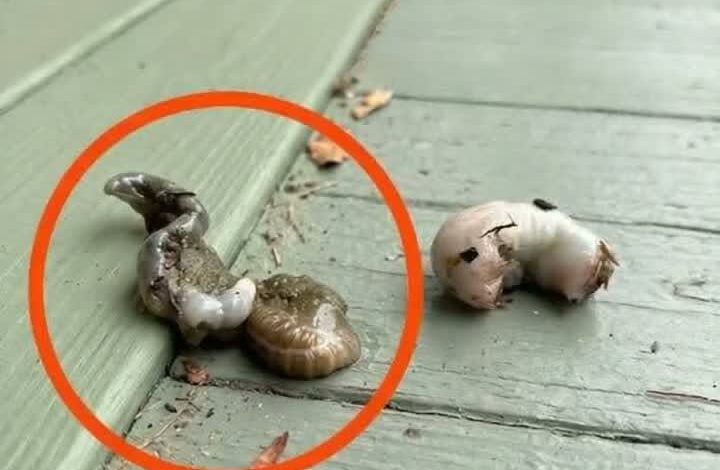
It was pale.
Soft-looking.
Strangely curved.
Against the gray tile, it seemed almost too visible, almost glowing in the morning light. It did not look like a leaf, or a pebble, or anything else my balcony usually collected.
It looked organic.
And that was the problem.
My body reacted before my mind did. I froze with one foot still inside the apartment and one hand gripping my coffee mug so tightly the handle pressed into my fingers.
The thing did not move.
Somehow, that made it worse.
If it had crawled, flown, wriggled, or scurried away, I might have understood it faster. But its stillness felt wrong. Deliberate. Suspicious.
Balconies collect harmless things all the time. Dust. Feathers. Dried leaves. The occasional confused insect. But this was different. From where I stood, it looked like something that had no business being in daylight.
Something pale enough to belong underground.
Something soft enough to be alive.
Something I absolutely did not want near my bare feet.
I took a step backward.
Then another.
My eyes stayed locked on it.
Immediately, the irrational part of my brain began writing a horror story.
Maybe it was some kind of parasite.
Maybe it was an invasive insect.
Maybe something had laid eggs nearby.
Maybe there were more hidden in the planters, beneath the chairs, inside the cracks between the tiles.
The more I stared, the more disturbing it became.
Its shape was not quite familiar enough to be comforting. It curved slightly like a small crescent pressed against the concrete. The surface looked faintly segmented, almost ribbed, with a pale color that seemed less like skin and more like something that had never been meant to see the sun.
I told myself to calm down.
Naturally, I did the opposite.
I grabbed my phone and used the camera as a barrier between myself and the unknown thing on my balcony. Somehow, looking at it through a screen made me feel slightly safer, as though the phone could protect me from whatever nightmare nature had delivered overnight.
My hands shook as I zoomed in.
That was a mistake.
The closer view made everything worse.
The texture became clearer. The body looked soft but defined. Not trash. Not a stone. Not a piece of food. Not anything harmless enough for my anxious mind to accept.
Something alive.
The thought landed hard.
I backed into the kitchen and shut the balcony door.
Then I stood there like a ridiculous hostage in my own apartment, staring through the glass at a creature smaller than my thumb.
For the next several minutes, I paced.
Every few seconds, I glanced back outside to make sure it had not moved. This made no sense, because if it had moved, I absolutely did not know what I planned to do about it. But watching felt better than not watching.
I crouched near the glass and tried to study it from different angles.
No obvious legs.
No eyes.
No wings.
No clear head.
That uncertainty was the worst part.
If I could identify it, I could contain the fear.
But without a name, it became everything at once.
A bug.
A larva.
A parasite.
A warning sign.
A biological mystery I was deeply unqualified to solve.
I texted photos to a few friends, pretending to be casual.
“Anyone know what this is?”
Their responses arrived quickly.
“What IS that?”
“Absolutely not.”
“Burn the balcony.”
“Call someone.”
“Why is it so pale?”
None of this helped.
In fact, their panic validated mine beautifully.
My peaceful morning was gone. My coffee sat untouched on the counter, cooling into bitterness while I conducted a full investigation from behind a locked glass door.
I imagined hidden infestations.
I imagined something nesting in the planters.
I imagined my entire building quietly filling with strange pale creatures while everyone slept.
The mind is impressive when it wants to be unhelpful.
Finally, curiosity became stronger than fear.
I opened a search engine and began typing the least scientific descriptions imaginable.
“Pale bug curled up balcony.”
“White worm-like insect on tile.”
“Soft ribbed creature outside apartment.”
“Larva balcony dangerous?”
The results were horrifying at first.
That is the problem with searching for strange things online. You begin with one unsettling object on your balcony and within five minutes you are reading about insects you had no desire to know existed.
I scrolled past photos of grubs, larvae, worms, beetles, parasites, and other creatures that seemed designed specifically to ruin breakfast.
Then one image stopped me.
It looked exactly like the thing outside.
Same pale body.
Same curved shape.
Same soft, segmented appearance.
I clicked.
And just like that, the monster became a beetle larva.
That was it.
Not poisonous.
Not aggressive.
Not an omen.
Not the beginning of an apartment-wide infestation.
Just a beetle larva, likely displaced from soil or carried onto the balcony accidentally by a bird, wind, or one of my neglected planters.
The relief was immediate.
The embarrassment arrived half a second later.
I stared through the glass again, and now that I knew what I was seeing, the entire scene changed.
The pale color no longer seemed unnatural. It made sense. The larva was something that normally lived underground, hidden in soil where sunlight rarely reached it.
Its stillness was not threatening.
It was defensive.
It was not waiting to attack.
It was lost.
Trapped in the wrong place.
Suddenly, the strange little creature that had terrified me all morning looked fragile instead of frightening.
I opened the balcony door carefully.
This time, I stepped outside.
The sunlight was still warm. The air still smelled faintly of dust and coffee. The city continued waking below me, completely unaware that I had just survived a dramatic confrontation with a harmless beetle larva.
Using a folded piece of paper, I gently lifted it from the tile.
It barely moved.
I carried it to one of the planters and placed it in the soil, where it immediately began to disappear beneath the dirt, returning to the hidden world it actually belonged to.
I watched until it was gone.
Then I laughed.
Not because anything had been funny in the moment, but because the whole thing was suddenly absurd.
A tiny larva had turned my quiet morning into a suspense thriller.
Nothing had changed except my understanding.
The object was the same.
The balcony was the same.
The world was the same.
But a few minutes earlier, my imagination had transformed uncertainty into danger.
That, I realized, is how fear often works.
It rarely waits for proof.
It rushes into empty spaces.
Where knowledge is missing, fear starts building stories.
The unknown becomes suspicious.
The unfamiliar becomes threatening.
A harmless shape becomes a monster simply because the mind cannot immediately explain it.
An hour later, I finally sat outside with my cold coffee.
The balcony had returned to being ordinary.
The cracked tiles were just cracked tiles.
The old chairs were just old chairs.
The neglected plants leaned toward the sun like they always did.
Nothing about the place had ever truly been unsafe.
Only misunderstood.
And somehow, that tiny difference mattered completely.
Because the moment I understood what I was looking at, the fear vanished.
The monster became a beetle larva.
The threat became a lost creature.
The nightmare became a story I would probably tell with too much dramatic flair for years.
And my balcony became peaceful again.