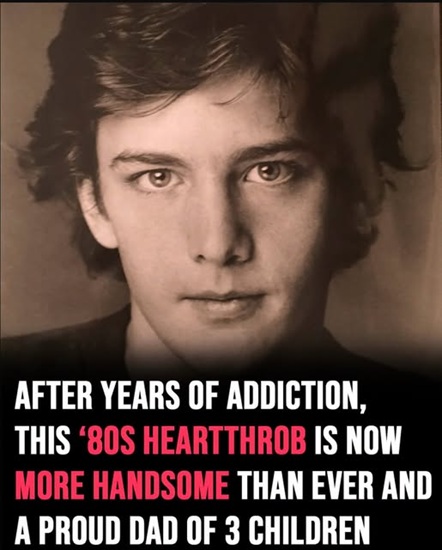
Long before he became one of the defining faces of 1980s cinema, Andrew McCarthy was simply a teenager who felt like he never quite fit in.
He wasn’t the loudest student in school.
He wasn’t the athlete everyone admired.
And he certainly wasn’t the confident future movie star people would one day see on magazine covers around the world.
In fact, if someone had told the young boy growing up in Westfield, New Jersey, that millions of fans would eventually hang his poster on their bedroom walls, he probably wouldn’t have believed them.
Yet life has a way of taking unexpected turns.
For Andrew McCarthy, that journey would transform him from an uncertain teenager struggling to find his place into one of Hollywood’s most recognizable young actors, a member of the legendary “Brat Pack,” a successful television director, an acclaimed travel writer, and ultimately a man who learned how to reinvent himself long after the spotlight shifted.
His story is not simply one of fame.
It is a story of survival, growth, second chances, and discovering that success means much more than celebrity.
A Childhood Far Removed from Hollywood
Andrew McCarthy was born on November 29, 1962, in Westfield, New Jersey.
Unlike many future stars who grew up dreaming of Hollywood, McCarthy’s upbringing was remarkably ordinary. He came from a middle-class family with no direct connections to the entertainment industry. There were no famous relatives opening doors or industry insiders guiding his path.
His world was suburban, familiar, and far removed from movie sets and red carpets.
Yet beneath the surface, McCarthy often felt disconnected from the people around him.
Years later, he would openly discuss how difficult adolescence felt. School wasn’t a place where he naturally thrived socially. Like many teenagers, he struggled with insecurity, self-doubt, and the uncomfortable feeling of not fully belonging.
Those emotions would eventually become an unexpected advantage.
Because while McCarthy sometimes felt out of place in real life, those same feelings helped him bring authenticity to the sensitive, introspective characters he would later portray on screen.
Even as a young man, acting offered something different.
It gave him a place where uncertainty could become expression.
A place where emotions that felt confusing in everyday life suddenly made sense.
And before long, acting began to feel less like a hobby and more like a calling.
A Rocky Start
After graduating from high school, McCarthy enrolled at New York University to study acting.
On paper, it seemed like the logical next step.
He wanted professional training.
He wanted to improve his craft.
He wanted to learn from experienced instructors.
But university life didn’t unfold as planned.
McCarthy quickly discovered that he struggled with rigid academic structures. He often skipped classes and found himself increasingly drawn toward real-world opportunities rather than classroom instruction.
Eventually, his attendance problems caught up with him.
He was expelled.
For many young people, being expelled from college would have felt like a devastating setback.
For McCarthy, it became an unexpected turning point.
Instead of abandoning his dream, he doubled down on it.
If traditional education wasn’t going to be his path, he would find another way.
And as it turned out, opportunity was closer than he realized.
The Breakthrough That Changed Everything
Not long after leaving NYU, McCarthy attended an open casting call for a film called Class.
Thousands of aspiring actors dream of getting noticed.
Very few actually do.
McCarthy did.
The 1983 film starred Jacqueline Bisset and Rob Lowe, but it was McCarthy’s performance that attracted attention from industry insiders.
There was something unique about him.
Unlike many young actors chasing attention through charisma or confidence, McCarthy brought vulnerability to the screen.
His performances felt natural.
Quiet.
Authentic.
Audiences responded immediately.
Hollywood took notice.
And suddenly, the struggling young actor from New Jersey found himself standing at the edge of something enormous.
The Rise of an ’80s Icon
The 1980s became one of the most influential eras in teen cinema.
Movies centered on young adults dominated popular culture, creating stars whose influence extended far beyond theaters.
Andrew McCarthy quickly became one of those stars.
By the middle of the decade, he was appearing in films that would eventually define an entire generation.
One of the most significant was St. Elmo’s Fire (1985).
The film followed a group of recent college graduates struggling to navigate adulthood, relationships, ambition, and identity.
Critics were divided.
Audiences were not.
The movie became a cultural phenomenon.
More importantly, it introduced the world to a collection of young actors who would become inseparable in the public imagination.
The media eventually labeled them the “Brat Pack.”
The group included performers such as Emilio Estevez, Rob Lowe, Demi Moore, Judd Nelson, Ally Sheedy, Molly Ringwald, and Andrew McCarthy.
Although the nickname became famous, many members of the group later admitted they disliked it.
At the time, however, it was impossible to escape.
The label followed them everywhere.
Magazine covers.
Interviews.
Television appearances.
The public viewed them as the faces of a generation.
And McCarthy was right at the center of it.
The Role That Made Him a Heartthrob
If St. Elmo’s Fire elevated his profile, Pretty in Pink (1986) cemented his place in pop culture history.
Starring opposite Molly Ringwald, McCarthy played Blane McDonough, the wealthy and sensitive love interest whose quiet demeanor stood in contrast to many of the louder male characters popular during the era.
The role resonated deeply with audiences.
Teenagers connected with his vulnerability.
Fans admired his understated charm.
His thoughtful performance turned him into one of the decade’s most recognizable young stars.
Suddenly, Andrew McCarthy was everywhere.
His face appeared on magazine covers.
His posters decorated bedroom walls.
Fan mail arrived in overwhelming quantities.
To millions of viewers, he represented a different kind of leading man—introspective rather than aggressive, emotional rather than arrogant.
That image only grew stronger when he starred in Mannequin (1987), another commercial success that further expanded his popularity.
By the end of the decade, McCarthy had become one of Hollywood’s most recognizable actors.
From the outside, it looked like a dream.
But inside, things were far more complicated.
The Hidden Cost of Fame
Success arrived quickly.
Too quickly.
Like many young actors thrust into fame before they fully understood it, McCarthy struggled with the sudden transformation of his life.
One day he was a relatively anonymous actor trying to get work.
The next, strangers recognized him everywhere he went.
His private life became public.
His mistakes became news.
His insecurities didn’t disappear simply because he became famous.
If anything, they intensified.
Years later, McCarthy would speak openly about how unprepared he felt for the realities of celebrity.
The attention was flattering at first.
Then exhausting.
Then confusing.
Beneath the success, he remained the same person who had once felt uncertain and out of place.
Only now those feelings existed beneath an increasingly visible public image.
As pressure mounted, McCarthy turned to unhealthy coping mechanisms.
Alcohol became a growing part of his life.
What began as social drinking gradually evolved into something more serious.
The fast-paced Hollywood lifestyle made it easy to avoid confronting deeper issues.
Parties were everywhere.
Temptation was constant.
And for a while, he convinced himself everything was under control.
It wasn’t.
A Life-Changing Decision
By the late 1980s and early 1990s, McCarthy reached a crossroads.
He recognized that the life he was living could not continue indefinitely.
The fame.
The parties.
The self-destructive habits.
None of it was sustainable.
What followed became one of the most important decisions of his life.
He chose recovery.
He chose sobriety.
And perhaps most importantly, he chose himself.
The decision was not easy.
Real change never is.
But it marked the beginning of a profound personal transformation.
For the first time in years, McCarthy began building a future based on stability rather than survival.
The process forced him to reevaluate everything.
His priorities.
His relationships.
His understanding of success.
And eventually, his career.
Reinventing Himself
Many actors struggle after becoming associated with a specific era or type of role.
McCarthy understood that remaining trapped in nostalgia would limit his future.
So he reinvented himself.
Rather than chasing the same roles that had made him famous, he gradually shifted toward new creative challenges.
One of those challenges was directing.
The transition surprised some people, but it suited him perfectly.
Directing allowed him to approach storytelling from an entirely different perspective.
Instead of being in front of the camera, he was shaping the entire narrative.
Over time, he built an impressive directing career.
He worked on numerous successful television projects, including episodes of Orange Is the New Black, Gossip Girl, The Blacklist, and several other acclaimed series.
Industry professionals began viewing him not merely as a former teen idol but as a skilled and respected director.
Once again, McCarthy had found a way to evolve.
Finding Another Voice Through Writing
Acting and directing were not the only creative outlets that captured his attention.
McCarthy also discovered a passion for writing.
Travel, in particular, became a significant part of his life.
As he explored different countries and cultures, he began documenting his experiences through essays and articles.
His writing revealed the same thoughtful, introspective qualities that had once made him such a compelling actor.
Readers connected with his observations.
Editors took notice.
Before long, McCarthy was contributing to respected publications including National Geographic Traveler, Travel + Leisure, and Men’s Journal.
His work earned widespread praise.
In 2010, he was named Travel Journalist of the Year, a remarkable achievement for someone many still primarily associated with 1980s films.
For McCarthy, writing represented yet another form of storytelling.
Whether through acting, directing, or journalism, the goal remained the same:
To explore human experiences and share meaningful stories.
Building a Life Beyond Hollywood
While his professional life evolved, so did his personal life.
In 1999, McCarthy married Carol Schneider, his college sweetheart.
The couple welcomed a son, Sam, and for a time built a family together before eventually divorcing in 2005.
Several years later, McCarthy found love again.
In 2011, he married Irish writer and director Dolores Rice.
Together, they built a family and welcomed two children.
Today, McCarthy often speaks about the importance of family, stability, and personal growth.
The priorities that once seemed secondary during his years of fame have become central to his life.
And he appears all the happier for it.
More Than a Teen Idol
For many people, Andrew McCarthy will always be remembered as the sensitive heartthrob from Pretty in Pink or the charismatic member of the Brat Pack.
Those films remain beloved cultural touchstones.
They introduced him to audiences around the world and secured his place in Hollywood history.
But reducing his story to those years alone misses something important.
The most remarkable part of Andrew McCarthy’s journey may not be the fame he achieved in his twenties.
It may be the life he built afterward.
He overcame addiction.
Reinvented his career.
Succeeded in multiple creative fields.
Built a family.
And continued growing long after many expected him to remain frozen in nostalgia.
His story is ultimately one of reinvention.
A reminder that success is not defined by a single chapter.
It is defined by the willingness to keep evolving.
Today, Andrew McCarthy stands as far more than an ’80s icon.
He is an actor.
A director.
A writer.
A traveler.
A storyteller.
And perhaps most importantly, proof that life’s most meaningful achievements often come after the spotlight fades.
The posters may have come down from bedroom walls decades ago.
The magazine covers may have yellowed with time.
But Andrew McCarthy’s journey continues—a story still being written, one chapter at a time.