Donald Trump has telling response after being booed during national anthem at Knicks NBA Finals game

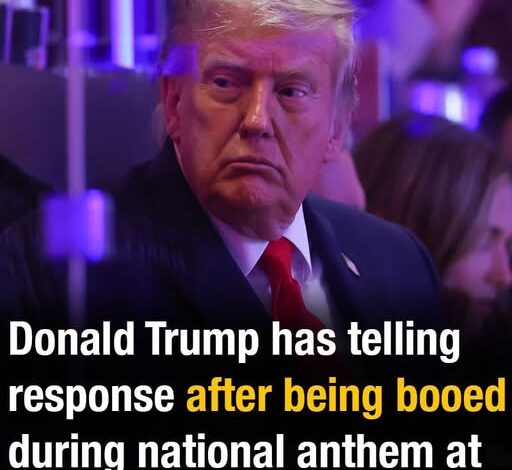
For a few unforgettable minutes, Madison Square Garden felt like far more than a basketball arena.
It felt like a snapshot of America itself.
The bright lights were the same. The packed crowd was the same. The anticipation of a major playoff game hung in the air. Yet when Donald Trump appeared on the arena’s giant screens during the national anthem, the focus abruptly shifted away from basketball.
Suddenly, the game wasn’t the only thing commanding attention.
As the anthem played, Trump stood and saluted.
The gesture was steady and deliberate.
Then came the reaction.
From different sections of the arena, boos began to emerge.
At first scattered.
Then louder.
Not overwhelming enough to drown out the entire building, but unmistakable nonetheless.
The sound rolled through the crowd, creating an uncomfortable tension that everyone in the arena seemed to feel at once.
For some spectators, the boos represented disrespect.
For others, they represented the freedom to express political disagreement in a public space.
Regardless of where people stood politically, few could deny the intensity of the moment.
It was raw.
Unscripted.
Impossible to choreograph.
And impossible to ignore.
In that instant, what should have been a routine appearance by a former president became something much larger—a public reflection of a country still deeply divided over the man who continues to dominate American politics years after leaving office.
The reaction wasn’t simply about Trump.
It was about everything attached to him.
His presidency.
His supporters.
His critics.
The controversies.
The loyalty.
The anger.
The admiration.
The exhaustion.
All of it seemed to collide inside one arena during a few brief moments of the national anthem.
Then something remarkable happened.
The Jumbotron cut away.
Trump disappeared from the screen.
In his place appeared Knicks star Jalen Brunson.
The change was immediate.
The boos vanished.
In their place came a wave of thunderous applause.
Cheers erupted throughout the building.
Fans jumped to their feet.
The arena transformed almost instantly from political tension back into sports excitement.
The contrast could not have been sharper.
One figure divided the room.
The other united it.
At least for that night.
At least for that crowd.
The moment highlighted a reality that extends far beyond basketball.
In modern America, sports stars, entertainers, and public figures often occupy very different emotional spaces than politicians. While athletes can become symbols of shared pride and collective identity, political leaders increasingly serve as lightning rods for conflict.
The shift from boos to cheers wasn’t merely about individual personalities.
It was about what each person represented.
Brunson symbolized basketball.
Competition.
Team pride.
A common cause for thousands of fans gathered in one place.
Trump symbolized something far more complicated.
Years of political battles.
Cultural divisions.
National debates that continue to shape conversations far beyond election cycles.
Outside Madison Square Garden, the atmosphere reflected that complexity as well.
Security measures had been noticeably heightened.
Road closures affected traffic patterns.
Law enforcement maintained a visible presence.
Reports of adjusted plans and canceled gatherings underscored a reality familiar to anyone following Trump’s public appearances in recent years.
Wherever he goes, politics follows.
Crowds form.
Opinions collide.
Arguments emerge.
Supporters and opponents often arrive carrying entirely different interpretations of the same event.
Inside the arena, however, Trump remained outwardly unchanged.
Despite the reaction, he showed little visible response.
No confrontation.
No acknowledgment.
No sign of irritation.
His expression remained largely fixed, his posture unchanged as the moment unfolded around him.
That composure became part of the story itself.
Observers interpreted it in different ways.
Some viewed it as confidence.
Others saw calculation.
Some believed it reflected resilience developed through years of political controversy.
Others questioned whether it represented detachment from criticism.
As with so much surrounding Trump, the meaning seemed to depend largely on the viewer.
And perhaps that was the most revealing aspect of the entire episode.
The moment acted as a mirror.
Not only reflecting opinions about one political figure, but revealing broader truths about the country itself.
Two people could witness the same scene and walk away with entirely different conclusions.
One might see courage.
Another might see division.
One might see patriotism.
Another might see polarization.
The event itself remained unchanged.
Only the interpretation shifted.
That reality has become increasingly common in modern American life.
Politics no longer stays confined to campaign rallies, debates, or election seasons.
It appears at sporting events.
Award shows.
Concerts.
Universities.
Restaurants.
Social media feeds.
And nearly every public gathering where large groups of people come together.
The boundaries between entertainment, culture, and politics have grown increasingly blurred.
As a result, moments like the one at Madison Square Garden resonate far beyond the walls of a single arena.
They become symbols.
Conversation starters.
Arguments waiting to happen.
By the time the game began, attention gradually returned to basketball.
The crowd settled.
The players took center stage.
The arena once again focused on the reason everyone had gathered there in the first place.
Yet the brief exchange during the anthem lingered in memory.
Not because it changed anything.
Not because it resolved any debate.
But because it captured something familiar.
A nation still wrestling with itself.
Still divided over its leaders.
Still searching for common ground while arguing about where that ground even exists.
And standing quietly in the middle of it all was a former president whose very presence continues to provoke powerful reactions from every corner of the political spectrum.
Whether the moment reflected strength, indifference, discipline, or simply experience is ultimately a matter of interpretation.
What is harder to dispute is what the scene revealed.
A basketball game became a political flashpoint.
A crowd became a reflection of a divided electorate.
And for a few brief moments, Madison Square Garden wasn’t just hosting a sporting event.
It was holding up a mirror to America.
What people saw in that reflection depended entirely on where they were standing.