Terrified Grocery Shopper Discovers Horrifying Object Hidden Inside Sealed Pack Of Breakfast Bacon

A quick trip to the grocery store is one of the most ordinary errands in modern life. Most of us walk through brightly lit aisles without giving much thought to the journey our food has taken before reaching the shelves. We trust labels, packaging, inspections, and familiar brand names to assure us that what we are buying is clean, safe, and exactly what we expect it to be. Rarely do we stop to consider the complex process behind every package of meat, dairy product, or prepared food sitting neatly in refrigerated displays.
For one shopper, however, a routine breakfast purchase became an experience they would never forget.
What began as a simple plan to cook bacon on a quiet afternoon quickly turned into a startling reminder of how disconnected many consumers have become from the realities of food production.
The day itself was entirely unremarkable.
After a brief stop at a local supermarket, the shopper returned home with a small bag of groceries and began putting everything away. Like countless people preparing a quick meal, they reached into the refrigerator, grabbed a freshly purchased package of bacon, and started getting ready to cook.
The package looked perfectly normal.
The bacon was vacuum-sealed, neatly arranged, and appeared no different from any other package they had purchased before. There was no reason to suspect anything unusual.
But the moment the plastic seal was cut open, something immediately felt off.
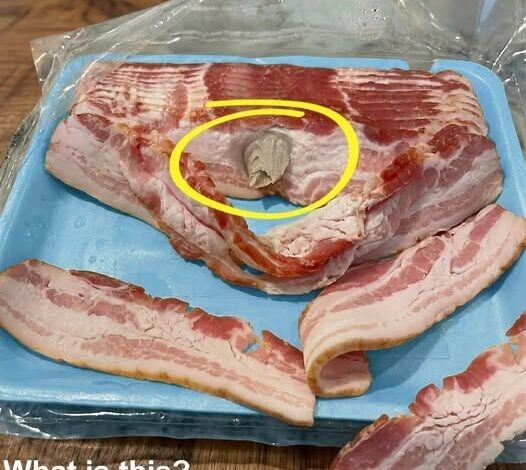
Nestled among the familiar layers of pink meat and white fat was a pale, oddly shaped object that seemed completely out of place. It was dense, solid, and noticeably different from the surrounding bacon. Unlike the soft texture of the meat, this material appeared firm, almost rubber-like, and strangely rigid.
The shopper paused.
At first, they wondered if their eyes were playing tricks on them.
They looked again.
The object was definitely there.
Wedged directly into the bacon slices was something that looked entirely foreign to the product.
Within seconds, curiosity gave way to concern.
Questions began racing through their mind.
Was it a piece of plastic from a processing machine?
Could it be packaging material that had somehow become trapped during manufacturing?
Was it evidence of contamination?
Or worse, was it some kind of biological abnormality that should never have made it through quality control?
Suddenly, breakfast no longer seemed important.
The more they stared at the object, the more unsettling it became.
Modern consumers are accustomed to seeing food in highly processed forms. Meat arrives trimmed, sliced, packaged, and presented in a way that feels far removed from its biological origins. Most people never encounter the raw anatomical structures that naturally exist within an animal’s body. As a result, anything unusual can immediately appear alarming.
Standing in the kitchen, the shopper felt a growing sense of unease.
They found themselves remembering stories they had read online about manufacturing mistakes, food recalls, and contamination incidents. Every possibility seemed to feel more disturbing than the last.
Unable to simply throw the bacon away without knowing what they were looking at, they decided to investigate.
They took photographs and began searching online.
For the next several minutes, they compared images, browsed consumer forums, and examined discussions involving similar discoveries. Some posts suggested manufacturing debris. Others proposed strange medical conditions. A few theories were so dramatic they only increased the shopper’s anxiety.
Eventually, however, a much simpler explanation emerged.
The mysterious object was not plastic.
It was not synthetic material.
It was not evidence of contamination.
Instead, it was a piece of cartilage.
Cartilage is a natural connective tissue found throughout an animal’s body. It helps support joints and provides structure in various areas. During processing, most cartilage is removed or trimmed away. Occasionally, however, a larger piece can remain attached to a cut of meat and pass through slicing equipment unnoticed.
In this case, that appears to be exactly what happened.
The strange object embedded within the bacon was simply a section of natural animal tissue that had escaped removal during processing.
Technically speaking, there was nothing dangerous about it.
The bacon remained safe to consume.
There was no contamination issue.
No health hazard.
No manufacturing disaster.
Yet despite receiving a perfectly reasonable explanation, the shopper couldn’t shake their discomfort.
The experience had already changed the way they viewed the product.
Learning that the object was natural did not completely erase the initial shock. In some ways, it created a different kind of unease.
The discovery forced them to confront something most consumers rarely think about: the fact that meat products come from living animals.
Modern food production does an extraordinary job of separating consumers from the biological realities of what they eat. Meat is carefully processed, trimmed, cured, sliced, packaged, and marketed in forms that often bear little resemblance to the animals from which they originated.
This separation makes grocery shopping convenient.
It also makes unexpected discoveries more startling.
When a visible piece of anatomy appears in a product that is normally uniform and predictable, it disrupts the comfortable illusion that many consumers unconsciously rely upon.
Suddenly, food feels less like a manufactured commodity and more like what it actually is.
That realization can be surprisingly powerful.
The shopper later admitted that the experience left them thinking about food differently. Not because they believed anything was wrong with the bacon itself, but because the encounter highlighted how little most people know about the production process behind the products they purchase every week.
Many consumers spend years buying meat without ever seeing cartilage, connective tissue, bones, or other anatomical structures that naturally exist within animals. Processing facilities remove most of these components long before products reach store shelves.
As a result, the rare occasions when something slips through stand out dramatically.
The incident also served as a reminder of how quickly assumptions can escalate in the age of the internet.
Before finding the answer, the shopper’s imagination had generated scenarios involving contamination, equipment failure, and food safety crises. Yet the truth turned out to be something entirely ordinary.
A simple piece of cartilage.
Nothing more.
Nothing less.
Still, the experience left a lasting impression.
The next time the shopper walked through the grocery store meat department, they found themselves looking more carefully at the products on display. They weren’t frightened or suspicious. Instead, they felt more aware of the complex journey food takes before arriving in a shopping cart.
What began as a brief moment of panic ultimately became a lesson in perspective.
The mysterious object hidden inside a package of bacon wasn’t a dangerous contaminant or a manufacturing catastrophe. It was merely a reminder that behind every neatly packaged product lies a biological reality that modern consumers rarely see.
The mystery was solved with a few minutes of research.
But the experience left behind something more valuable than an answer.
It left a greater appreciation for where food comes from—and a deeper awareness of how easily we forget the realities hidden beneath the packaging.