The Impossible Flight: What Scientists Discovered After Tracking This Eagle for 20 Years Will Shatter Your Understanding of Nature

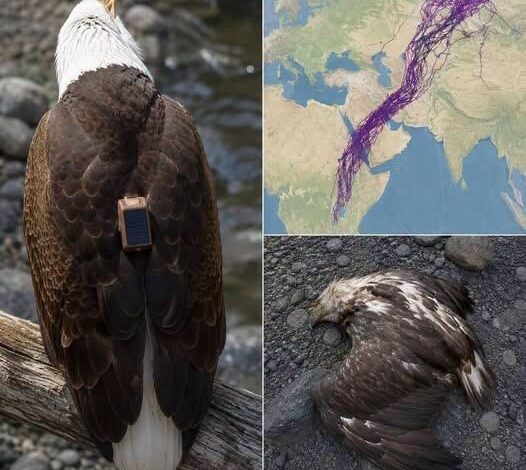
For nearly two decades, a single eagle carried a secret across thousands of miles of sky.
Scientists first attached a tracking device to the bird expecting something relatively straightforward. The goal was simple: monitor its migration patterns, collect data, and gain a better understanding of how large birds navigate between breeding grounds and feeding territories.
It was the kind of long-term wildlife study researchers conduct around the world every year.
Routine.
Predictable.
Useful.
Or so they thought.
What followed would challenge assumptions about animal behavior and force researchers to reconsider how much humans truly understand about the natural world.
From the very beginning, the eagle refused to cooperate with expectations.
Instead of following the familiar migration routes scientists anticipated, the bird seemed to wander unpredictably. Its path zigzagged across enormous distances. It revisited places it had already left behind. It lingered for days or weeks in remote regions that appeared to offer little food or shelter.
At times, it changed direction abruptly.
At others, it traveled far beyond areas where researchers expected it to go.
The data looked messy.
Confusing.
Almost irrational.
As months turned into years, the mystery only deepened.
Most migratory animals follow patterns that can be identified relatively quickly. Researchers expected the eagle’s movements to reveal familiar seasonal rhythms and recognizable routes.
Instead, every new dataset seemed to create more questions.
Why was the bird wasting energy by taking such indirect paths?
Why return repeatedly to isolated locations?
Why ignore routes that appeared faster and more efficient?
The more scientists studied the tracking records, the less sense they seemed to make.
Naturally, researchers began searching for explanations.
Perhaps the eagle was injured.
Perhaps it suffered from a neurological problem affecting navigation.
Maybe environmental contamination had altered its behavior.
Could disease be interfering with its instincts?
Some even wondered whether the tracking equipment itself was malfunctioning.
One possibility after another was examined.
Yet every explanation fell apart under scrutiny.
The tracking devices proved accurate.
The bird remained healthy.
Its survival rate was exceptional.
Year after year, it continued thriving despite behavior that appeared, from a human perspective, strangely inefficient.
The contradiction became impossible to ignore.
If the eagle was making poor decisions, why was it so successful?
Eventually, the research team made a crucial shift.
Instead of asking why the eagle was behaving incorrectly, they began asking a different question:
What if the eagle wasn’t wrong at all?
What if humans were measuring the wrong things?
That change transformed the entire investigation.
Rather than forcing the bird’s movements into existing migration models, scientists started examining environmental factors that traditional studies often overlooked.
They compared the eagle’s route with weather records.
Wind patterns.
Atmospheric pressure systems.
Thermal activity.
Magnetic fluctuations.
Regional climate data.
At first, the connections were subtle.
Then they became impossible to dismiss.
What appeared random from above began revealing an astonishing level of structure.
Locations that had seemed barren and purposeless suddenly made sense.
Remote desert regions where the eagle repeatedly paused were often generating powerful thermal columns—rising currents of warm air created by sunlight heating uneven terrain.
These invisible elevators allowed the bird to gain altitude without expending significant energy.
By riding the thermals, the eagle could travel enormous distances while conserving strength.
What looked like unnecessary detours were actually strategic opportunities.
The same pattern emerged elsewhere.
Over oceans and coastal regions, dramatic changes in direction frequently aligned with powerful wind systems and high-altitude air currents.
Rather than fighting against environmental forces, the eagle was using them.
It adjusted constantly.
Adapted continuously.
Responded to opportunities invisible to human observers standing on the ground.
The bird wasn’t wandering.
It was optimizing.
Every apparent deviation served a purpose.
Every pause offered an advantage.
Every course correction reflected information humans had failed to consider.
The realization transformed years of confusing data into something remarkable.
The eagle wasn’t navigating according to fixed routes alone.
It was reading the environment in real time.
Weather.
Geography.
Air movement.
Thermal energy.
Invisible conditions shifting from day to day and season to season.
Its migration wasn’t based solely on destination.
It was based on opportunity.
The implications extended far beyond a single bird.
Researchers began questioning how many other species might possess similar abilities.
How much environmental information do animals perceive that humans rarely notice?
How many survival strategies remain hidden because we lack the senses necessary to detect the signals guiding them?
For centuries, humans have measured intelligence through human standards.
Problem-solving.
Language.
Technology.
Planning.
But nature frequently demonstrates forms of intelligence that look very different from our own.
The eagle’s journey suggested a deeper possibility.
Perhaps animals are not simply reacting to their environment.
Perhaps they are interpreting it in ways we barely understand.
Evolution has spent millions of years refining survival systems far older than human civilization itself.
Creatures that depend on migration, hunting, and environmental awareness may be processing subtle information with extraordinary sophistication.
Magnetic fields.
Air pressure changes.
Thermal patterns.
Environmental cues too faint or complex for human perception.
What appears chaotic to us may actually represent a highly advanced form of adaptation.
The study also revealed something profound about the limits of human understanding.
People naturally seek simple explanations.
We like predictable models.
Straight lines.
Clear rules.
Neat conclusions.
But nature often resists simplicity.
Its systems are layered, interconnected, and dynamic.
The eagle became a reminder that complexity is not the same thing as disorder.
Sometimes what appears random is merely operating according to rules we have not yet learned to recognize.
For nearly twenty years, researchers believed they were studying migration.
In reality, they were studying perspective.
The bird they initially suspected might be lost was navigating with extraordinary precision.
The routes that seemed inefficient were often brilliant.
The decisions that looked irrational were deeply logical.
The mystery existed not in the eagle’s behavior, but in humanity’s limited ability to interpret it.
By the end of the project, the eagle had become something more than a research subject.
It became a symbol.
A symbol of resilience.
Adaptation.
Hidden intelligence.
And the countless lessons nature still has left to teach.
Its long journey across continents demonstrated that survival is not always about following the shortest path or adhering to a fixed plan.
Sometimes survival depends on flexibility.
On reading subtle changes.
On recognizing opportunities invisible to others.
Most importantly, the eagle’s story reminds us that the natural world remains filled with mysteries.
Even after centuries of scientific discovery, there are still forces, relationships, and forms of knowledge operating beyond the boundaries of human understanding.
The bird never changed its behavior.
The scientists changed their perspective.
And in doing so, they uncovered a truth far more fascinating than the one they originally set out to find:
Nature often knows exactly what it is doing long before we understand why.