She Bought a $5 Storage Unit Filled With Junk — What Her Family Found Inside Transformed Their Future Posted onFebruary 14, 2026 Byadmin

Five dollars.
That was all Alicia Morales had left to gamble on hope.
Not hope in the way people usually mean it—not dreams of striking it rich or stumbling across a hidden fortune. Her version of hope was much smaller and far more urgent. It was the hope of finding something, anything, that might help her children get through another week.
The February wind swept through Tulsa with a bitter edge, cutting through coats that weren’t warm enough and finding every gap in the aging sedan that had become Alicia’s second home. For nearly three weeks, she and her two children had been living between that car and a budget motel on the outskirts of town.
It hadn’t happened all at once.
Disasters rarely do.
First, the diner where Alicia worked as a waitress shut down unexpectedly after the owner declared bankruptcy. What was supposed to be a temporary closure became permanent. Then came the missed rent payment. Then another. Her old Honda developed transmission problems she couldn’t afford to fix. Bills piled up faster than she could manage them.
Within a month, the life she had spent years carefully building had collapsed.
Now, every day revolved around survival.
Finding affordable meals.
Stretching the last dollars in her account.
Keeping her children reassured even when she felt terrified herself.
Twelve-year-old Mateo tried to act brave for his younger sister, Sofia, but Alicia could see the worry in his eyes.
Children always know more than adults think.
That particular afternoon, Alicia wasn’t looking for miracles.
She was simply trying to stay warm.
While driving through an industrial section of Tulsa, she noticed a crowd gathered outside a storage facility. A large banner announced a public storage auction. Curious, she parked nearby and walked over.
Maybe it was boredom.
Maybe it was desperation.
Maybe it was the small voice inside her refusing to give up.
Whatever the reason, she stayed.
The auctioneer moved quickly from unit to unit.
Some attracted enthusiastic bidding.
Others barely received attention.
Alicia watched from the back, hands buried in her jacket pockets.
Then they reached Unit 27.
The metal door rolled upward with a loud rattle.
Nobody looked impressed.
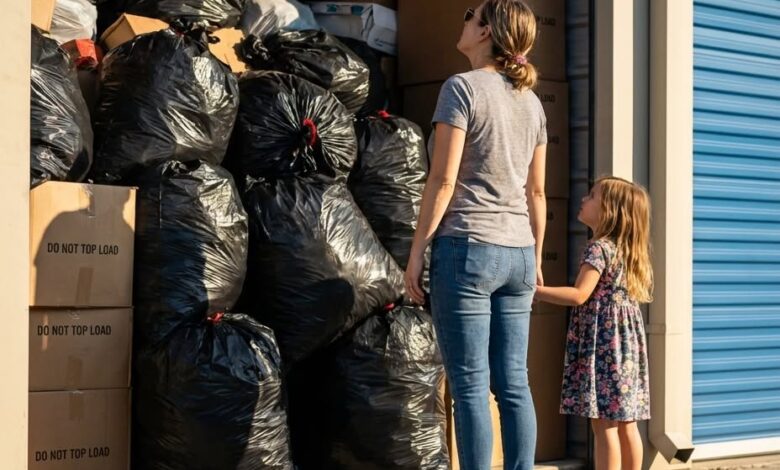
Inside sat what appeared to be a collection of worthless junk accumulated over decades.
Broken furniture.
Water-damaged mattresses.
Rusted lamps.
Cardboard boxes sagging from moisture.
A stained recliner with torn upholstery.
The crowd immediately lost interest.
Several bidders laughed and moved away.
The auctioneer tried to generate excitement but failed.
The bids stalled almost instantly.
Ten dollars.
Nothing.
Eight dollars.
Still nothing.
Five dollars.
Silence.
The auctioneer glanced around.
“Anybody?”
Alicia looked at the unit.
Then at her children.
Then back at the unit.
She didn’t see treasure.
She didn’t see opportunity.
She saw one final chance to try something.
Anything.
Before she could talk herself out of it, her hand went up.
“I’ll take it.”
The auctioneer nodded.
“Sold.”
Just like that, Unit 27 belonged to her.
Mateo groaned immediately.
“Mom, we just paid five dollars for garbage.”
Alicia smiled weakly.
“Maybe.”
But even she wasn’t convinced.
The following morning, reality arrived quickly.
The facility manager reminded her that auction winners had forty-eight hours to clear out their units.
Every item.
No exceptions.
So Alicia, Mateo, and Sofia got to work.
For hours, Mateo’s prediction seemed accurate.
The unit was filled with junk.
Old newspapers.
Broken tables.
Moldy blankets.
Damaged household items nobody would ever buy.
Dust coated everything.
The air smelled stale.
By midday, frustration was beginning to replace optimism.
Even Alicia wondered whether she had made a mistake.
Five dollars wasn’t much.
But right now, every dollar mattered.
Then Sofia found something unusual.
“Mom?”
Her voice echoed from the back corner.
“What’s this?”
Buried beneath several layers of old blankets sat a large oak trunk.
Unlike everything else in the unit, it appeared well cared for.
Heavy.
Solid.
Deliberately protected.
Alicia knelt beside it and brushed away years of dust.
The brass lock had long since broken.
Slowly, she lifted the lid.
Inside was an entirely different world.
Neatly bundled documents.
Leather-bound journals.
A velvet pouch.
Several wrapped packages.
Everything organized carefully, as though someone had intended it to survive.
Mateo immediately reached for the pouch.
Coins spilled into his hands.
Old silver coins.
Dozens of them.
Alicia examined the dates.
Many were from the early 1900s.
Some appeared even older.
Then Sofia pointed toward another bundle.
Wrapped carefully in faded cloth rested a violin.
The moment Alicia uncovered it, she knew it was special.
She couldn’t explain why.
She wasn’t a musician.
She knew almost nothing about instruments.
But this violin looked different.
Elegant.
Beautifully crafted.
Preserved despite decades in storage.
For the first time, the unit no longer felt like garbage.
It felt like a mystery.
A story waiting to be told.
The following week brought a series of discoveries Alicia never could have imagined.
An antique dealer examined the coins first.
His eyes widened immediately.
Several were rare collectible pieces.
Some carried values in the thousands.
Others were worth even more.
Then came the violin.
A specialist spent nearly an hour studying the instrument.
When he finally looked up, he seemed stunned.
“This isn’t ordinary,” he said.
“It was handcrafted in Italy sometime during the 1920s.”
Alicia stared at him.
“What does that mean?”
“It means,” he replied carefully, “that this violin is worth a great deal of money.”
Enough money.
Those two words changed everything.
Enough money to leave the motel.
Enough money to repair transportation.
Enough money to breathe again.
Enough money to give her children stability.
For the first time in months, the future looked possible.
But that evening, something unexpected happened.
Alicia began reading the journals.
And suddenly, the treasure felt different.
The journals belonged to a man named Leonard Whitaker.
Page after page documented his life.
His arrival in America.
His struggles as an immigrant.
His dreams.
His failures.
His love of music.
Most of all, his violin.
The instrument wasn’t simply valuable.
It had been his companion.
His comfort.
His greatest joy.
As Alicia continued reading, Leonard became more than a name.
He became a person.
A real human being whose life had somehow been packed into a forgotten storage unit.
The final journal entry stopped her cold.
His handwriting had grown shaky.
The words carried unmistakable sadness.
He wrote about losing his home.
About growing older.
About watching pieces of his life disappear one by one.
Then came a final sentence Alicia would never forget:
“If someone someday finds these things, I hope they understand that the violin was always my greatest treasure. Not because it was worth money, but because it carried every piece of my heart.”
Alicia closed the journal.
Silence filled the room.
The violin sat nearby.
Suddenly, selling it felt different.
Not impossible.
But different.
The next morning, she made a decision.
One that surprised even her children.
She sold the coins.
The proceeds secured an apartment deposit.
Reliable transportation.
Food.
Stability.
A future.
But the violin stayed.
Instead of auctioning it, Alicia contacted a local community center that offered free music lessons to underprivileged children.
When she explained Leonard’s story, the center’s director became emotional.
The violin was donated.
Not stored away.
Not sold to a private collector.
Not locked inside someone’s display case.
Played.
Loved.
Shared.
Exactly as Leonard would have wanted.
The gesture created consequences Alicia never expected.
The director, deeply moved by her decision, offered her a position helping coordinate programs at the center.
It wasn’t glamorous.
But it was steady.
Meaningful.
Reliable.
For Alicia, it represented another fresh start.
Months later, she found herself sitting inside a small auditorium.
Beside her sat Mateo and Sofia.
On stage, a young student walked forward carrying a familiar instrument.
Leonard’s violin.
The room fell silent.
Then the music began.
Beautiful.
Clear.
Alive.
The notes filled the auditorium and seemed to travel beyond the walls themselves.
Alicia listened quietly.
She thought about the storage unit.
The motel.
The cold nights.
The fear.
The uncertainty.
The five-dollar bid that had felt almost foolish at the time.
She thought about Leonard.
A man she had never met.
A man whose life had somehow intersected with hers decades later.
And as the music continued, she realized something important.
The true treasure had never been the coins.
It wasn’t even the violin.
It was the opportunity hidden inside both.
A second chance.
For her family.
For Leonard’s legacy.
For children who now had access to music they otherwise might never have experienced.
The storage unit had looked like junk to everyone else.
Broken furniture.
Damaged mattresses.
Worthless debris.
But hidden beneath all that clutter was something priceless.
Hope.
Not the kind you buy.
Not the kind you inherit.
The kind you discover when you refuse to stop believing that better days are still possible.
Alicia had arrived at that auction searching for a way to survive.
She left with something much greater.
A home.
A future.
A career.
And the knowledge that sometimes the most valuable things aren’t what we keep.
They’re what we choose to pass on.
As the final note echoed through the auditorium, Alicia smiled.
The violin had found its voice again.
And so had she.