I was burned all over my body after saving my little sister from a house fire when she was ten. Years later, I came to her wedding in a wheelchair, and she whispered, “Go sit in the back. You’re ruining my perfect wedding.”

I had burns across almost my entire body because, at seventeen, I ran into a burning house to save my ten-year-old sister.
Twelve years later, at her wedding, she leaned toward me and whispered, “Move to the back. You’re ruining the pictures.”
Then the groom’s mother stood and said five words that stopped the ceremony.
“She saved your life, Emily.”
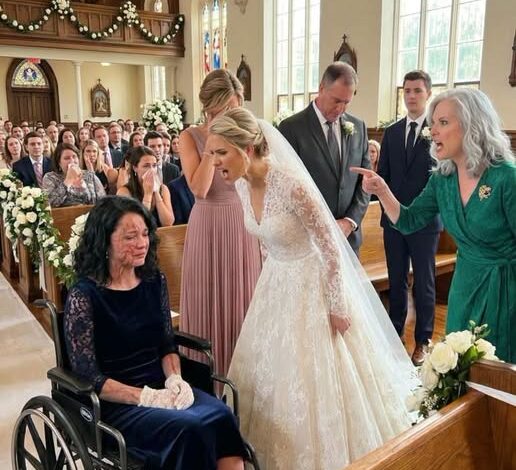
The church in Charleston smelled of white roses, polished wood, and expensive perfume. I sat beside the second pew in my wheelchair, careful not to block the aisle. Ivory gloves covered my scarred hands, and the long sleeves of my navy dress concealed most of the grafts along my arms.
The rest could not be hidden.
Scars climbed my neck, crossed half my face, and disappeared beneath the fabric at my shoulders. Guests tried not to stare. Some failed.
At the altar, my sister Emily looked flawless in a pearl-white gown. Colored light from the stained-glass windows surrounded her like something holy.
Watching her, I remembered carrying her through smoke.
Our parents had been outside screaming. Firefighters were still minutes away. Emily was trapped upstairs beneath a fallen curtain, clutching a stuffed rabbit.
I wrapped myself around her and crawled toward the stairs while the house burned around us.
She escaped with one small scar near her shoulder.
I survived with a body strangers whispered about.
Before the ceremony began, Emily walked toward me with a photographer trailing behind her. Her smile stayed fixed until she bent close, pretending to kiss my cheek.
“Go sit in the back,” she whispered. “You’re ruining the atmosphere.”
I stared at her.
“People keep looking at your chair and your scars. This is supposed to be perfect.”
Behind her, our mother suddenly became fascinated by the flowers. Our father stared straight ahead.
Neither defended me.
My hands settled on the wheels.
Then Margaret Callahan, the groom’s mother, rose from the front row.
The organist stopped mid-note.
Margaret was tall, silver-haired, and dressed in deep green silk. She looked first at Emily, then at my parents, and finally at me.
“She saved your life, Emily.”
Silence swallowed the church.
Emily’s face changed. For an instant, she looked ten years old again—frightened and exposed.
Then she recovered.
“Margaret misunderstood,” she said.
“No,” Margaret replied. “I heard every word.”
Daniel, the groom, turned toward Emily.
“What did you say to Claire?”
“Nothing important.”
Margaret stepped into the aisle.
“Twenty years ago, I was an emergency-room nurse at St. Anne’s,” she told the congregation. “I worked the night Claire Whitmore arrived after the Laurel Street fire.”
My breath caught.
Margaret continued.
“She was seventeen and burned across most of her body. Whenever she regained consciousness, she asked the same question.”
Daniel looked at her. “What question?”
Margaret faced Emily.
“She asked, ‘Is my sister alive?’”
The room seemed to tilt.
For years, my family had told the fire as Emily’s survival story. Then, when my scars became uncomfortable, they stopped telling it altogether.
Daniel stepped away from the altar.
“Emily, did you ask Claire to move?”
My sister’s chin lifted.
“This is my wedding.”
“That isn’t an answer.”
“People were staring,” she snapped. “This day is supposed to be beautiful.”
Daniel’s expression hardened.
“Beauty is not what I thought you meant.”
Every face turned toward me.
“Claire,” he asked carefully, “did she say those things?”
Emily met my eyes.
I knew what she wanted.
She wanted me to protect her again.
That had always been my role.
Protect Emily from guilt. Protect Mom from shame. Protect Dad from choosing sides. Protect the family from any truth that made dinner uncomfortable.
But I was tired.
“Yes,” I said.
The microphone near the minister carried that one word through the sanctuary.
Emily’s shoulders dropped.
“I was stressed,” she said quickly. “The flowers were wrong. The photographer kept complaining about balance. I wanted one day when everyone looked at me instead of her.”
There it was.
The truth I had felt for years.
At twelve, Emily had been grateful.
At thirteen, guilty.
By fifteen, resentful.
Eventually, she began treating my scars as if they were something I had done to her.
Daniel stared at her.
“Instead of Claire?”
“You don’t understand,” Emily cried. “Everything after the fire was about her surgeries, her pain, her recovery. She became the hero, and I became the reason everyone whispered.”
My father finally stood.
“That is enough. This is a private family matter.”
For one foolish second, I thought he meant to defend me.
Instead, he looked at Margaret.
“Claire has always been sensitive.”
The word struck harder than Emily’s whisper.
Sensitive was what they called me when children pointed at my face.
Sensitive when Emily joked about my “Halloween hands.”
Sensitive when my mother asked me to wear long sleeves because my scars made people uncomfortable.
I locked the brakes of my wheelchair.
The click echoed through the church.
“I was not sensitive when I entered that house,” I said.
My father stared at me.
“I was not sensitive when my skin was burning. I was not sensitive during the grafts, infections, or months when nurses had to turn me because I could not move.”
Emily covered her mouth.
“I became sensitive when I asked this family to treat me like a person instead of a reminder.”
No one interrupted.
I faced my sister.
“I never asked you to spend your life thanking me. I came today because I loved you. I wore this dress because Mom said navy matched your colors. I wore gloves because you once told me my hands embarrassed you in photographs.”
My voice shook.
“I sat where the usher placed me. I smiled while people stared. And somehow, I was still too much.”
Daniel slowly removed his boutonniere.
Emily reached for him.
“Please don’t do this.”
“I can’t continue today,” he said.
“One mistake?” she cried. “You’re ending our wedding over one mistake?”
Margaret answered quietly.
“A mistake is spilling wine. This is a pattern.”
The minister closed his book.
Emily looked at me with fury and humiliation.
“Are you happy now?”
The old Claire would have apologized.
She would have tried to repair the wedding her sister had shattered.
But that woman had spent too long making herself smaller.
“No,” I said. “I’m free.”
I released the brakes and moved into the aisle.
People stepped aside.
For once, not from pity.
From respect.
Outside, Daniel caught up with me.
“I’m sorry,” he said. “I believed what was easiest.”
“You didn’t know.”
“I should have wanted to.”
It was the first honest apology I received that day.
Margaret joined us beneath the church entrance.
“I remembered you,” she said. “A burned girl asking whether her sister was alive before asking about herself.”
Her words returned something my family had taken from me: the truth of who I had been.
The wedding was eventually canceled.
Emily entered therapy. For months, her messages sounded rehearsed and formal. I did not rush to comfort her simply because guilt had finally become painful.
A year later, we met at a quiet café.
There were no cameras, flowers, or guests.
“I’m not asking you to forgive me,” she said.
That surprised me.
“My therapist asked what I lost in the fire. I said safety and childhood. Then she asked what you lost.”
Emily’s eyes filled.
“You lost your body as you knew it. Your independence. Your privacy. And afterward, I helped take your family from you.”
I remained silent.
For once, she did not ask me to save her from discomfort.
“I was jealous of someone I should have grieved for,” she whispered. “I made your sacrifice into my burden because admitting I survived through your suffering was too painful.”
Her apology did not erase anything.
But it was honest.
“I believe you’re sorry,” I said.
She nodded.
“That’s where we start.”
And it was a start—not a miracle.
Our parents remained complicated. My mother apologized in fragments. My father eventually wrote, “I failed you whenever silence felt easier.”
I kept the letter, but I did not frame it.
Margaret became part of my life. She encouraged me to speak to nursing students and hospitals about dignity, trauma, and what happens after people survive the part everyone calls heroic.
I stopped wearing gloves unless I wanted to.
I allowed my hands to be seen.
I stopped sitting in the back.
My favorite photograph was taken at Margaret’s retirement dinner. She sat beside me laughing, her hand resting over mine. No one tried to hide my scars. No one asked me to make myself easier to look at.
For years, I believed the fire had stolen my place in the world.
It had not.
The fire changed my body.
Other people tried to take my place.
And on my sister’s wedding day, when five words silenced an entire church, I finally began taking it back.