They Divided My Father’s House Car And Savings Then Gave Me The One Thing They Thought Was Worthless

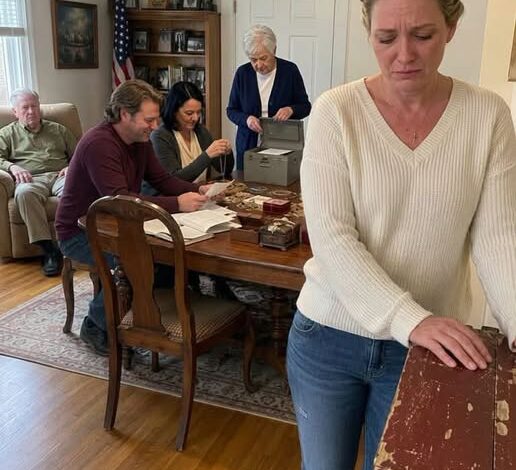
The wardrobe should not have weighed that much.
Its doors were warped, one leg had split near the base, and years of damp air had swollen the wood until the faded cherry-red paint peeled away in brittle flakes. It looked ready to collapse under its own age.
Yet when my uncle and I lifted it toward the bed of my truck, it felt as though someone had packed the entire thing with stones.
“Good Lord,” Uncle Robert grunted as we lowered it onto the moving blankets. “Did your father hide bricks in this thing?”
I barely heard him.
I was looking toward the porch.
My mother stood behind the railing with both hands wrapped around it. Her knuckles were white. Forty days had passed since Dad’s funeral—forty days of sympathy cards, reheated casseroles, and rooms that still carried traces of his aftershave.
But she did not look grief-stricken.
She looked terrified.
From inside, my sister Sarah called, “If Daniel changes his mind, leave it by the alley. Just don’t bring that ugly thing back.”
My older brother, Michael, remained at the kitchen table without lifting his head.
I closed the tailgate.
Uncle Robert rode with me back to Columbus. For several miles, he watched the suburbs pass in silence.
Then he said, “Your father never let anyone move that wardrobe.”
“I remember.”
As a child, I had once reached inside it for a hammer. Dad slapped my hand away—not hard, but fast enough to startle me.
“Never take anything from there without asking.”
Later, he came to my bedroom carrying a powdered doughnut wrapped in a paper towel. That was how he apologized when words failed him.
He set it beside me and said, “Some things are kept because you don’t want the wrong people touching them.”
At the time, I thought he meant his tools.
Now, with the wardrobe thudding in the truck bed, I wondered what else he had been protecting.
Uncle Robert glanced at me.
“Your mother didn’t want you taking it.”
“You noticed?”
“I knew her before you were born. When she’s frightened, she bites the inside of her lip.” He paused. “Don’t start a war until you know what you’ve brought home. Your father wasn’t the kind of man who left loose ends while vultures circled.”
At my apartment, we wrestled the wardrobe into the spare room. After Robert left, I opened both doors.
Inside were mothballs, bent hangers, old receipts, nails, pocketknives, and a rusted measuring tape.
Nothing remarkable.
Then I reached the bottom drawer.
It stopped halfway.
When I removed it from its rails, I discovered several inches of missing depth. A thin seam ran across the back panel, nearly invisible beneath the wood grain.
Behind it was a hidden compartment.
Inside lay a yellowed envelope, a small black ledger, and a brass key wrapped in electrical tape.
The envelope was addressed in my father’s unsteady handwriting.
For Daniel.
I sat on the floor before opening it.
If you are reading this, I am gone. I did not leave you this wardrobe because I pitied you. I left it because you understand the difference between old and worthless. Of my three children, you were the one who stayed when hospitals became inconvenient. The notebook contains truths your mother does not fully know and your brother and sister prefer to forget. Do not let them replace the truth with a version that benefits them.
My hands tightened around the paper.
The ledger contained dates and exact amounts.
Ten thousand dollars for Michael’s house deposit. Repaid: zero.
Sarah’s graduation expenses.
Michael’s attorney after his drunk-driving arrest.
Repairs, vacations, car payments, business withdrawals.
Then one entry stopped me.
Daniel paid for new refrigerator. Six hundred dollars. Asked me not to record it. Recording it anyway.
All my life, Mom had insisted that families did not keep score.
Dad had kept one.
Not for revenge.
For memory.
A strip of blue painter’s tape marked another page.
Read the second envelope.
I reached deeper into the compartment and found a thicker packet containing a notarized statement, a certified deed, and another key.
The documents concerned the rear lot behind my parents’ house—a neglected strip of weeds, broken machinery, and rusted scrap everyone called “the back.”
Dad had purchased it separately in 1998 using compensation from an accident that had crushed two fingers and kept him from work for almost a year.
The lot was never part of the main property.
And he intended it for me.
His statement described it as repayment for years of financial help and care my siblings had never shared.
At the bottom was one final note.
Do not fight for affection from people who only value convenience. But do not walk away empty-handed merely to avoid noise. Some silences are peace. Others are permission.
The next morning, Sarah called before seven.
“Mom says you need to return the wardrobe. She remembered some insurance papers are inside.”
I nearly laughed.
“Did she?”
“Michael can pick it up.”
“It’s staying here.”
A pause.
“And the papers?”
There it was.
“I’ll review everything carefully.”
“Don’t make this difficult, Daniel.”
I ended the call.
By noon, I had nine missed calls. Michael sent one message.
If you found something, we handle it as a family.
Now they remembered that word.
That afternoon, I took the documents to Mr. Henderson, a retired attorney and longtime friend of Dad’s. He studied every page on his porch.
When he finished, he removed his glasses.
“Your father knew exactly what he was doing.”
“Is it valid?”
“Strong enough to stop any sale. Verify the original deed with the county recorder, but if your family is already panicking, they know there’s something worth recovering.”
When I returned home, Michael was waiting outside my apartment.
“Mom is upset,” he said.
“She should be. She promised you property that wasn’t hers.”
His eyes shifted.
“What did you find?”
“Interesting. Yesterday it was junk.”
He stepped closer.
“No lawyers. We settle this privately.”
“They weren’t family favors when the money only traveled one way.”
I unlocked my door but did not invite him inside.
Then I saw Mom getting out of his SUV.
She had not come to visit.
She had come to retrieve evidence.
I let her in because she was still my mother.
She sat on my secondhand sofa with her handbag clutched against her stomach.
“I know what was inside,” she admitted.
“Then you know why you’re not getting it back.”
Tears gathered in her eyes.
“Your father hid things from me.”
“I believe you.”
And I did.
She may not have created every inequality, but she had spent decades defending them.
“What do you want?” she asked.
“The rear lot. Nothing more. And I want everyone to stop calling greed grief.”
She left without agreeing.
She also stopped asking for the wardrobe.
Weeks later, county records confirmed everything. The rear parcel had been purchased separately and registered only in Dad’s name.
Michael tried intimidation first, then nostalgia. He invited me for drinks and talked about childhood vacations as though memories could erase legal documents.
Sarah mostly stayed silent, probably afraid of what else the ledger contained.
I showed it to no one.
Dad had taught me that information did not have to become humiliation to become leverage.
Three months later, the estate formally transferred the lot to me.
Developers contacted me almost immediately. Their offers were large enough to make my hands tremble.
Eventually, I sold two-thirds of the land. The money erased my student debt and helped me buy a modest house of my own.
I kept the final third.
An old oak tree stood there among the rusted debris. I cleared the ground, hired an arborist, and placed a bench beneath its branches facing east.
No plaque.
No monument.
Just a quiet place on land everyone else had dismissed as worthless.
The wardrobe now stands near the entrance of my home.
I repaired its broken leg, rehung the doors, and preserved the faded red paint. My tools are stored inside.
The ledger and letters remain in the hidden compartment.
I never discovered what the taped brass key opened.
Eventually, I accepted that not every mystery required an answer.
Sometimes at night, I remove the bottom drawer and run my fingers along the compartment Dad built decades earlier.
I think about powdered doughnuts wrapped in paper towels.
About a quiet man who struggled to say he was sorry but never forgot who showed up.
For years, I believed silence made me peaceful.
Sometimes it did.
Other times, it merely gave people permission to take more.
My father had been underestimated his entire life.
But he had watched.
He had remembered.
And in the end, he left the truth inside an old wardrobe, waiting for the one child who would recognize that something battered, faded, and overlooked could still contain enormous value.