In the Pacific Northwest, rain does not simply fall. It occupies.
It settles into the bark of cedar trees, leaks into denim jackets left hanging by doors, pools in tire ruts on logging roads, and sinks into your bones slowly enough that you stop noticing the weight until summer finally returns. Tourists imagine Washington rain as romantic — soft mist curling through evergreen forests like something from a postcard. But people who spend their lives in towns like Forks know better.
There are different kinds of rain.
Some clean.
Some nourish.
Some warn.
And then there is the kind that drowns.
The morning Sarah called me, the rain was drowning.
I remember because the mud beneath my excavator tracks looked almost black, thick as crude oil where the hillside had been carved open for the new housing development. Pine needles floated across puddles like drowned insects. Fog hung low enough to swallow the tree line entirely, leaving the world feeling unfinished around the edges.
I sat alone inside the cab of my Volvo EC950F excavator, ninety tons of steel and hydraulic fury idling beneath me. The machine vibrated through the seat into my spine with a deep mechanical rhythm I trusted more than most human voices anymore. After forty years in excavation and demolition, engines made more sense to me than people did.
Machines are honest.
They break where stress fractures form.
They fail when overloaded.
They respond to force predictably.
People crack silently.
My phone buzzed once against the dashboard.
Then again.
Then a third time.
I ignored it at first.
Work had always been the easiest place to bury emotion. Ever since my wife died twelve years earlier, I had learned how to disappear inside labor: diesel engines, concrete dust, steel cables, mud. Digging holes for other people’s futures distracted me from the emptiness waiting back home.
But something about the persistence of the vibration finally irritated me enough to answer.
“This is Elias,” I muttered.
For a second, I heard only static.
Then:
“Dad?”
Everything inside me stopped.
Sarah’s voice sounded wrong immediately — thin, strained, almost translucent with fear.
“Sarah?” I straightened so fast my lower back popped painfully. “Honey, what’s going on?”
“I’m in the pantry,” she whispered.
And suddenly every instinct I possessed sharpened at once.
“What?”
“He put cameras everywhere,” she said rapidly, voice trembling harder now. “The living room. Kitchen. Hallways. I found a blind spot behind the rice sacks in the pantry.”
My grip tightened around the phone.
“Who? Greg?”
“He hurt me.”
Three words.
Quiet.
Flat.
Devastating.
Not panic.
Not drama.
Certainty.
I closed my eyes.
“What did he do?”
“My arm.” She sucked in a painful breath. “I think it’s broken this time.”
This time.
God.
“He locked the doors,” she continued. “The electronic ones. The codes are on his phone. He said I’m on lockdown until I learn how to behave.”
Outside the excavator windshield, rain hammered the world into gray blur.
Inside me, something ancient and violent woke up.
Greg Sterling.
My son-in-law.
The architect with perfect posture and expensive watches who shook my hand five years earlier at the altar promising to protect my daughter. The same man who designed their cliffside home himself — all steel beams and imported glass overlooking the Sol Duc River like a modern fortress pretending to be art.
He used to talk about architecture the way priests talk about God.
Control.
Precision.
Perfection.
I hated him almost immediately.
Not because he was polished or wealthy. I’ve worked around rich men my entire life. Most are harmless once you understand their egos.
No, what unsettled me was the emptiness beneath his charm. He smiled correctly instead of naturally. Every conversation felt rehearsed, optimized for effect rather than connection. Like he had studied how decent men behaved and copied the surface without understanding the substance underneath.
Sarah thought I judged him unfairly.
Maybe I did at first.
Then slowly she disappeared inside that house.
First came the small things:
she stopped painting because “the fumes bothered Greg.”
Stopped visiting spontaneously because “Greg likes structure.”
Stopped laughing loudly because “Greg says neighbors can hear.”
Each change sounded harmless alone.
Together, they erased her.
The daughter I raised used to fill rooms effortlessly. She painted murals on bedroom walls without asking permission first. She danced barefoot while cooking. She cried openly during movies and laughed with her whole body.
By the third year of marriage, she moved like someone apologizing for taking up space.
And now she was whispering from a pantry.
“Did you call the police?” I asked carefully.
“I tried before.” Her voice cracked. “Greg knows the Sheriff. He donates money. He’ll tell them I’m unstable again.”
Again.
Another word that told me too much.
“He’ll punish me if they leave,” she whispered.
That sentence made my decision instantly.
Not because I distrusted law enforcement entirely.
But because I understood men like Greg.
Publicly charming.
Privately controlling.
Experts at sounding calm while destroying someone psychologically behind closed doors.
By the time police sorted truth from manipulation, Sarah might already be dead.
“Where is he right now?”
“In his study.” Her breathing quickened. “Listening to opera while working on designs.”
The image nearly made me sick.
Somewhere in that beautiful glass prison my daughter sat hiding behind bags of rice while her husband calmly designed buildings.
I looked through the excavator windshield at the enormous boom arm stretching against the rain-dark sky.
“Listen to me carefully,” I said quietly. “Stay in the pantry.”
“What are you going to do?”
I stared at the steel teeth of the bucket dripping mud.
“I’m going to work.”
The call ended.
I did not call the police afterward.
Maybe that makes me a bad man.
Maybe it makes me dangerous.
But fathers understand something the law sometimes forgets:
there are moments when waiting politely becomes its own form of betrayal.
I radioed my foreman immediately.
“Miller,” I barked. “Unhook the low-boy trailer. We’re moving the 950.”
Static crackled.
“The big excavator?” he asked incredulously. “Boss, we’re in the middle of grading.”
“I’ve got an emergency demolition contract.”
Technically, that wasn’t entirely a lie.
The drive to Greg’s property took nearly an hour. Rain battered the windshield while the massive excavator rode chained behind the semi-truck like some prehistoric beast waiting for release.
And the entire time, I kept remembering Sarah as a little girl.
Age six:
running through puddles in oversized rain boots.
Age twelve:
painting mountains on our garage wall because she said blank spaces felt lonely.
Age nineteen:
crying in my driveway after Greg proposed because she thought she’d finally found someone who understood her completely.
I wondered at what exact point love had transformed into captivity.
That question haunted me more than the rage.
Because abuse rarely begins with violence.
It begins with adjustment.
Tiny concessions.
Subtle isolation.
Carefully planted doubt.
By the time bruises appear, freedom is often already gone.
When I reached the property, Greg’s gate rose twelve feet high — black iron reinforced with steel supports hidden inside decorative masonry columns.
A gate designed not merely for privacy.
Control.
I parked the truck.
Stepped into the rain.
Unhooked the chains manually.
The excavator descended from the trailer with earth-shaking weight, hydraulic systems hissing like something alive.
Climbing into the cab felt strangely calming.
Up there, inside ninety tons of engineered force, I no longer felt helpless.
The gate waited ahead.
Most people think destruction happens through chaos.
They’re wrong.
Real demolition requires precision.
I didn’t ram the gate.
I hooked the bucket teeth carefully over the top rail and pulled backward slowly.
The metal screamed.
Masonry exploded sideways.
Iron twisted.
The entire structure peeled apart like wet paper.
And suddenly the path toward my daughter stood open.
I drove forward.
The house emerged through rain and fog at the end of the long driveway:
all glass walls and sharp geometric angles glowing against the gray sky.
Beautiful from a distance.
Cold up close.
I crushed manicured landscaping beneath the tracks without slowing. Mud sprayed across imported stone pathways while security lights flickered desperately overhead.
Then I saw movement upstairs.
Greg.
Standing inside his study frozen with a wine glass in his hand.
Even through rain and distance, I watched the exact moment fear entered him for the first time.
Because powerful men always assume systems will protect them:
money,
reputation,
law,
social status.
They never imagine ninety tons of steel ignoring those systems entirely.
The front door burst open minutes later.
Greg emerged onto the porch shouting hysterically.
“You’re insane!” he screamed. “Do you know what this landscaping cost?”
I looked down at him from inside the cab.
“Where’s my daughter?”
“Get off my property!”
I asked again.
This time quieter.
“Where is she?”
He pulled out his phone dramatically.
“I’m calling the police!”
“Go ahead,” I said calmly. “Sheriff’s twenty minutes away. I can renovate a lot in twenty minutes.”
That finally rattled him.
He stared at the excavator differently after that — not as property damage, but as threat.
“You wouldn’t dare,” he spat. “This house was featured in Dwell magazine.”
I looked at the glass walls reflecting storm clouds.
“It’s a cage,” I answered.
Then I shut the cab door.
The diesel engine roared louder.
And I went to work.
I knew the blueprints from construction years earlier. Knew where the pantry sat behind the kitchen. Knew where structural beams carried weight.
This mattered.
Because I wasn’t there to destroy blindly.
I was there to retrieve my daughter.
The bucket struck the living room glass first.
The explosion sounded like a bomb.
Glass erupted inward across leather furniture and marble floors. Steel teeth ripped through support walls while expensive artwork vanished beneath drywall dust and shattered timber.
The house groaned around itself.
And somewhere inside it, Greg ran.
I saw him sprinting through hallways looking suddenly tiny inside his masterpiece.
Good.
Let him feel trapped for once.
I advanced slowly, tearing open pathways room by room.
Precision.
Control.
Surgery.
Not rage.
The kitchen wall finally appeared.
Behind it:
the pantry.
I shut the engine down completely before touching that wall.
Silence crashed over the property except for rain tapping broken glass.
Then carefully — carefully — I pushed.
Cabinets collapsed inward.
Marble cracked.
Drywall split.
And suddenly there she was.
Curled in the pantry corner.
Hands over her ears.
Tiny against shelves of imported food.
My daughter.
I don’t remember climbing out of the excavator.
One second I stood in the cab.
The next I was ripping twisted framing apart with a crowbar screaming her name.
The pantry door jammed crooked from the shifting structure. I wedged the bar into the frame and heaved until wood exploded apart.
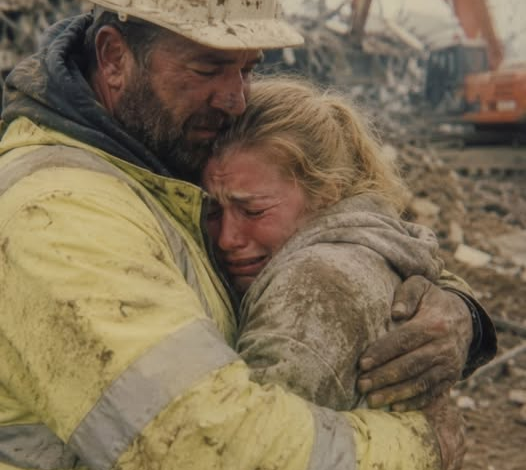
Sarah looked up at me through dust and tears.
“Dad?”
I dropped to my knees beside her instantly.
Her arm hung wrong.
Purple bruises darkened her cheek.
And all I could think was:
I should have seen it sooner.
She collapsed against me shaking violently.
“He has a gun,” she whispered.
I stood.
And then Greg appeared upstairs holding a silver handgun with trembling hands.
“You ruined my house!” he screamed.
Not:
You took my wife.
Not:
You broke in.
My house.
Even then, standing inside wreckage with police sirens beginning faintly in the distance, his first grief was property.
That told me everything.
“You broke her arm,” I said.
“She needed discipline!”
There it was.
The truth beneath every controlling man eventually:
ownership mistaken for love.
He aimed the gun downward.
“You shoot me,” I told him quietly, “and you better kill me immediately.”
Because I meant it.
Every word.
Something inside Greg recognized that truth too.
His hands shook harder.
Then slowly…
the gun lowered.
By the time deputies arrived, the property resembled a war zone:
excavator half inside the structure,
glass everywhere,
walls peeled open like torn cardboard.
Greg screamed about lawsuits while Sarah sat wrapped in blankets beside paramedics finally safe enough to cry openly.
And despite handcuffs tightening around my wrists afterward…
I felt peaceful.
Because fathers know certain things instinctively.
A house can be rebuilt.
Money returns.
Reputation heals.
But if I had waited politely for systems to catch up while my daughter remained trapped inside that place…
I would have lost something no court could ever restore.
The legal battle afterward became its own spectacle.
Property destruction.
Trespassing.
Reckless endangerment.
Until my lawyer uncovered the lease agreement.
The land beneath Greg’s architectural masterpiece had always belonged to me.
And buried deep inside the contract sat a clause terminating occupancy rights immediately if criminal abuse occurred on the property.
Technically speaking…
the moment Greg turned that house into a prison,
it became mine again.
The judge actually laughed hearing it.
Quietly.
Against her will.
Greg went to prison eventually after investigators uncovered months of surveillance footage documenting abuse, intimidation, and confinement.
And six months later, the house was gone entirely.
Not partially repaired.
Not restored.
Gone.
I demolished the rest properly afterward.
Foundation included.
Now only open land remains beside the river.
Sarah says the emptiness feels peaceful.
She paints again now.
Laughs too.
Sometimes her arm aches when rainstorms move in from the coast, but otherwise she’s healing slowly.
One evening we stood together overlooking the vacant property while sunlight finally broke through clouds for the first time in days.
“You know,” she said softly, “you still had the front door key.”
I checked my keyring.
Sure enough…
there it was.
Old brass.
Slightly tarnished.
I smiled without looking at her.
“Forgot.”
She laughed quietly.
“No you didn’t.”
Maybe she was right.
Maybe part of me wanted Greg to understand exactly what it feels like when the walls protecting power suddenly stop mattering.
Or maybe I simply trusted steel more than doors.
Either way, I would do it again.
Every single time.
Because love is not passive when danger enters the room.
It is not polite.
It is not always lawful in appearance.
Sometimes love arrives wearing mud-covered boots,
smelling like diesel fuel and rain,
driving ninety tons of yellow steel straight through the walls someone built to imprison the people you cannot live without.