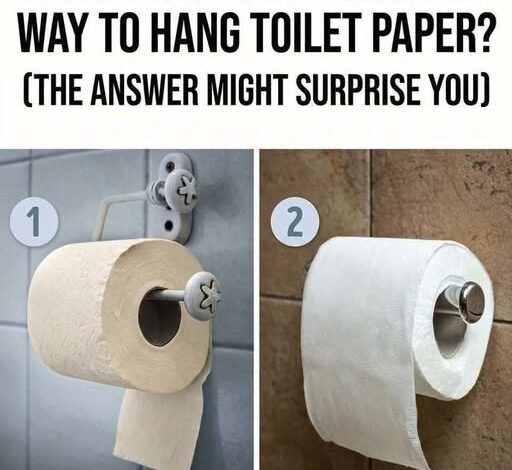
Few household debates have lasted as long—or been argued as passionately—as the question of how to hang a roll of toilet paper.
Should the loose end hang over the top?
Or should it fall under the roll?
At first glance, the disagreement seems trivial. Yet the conversation has endured for generations because it touches on something larger than bathroom habits: the small routines that shape daily life and the different ways people approach convenience, order, and shared living.
Those who prefer the under position often describe it as the more practical choice for their household. In homes with curious toddlers or playful pets, placing the paper against the wall can make it harder for little hands or paws to unravel an entire roll. Others simply prefer its tidy, understated appearance, appreciating a setup that minimizes accidental messes and keeps the bathroom looking neat.
Supporters of the over position make an equally strong case.
With the loose end visible and easy to grasp, replacing or using the roll can feel quicker and more intuitive. Many people also point to history: the original 1891 patent for the perforated toilet paper roll illustrated the paper hanging over, a detail that has become a favorite piece of evidence for those convinced their method is the “correct” one.
Of course, neither approach is objectively superior for every household.
The best choice often depends on practical considerations, personal preference, and the people sharing the space. A family with young children may value one arrangement, while someone living alone may choose another without giving it much thought.
What makes the debate so entertaining is that it isn’t really about toilet paper.
It’s about how people navigate everyday differences.
Every shared home is filled with similar decisions: where the mugs belong, how to load the dishwasher, whether the thermostat should be higher or lower, and countless other habits that seem insignificant until two people with different routines begin living together.
Successful households rarely depend on winning those arguments.
They depend on flexibility.
Sometimes one person changes the roll.
Sometimes the other changes it back.
And sometimes both realize that preserving harmony is far more valuable than proving a point.
The direction of the paper may never be universally settled.
But the conversations—and the good-natured teasing they inspire—have become part of what makes home feel human.
In the end, the real measure of a happy household isn’t whether the toilet paper hangs over or under.
It’s whether the people sharing the bathroom can smile at the disagreement, respect each other’s preferences, and remember that the strongest relationships are built not on perfect agreement, but on everyday compromise.