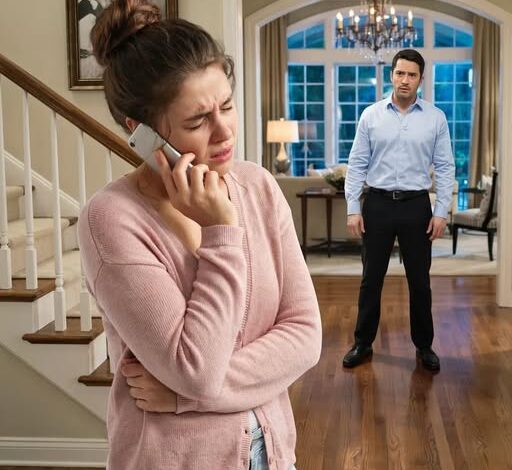
The call came at 2:00 a.m. on a freezing Tuesday in February.
My phone rang once, and I was awake before the second ring.
That’s what happens when you’ve spent decades being a father. Some sounds never stop commanding your attention.
My daughter’s name glowed on the screen.
Emma.
I answered immediately.
“Dad.”
Her voice was barely audible, a fragile thread stretched so thin I was afraid it might break.
“Dad, I need you to come. Please. I need you right now.”
I was already reaching for the lamp.
“Where are you?”
“At home.”
A pause.
“Derek’s here.”
Something in the silence that followed chilled me more than her words.
I heard fear.
Not panic. Not hysteria.
Fear that had been contained for so long it had become careful.
Measured.
Controlled.
The kind of fear that learns how to survive.
Then she whispered:
“They won’t let me leave.”
My grip tightened around the phone.
“Who won’t?”
Another pause.
Then her voice cracked.
“Dad… I think if I try to leave by myself, something bad is going to happen.”
Every instinct inside me came alive.
Questions flooded my mind.
The bruises I thought I imagined at Christmas.
The nervous glances.
The way she changed the subject whenever Derek came up.
The forced smiles.
The excuses.
The distance.
Before I could ask another question, I heard a door open.
Then a man’s voice.
Low.
Calm.
Dangerously calm.
“Who are you talking to?”
Derek.
“Give me the phone, Emma.”
The line went dead.
I sat motionless for exactly three seconds.
One.
Two.
Three.
Then I stood up.
By the time my feet touched the floor, I already knew I was leaving.
Most people know me as Robert Hale.
Sixty-three years old.
Retired.
Lives outside Columbus in a modest house with a vegetable garden, a cracked birdbath, and an elderly dog named Clarence who only barks when absolutely necessary.
I drive an ordinary sedan.
Drink one cup of coffee every morning.
Read the newspaper at the kitchen table.
Bring tomatoes to neighborhood cookouts.
Wave at people from the porch.
To everyone around me, I am completely forgettable.
I worked very hard to become that man.
Because the man I used to be was someone entirely different.
For twenty-two years, I ran forensic investigations for government agencies, prosecutors, and international clients.
Before that, I worked criminal investigations for the IRS.
I specialized in finding money people thought could never be found.
Shell companies.
Fraud schemes.
Hidden assets.
Financial architecture built to withstand scrutiny.
I spent my career taking those structures apart.
Eventually I earned enough money to disappear quietly.
When Emma was born, I decided I wanted something different.
I wanted to be a father.
Not an investigator.
Not a fixer.
Not a man people called when millions of dollars vanished.
So I buried that life.
Or at least I thought I had.
Until 2:00 a.m. on a Tuesday morning.
The drive to Memphis felt endless.
By the time I arrived, dawn was beginning to creep across the sky.
Emma and Derek lived in one of those enormous houses built to impress people.
White columns.
Iron gates.
Perfect landscaping.
The kind of place that feels expensive before you even reach the front door.
I knew the gate code.
Emma had slipped it to me during my last visit.
She pressed the folded paper into my hand while Derek was pouring himself a drink in the kitchen.
Neither of us explained why.
Neither of us needed to.
I entered the code.
The gates opened.
I drove straight up the driveway.
Every light inside the house was on.
I walked to the front door.
And I didn’t knock.
Derek was waiting.
Pressed shirt.
Polished shoes.
Hair perfectly combed.
He looked less like a worried husband and more like a man preparing for a meeting.
The moment I saw him, I knew.
He had expected me.
Which meant this wasn’t the first time.
Maybe not even the tenth.
“Where is she?” I asked.
He smiled.
The practiced corporate smile of someone accustomed to controlling rooms.
“Robert. You must be exhausted.”
“Where is Emma?”
“She’s resting.”
His voice carried manufactured concern.
“She’s been struggling lately.”
“Struggling with what?”
“We’re getting her help.”
There it was.
The script.
The explanation already prepared.
The foundation of every manipulation.
Make the victim appear unstable.
Make the concern sound compassionate.
Make the truth sound irrational.
I stared at him.
He stared back.
Then he said:
“She creates crises sometimes.”
I didn’t answer.
“Perhaps you should go home.”
I took a step toward the staircase.
He moved immediately.
A hand against my chest.
Firm.
Possessive.
“This is my house.”
I looked down at his hand.
Then back at him.
“You should call the police,” I said calmly.
His smile disappeared.
Because for the first time since I’d arrived, he wasn’t controlling the conversation anymore.
Emma sat in the guest room.
Fully dressed.
Coat on.
Shoes on.
A packed bag waiting beside the bed.
She looked like someone who had been preparing to flee for a very long time.
And like someone who had been told exactly what would happen if she tried.
When I sat beside her, she grabbed my hands.
Her fingers were ice cold.
“Tell me everything.”
And she did.
For twenty minutes.
She told me about the accounts.
The signatures.
The shell companies.
The money moving through names she didn’t recognize.
The documents she signed because she trusted her husband.
The threats that came later.
The promises that if anyone investigated, she would be blamed.
Not him.
Her.
By the time she finished, I understood the structure.
Not the emotions.
The structure.
And structures were my specialty.
When I walked back downstairs, Derek wasn’t alone anymore.
His father had arrived.
Gerald Makin.
Real estate developer.
Millionaire.
Political donor.
Professional manipulator.
The moment I saw him, I understood exactly how the machine worked.
Generational.
Refined.
Practiced.
I looked at both of them.
“I know about the accounts.”
Silence.
“All seventeen of them.”
Gerald slowly lowered his coffee mug.
Derek’s posture changed.
Just slightly.
Enough.
That was all I needed.
Because people reveal themselves in moments like that.
Not through words.
Through reactions.
And theirs told me everything.
I looked directly at them.
“I’m taking my daughter home.”
Derek laughed.
“You don’t know what you’re talking about.”
“Actually,” I said, “I know exactly what I’m talking about.”
Then I started listing details.
Specific ones.
Names.
Transactions.
Dates.
Relationships.
Investigations.
Old files.
Old favors.
Old connections.
Information nobody should have known.
The room changed.
Not dramatically.
Quietly.
Like a foundation beginning to crack.
By the time I finished speaking, Gerald had sat down.
Derek had gone pale.
And for the first time since I arrived, nobody was smiling.
“Emma,” I called.
She appeared at the top of the stairs.
Bag in hand.
Ready.
Derek stepped forward.
“If she leaves,” he said, “she’ll be arrested.”
I shook my head.
“No.”
His confidence faltered.
“She’s a witness now.”
Silence.
“Witnesses cooperate.”
More silence.
“People in your position know exactly how that changes things.”
I watched realization settle across both their faces.
The calculations.
The probabilities.
The legal realities.
The understanding that the leverage they thought they possessed had evaporated.
Finally, Gerald put a hand on his son’s arm.
“Derek.”
His voice sounded older now.
Smaller.
“Let her go.”
And just like that, the fight was over.
We drove away without looking back.
For several miles, neither of us spoke.
Then Emma started crying.
Not softly.
Not politely.
Years of fear poured out of her all at once.
I handed her the tissue box and kept driving.
Sometimes there are no perfect words.
Sometimes the greatest comfort is simply staying in the driver’s seat and refusing to leave.
Eventually she looked at me.
“Dad?”
“Yes?”
“You came.”
Three simple words.
Yet they carried everything.
The fear.
The relief.
The disbelief.
The hope.
I glanced over.
My daughter sat beside me with swollen eyes, a paper cup of diner coffee warming her hands, and the first real freedom she’d felt in years.
And in that moment, none of my old files mattered.
None of the investigations.
None of the money.
None of the connections.
Only this.
Only her.
Only the fact that when she called, I came.
“Of course I did,” I said.
“I’m your father.”
She looked out the windshield and smiled through her tears.
And for the first time that morning, I knew we were finally heading home.