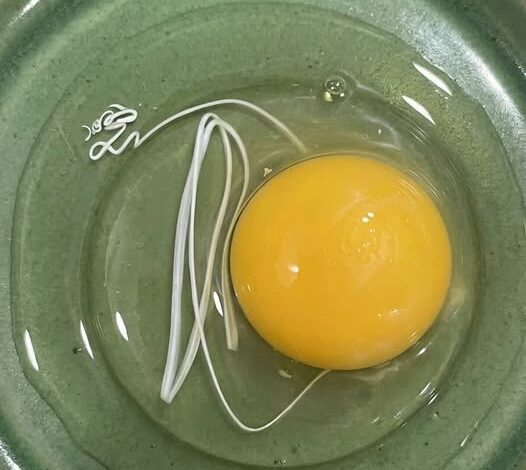
I froze in the middle of my kitchen, staring at the strange white strand floating inside the egg. My appetite vanished instantly. Every food-safety horror story I had ever heard came rushing into my mind, and I was convinced I had just cracked open something disgusting.
With growing anxiety, I inspected the rest of the carton, expecting to find more of the same. My hands shook slightly as I cracked each egg, but one after another looked completely normal. Oddly enough, that only made the mysterious strand seem even more unsettling. Why was it only in this one egg?
Curiosity eventually overcame panic.
I snapped a photo and began searching online, scrolling through food safety websites, articles, and discussion forums. After several minutes of frantic research, I finally discovered the answer.
The strange white cord had a name: the chalaza.
Far from being a worm, parasite, or sign that the egg had gone bad, the chalaza is a completely natural part of the egg. Its purpose is to act like a tiny anchor, holding the yolk securely in the center and protecting it from damage.
The most surprising part was learning that a prominent chalaza is actually a sign of freshness. The more visible it appears, the fresher the egg tends to be.
What had initially seemed revolting turned out to be exactly the opposite. The thing that made me question my breakfast was actually proof that the egg was fresh and perfectly safe to eat.
By the end of my research, the fear had disappeared, replaced by relief—and a little embarrassment. The mysterious strand that had nearly ruined my morning wasn’t a warning sign at all. It was nature’s way of keeping the egg intact, quietly doing its job all along.