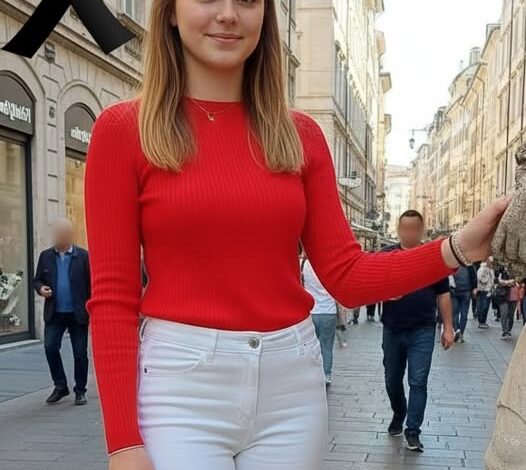
She left the house expecting an ordinary day.
That detail is what keeps haunting people afterward.
Not because ordinary days are rare, but because we trust them so completely. We leave home thinking about errands, bills, interviews, text messages we forgot to answer, what we might eat later, whether we’re running late. We move through streets believing routine itself offers a kind of invisible protection. Most of the time, it does.
Until suddenly it doesn’t.
At twenty years old, she was carrying the fragile optimism of someone still trying to build a future. Friends later said she had been talking excitedly about a job interview, imagining independence, stability, maybe even a fresh start. Nothing dramatic. Nothing extraordinary. Just the small, hopeful plans young people make quietly every day while believing life is still unfolding ahead of them in endless directions.
She walked through the commercial strip like thousands of others had that same afternoon.
Storefronts buzzing.
Cars inching through traffic.
Music leaking from open windows.
People buying coffee, arguing on phones, hurrying home before dark.
Life continuing normally around her.
Then the gunfire started.
Witnesses later described confusion first, not fear. Loud cracks echoing between buildings often take a few seconds for the brain to recognize properly. Some people thought fireworks exploded nearby. Others froze completely, trying to understand why crowds suddenly shifted direction all at once.
But violence moves faster than comprehension.
Somewhere nearby, a feud already burning long before she entered the scene finally erupted openly. Arguments, grudges, retaliation — the kind of conflict that grows slowly through pride, anger, humiliation, and recklessness until eventually somebody decides public streets are acceptable places to settle private wars.
The bullets were not meant for her.
That fact makes tragedies like this feel especially unbearable afterward.
Because randomness carries its own cruelty.
A person can spend years making careful decisions, avoiding danger, working toward something better — and still collide fatally with someone else’s rage for reasons completely unrelated to their own life.
Witnesses remember seeing her collapse almost immediately.
One moment walking.
The next crumpled against concrete while screams erupted around her.
People scattered instinctively at first. Then came the terrible realization spreading through the crowd: someone was down, and she was not moving properly.
Strangers rushed toward her.
That part matters too.
Because amid all the horror, ordinary people still ran toward suffering instead of away from it completely. A woman dropped shopping bags and pressed trembling hands against the wound trying desperately to slow bleeding she barely understood how to stop. Another bystander knelt beside her repeating “stay with us” over and over again like words themselves might anchor her consciousness to the world long enough for help to arrive. Someone removed a sweatshirt to use as pressure against the injury.
No one asked who she voted for.
What neighborhood she came from.
Whether they knew her.
For a few frantic minutes, she belonged emotionally to everyone there.
Sirens arrived fast.
Not fast enough.
Emergency responders later admitted privately that the injuries were catastrophic almost from the beginning. Still, paramedics worked with the fierce determination medical workers often carry into hopeless situations anyway because surrendering before the body does feels impossible emotionally.
Inside the ambulance, machines monitored fading vital signs while radio traffic cleared routes toward the hospital. One medic reportedly kept speaking calmly to her the entire ride despite uncertainty about whether she could still hear anything at all.
Sometimes emergency workers talk because silence feels too much like giving up.
At the hospital, trauma teams moved immediately.
Doctors.
Nurses.
Surgical staff.
Everyone pulling against time together in fluorescent rooms where survival often becomes measured minute by minute.
But some injuries arrive already carrying too much destruction inside them.
Machines beeped.
Commands echoed.
Blood moved through gloved hands and hurried equipment.
And still, despite every intervention, the damage kept winning.
When the official time of death was finally called, the room reportedly fell unusually quiet afterward. Medical professionals learn quickly how to compartmentalize grief because emergency medicine would become psychologically impossible otherwise. Yet deaths involving young people often strike differently. Especially innocent bystanders. Especially twenty-year-olds carrying futures interrupted before they properly began.
Outside the hospital, news traveled faster than police investigations could fully form.
Phones lit up.
Messages spread.
Names circulated before confirmation reached some family members officially.
That may be one of modern tragedy’s cruelest realities: grief now moves digitally at the speed of panic. Families increasingly learn fragments of catastrophic news through rumors, social media, screenshots, or frantic calls before authorities can even finish notifying people carefully.
Friends refused to believe it initially.
They searched for mistakes.
Wrong identities.
False reports.
Because twenty-year-olds are not supposed to vanish during ordinary afternoons.
Parents are not supposed to answer calls that permanently divide life into before and after.
Friends are not supposed to scroll through photos of someone smiling hours earlier while trying to process that those moments have already become memory instead of present tense.
Yet by nightfall, candles appeared along Fifth Street.
Small flames flickering against storefront glass while people gathered quietly beneath police tape and lingering shock. Some cried openly. Others stood silent staring toward the spot where she fell as though repetition might somehow force reality backward into something survivable again.
The memorial grew quickly.
Flowers.
Handwritten notes.
Photographs.
Stuffed animals.
Messages demanding peace from people no longer convinced peace still belonged naturally to their neighborhoods anymore.
And underneath all the mourning lived another emotion too:
fear.
Not abstract political fear discussed on television panels.
Personal fear.
The fear that ordinary public spaces no longer feel predictably safe. That random violence now hovers invisibly over routine life in ways impossible to fully anticipate or control. People kept returning afterward to the same unsettling thought:
if it could happen to her…
walking home…
thinking about a job interview…
doing absolutely nothing wrong…
then what protection does ordinary innocence actually provide anymore?
That question lingered long after investigators collected shell casings and surveillance footage.
The city continued moving because cities always do.
Buses still ran.
Stores reopened.
Traffic returned.
People hurried past memorial candles while balancing groceries and phone calls and exhausted routines.
Life resumed externally.
But something underneath it had shifted.
Communities absorb violence psychologically even when individuals survive physically. Residents begin scanning streets differently. Parents text children more often asking if they got home safely. Store owners glance up nervously whenever arguments grow loud nearby. Every sudden noise briefly sharpens attention again.
Safety, once cracked, does not repair immediately.
Meanwhile, detectives searched for the intended targets — the people connected to the feud that spilled outward violently enough to claim someone entirely uninvolved. Officials promised accountability. Politicians offered statements about justice and community healing. Investigators reconstructed timelines trying to explain how public anger transformed into irreversible loss within seconds.
But explanations rarely comfort grieving families.
Especially when the victim never chose participation in the conflict at all.
That randomness remains the hardest part to accept.
She was not chasing danger.
Not provoking confrontation.
Not expecting violence.
She was simply living.
And then suddenly, she wasn’t.
In the weeks afterward, people kept describing her using future tense accidentally before correcting themselves painfully mid-sentence.
“She wants to—”
“She’s going to—”
“She was…”
That grammatical shift destroys people quietly after sudden deaths. The mind struggles to catch up because emotionally, the future still feels occupied by the person long after reality removes them from it physically.
At twenty, life is supposed to remain unwritten.
Possibilities still expanding outward.
Mistakes recoverable.
Dreams adjustable.
Time abundant.
Instead, her story ended inside someone else’s argument before she even understood she had stepped near it.
And perhaps that is what the candles on Fifth Street truly represented in the end:
not only grief for one young woman,
but grief for a disappearing sense of ordinary safety itself.
The belief that walking home should not require luck.
That strangers should not die because anger lost control nearby.
That young people deserve futures larger than memorial photos and police reports.
The city kept moving after her death because cities always must.
But for many people standing beneath those flickering candles, one realization settled heavily into the night and never fully left afterward:
sometimes tragedy does not arrive because of who you are.
Sometimes it arrives simply because you happened to be standing where someone else decided life no longer mattered enough to protect.