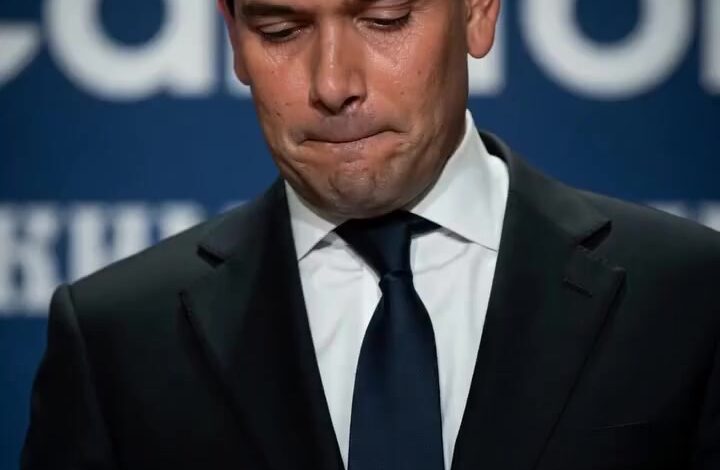
Rubio’s rapid confirmation did far more than fill a vacant position in government. It shifted the emotional and political atmosphere surrounding power itself. In another era, the appointment of a seasoned senator to a major role might have been treated as routine — important, certainly, but ultimately procedural. Today, nothing involving influence feels routine anymore. Every promotion, every endorsement, every carefully orchestrated vote unfolds inside a nation already exhausted by distrust, polarization, and the constant suspicion that decisions affecting millions are being shaped far beyond public view. In that climate, Rubio’s elevation landed less like administrative housekeeping and more like a referendum on who is trusted to steer the country through instability.
To supporters, the confirmation represented the natural culmination of years spent navigating national politics with discipline and precision. Rubio has long understood the value of restraint in an era addicted to spectacle. While louder figures dominated headlines through outrage and confrontation, he built influence more methodically — through committee work, foreign policy visibility, strategic alliances, and careful positioning inside a rapidly shifting Republican landscape. Allies see him as someone who survived political volatility not by disappearing into the background, but by learning how to remain relevant without becoming consumed by chaos.
That distinction matters to his defenders.
In their eyes, Rubio embodies a version of leadership rooted in preparation rather than improvisation. They point to his Senate experience, his fluency in international affairs, and his ability to project steadiness at a moment when many Americans feel trapped inside endless cycles of institutional instability. For them, his confirmation is not alarming but reassuring — proof that competence, patience, and political discipline can still be rewarded in a system increasingly dominated by outrage and performance.
But outside those supportive circles, the reaction revealed something far more unsettled underneath the surface.
The speed of the process raised eyebrows immediately.
So did the intensity surrounding it.
And perhaps most significantly, the feeling that decisions carrying enormous national consequences now unfold with an almost disorienting pace, leaving the public struggling to separate transparency from choreography.
That unease is bigger than Rubio himself.
It reflects a broader exhaustion with modern political culture, where every major appointment becomes instantly absorbed into larger fears about influence, loyalty, and institutional control. People no longer evaluate confirmations purely on qualifications. They evaluate them symbolically. A vote becomes a statement about ideology. An endorsement becomes evidence of hidden alliances. Every advancement feels connected to larger questions about who truly holds power and how that power is being exercised behind closed doors.
In this environment, perception becomes inseparable from reality.
To supporters, Rubio’s confirmation signals stability.
To critics, it signals consolidation.
To others, it signals the continuation of a political system where influence often appears to move faster than accountability.
That tension explains why reactions to his rise feel emotionally charged far beyond the office itself. Americans increasingly interpret leadership appointments not as isolated events, but as clues pointing toward the country’s future direction. Every public figure elevated into greater authority becomes a vessel for projection. People see in them either the restoration of competence or the expansion of something more dangerous, depending largely on what they already fear most about the political moment they are living through.
And Rubio now occupies a position where every action will carry amplified meaning.
Every statement will be parsed for hidden intent.
Every alliance will be measured.
Every silence will be interpreted.
That is the burden attached to modern influence. Once someone reaches a certain level of visibility, they stop functioning solely as an individual politician and begin operating as a symbol. Their decisions no longer belong only to policy debates; they become emotional signals consumed by millions searching for reassurance, validation, or warning signs about the future.
The irony is that confirmations themselves are often remembered far less than what follows afterward.
Years from now, few people will remember procedural details, vote counts, or the exact choreography of hearings and press conferences. What history tends to preserve instead are consequences:
the crises handled well or poorly,
the policies defended,
the alliances strengthened,
the institutions weakened or reinforced,
the ordinary people affected by decisions made far above their lives.
That is where reputations harden permanently.
Because power is easy to announce.
Legacy is much harder to build.
For Rubio, this moment represents both opportunity and exposure. The trust placed in him — whether enthusiastic, strategic, or reluctant — now carries enormous expectations attached to it. Supporters expect competence, steadiness, and leadership capable of navigating uncertainty. Critics will watch for signs that their suspicions about ambition, calculation, or ideological maneuvering were justified all along.
And in a deeply divided nation, there may be no way to satisfy both realities simultaneously.
Still, the deeper significance of his confirmation lies less in the ceremony itself than in what it reveals about the country witnessing it. Americans are no longer reacting only to politicians; they are reacting to accumulated years of disappointment, anxiety, distrust, and exhaustion. Every new figure elevated into authority inherits not only the office, but the emotional weight attached to the era.
That is why moments like this feel larger than titles or resumes.
They become tests of faith.
Faith in institutions.
Faith in leadership.
Faith that power is being handed to people capable of carrying it responsibly.
Whether Rubio ultimately strengthens that faith or deepens the cynicism surrounding it will not be decided by headlines celebrating his confirmation week. It will be decided slowly, through choices made under pressure when visibility fades and consequences become real.
Because confirmations create expectations.
But only time reveals whether those expectations were wisdom…
or warning.