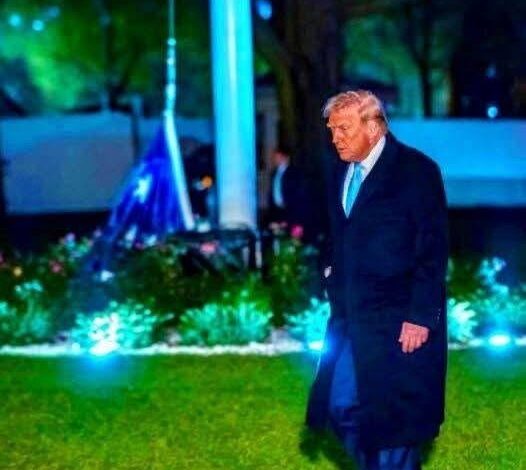
By the time morning arrived, the object in his hand had almost stopped mattering.
That was the unsettling part.
Not because the object itself was harmless or harmless-looking, but because reality had already been buried beneath interpretation before the sun even rose. Within minutes of the photo appearing online, millions of people had begun constructing entire narratives around a single frozen frame. The image spread faster than facts could follow it, crossing timelines, television screens, private group chats, and news alerts with the velocity of outrage.
Some viewers saw danger immediately.
Others saw persecution.
Others saw symbolism.
Others saw proof of everything they already believed about him long before that night ever happened.
And even the people claiming not to care became part of the same machine, feeding the spectacle through mockery, exhaustion, or performative indifference.
The photograph stopped being evidence almost instantly.
It became a mirror.
That’s what viral images often become now in the modern world: less a reflection of reality than a projection surface for collective fear, anger, tribal loyalty, and imagination. People weren’t only reacting to what was visible in the frame. They were reacting to years of accumulated resentment, ideology, distrust, and emotional investment already living inside them before they ever saw the image at all.
The object in his hand merely gave those emotions somewhere to land.
Comment sections transformed into psychological battlegrounds within hours. Strangers argued with absolute certainty over details nobody could actually confirm. Zoomed-in screenshots circulated like forensic evidence despite becoming blurrier and less reliable with every repost. Amateur analysts outlined shapes, shadows, angles, and gestures as though solving a national mystery in real time.
Every pixel became loaded with meaning.
Or imagined meaning.
Cable news panels amplified the frenzy further. Discussions framed speculation as near-fact simply because uncertainty itself no longer holds public attention long enough to satisfy modern media cycles. Experts interrupted each other. Hosts demanded immediate conclusions. Social media clips isolated single opinions and launched them back online where audiences consumed them detached from context entirely.
The speed became part of the danger.
Not the speed of information —
the speed of certainty.
People no longer wait to understand events before emotionally committing to them. They choose interpretations almost instantly, then defend those interpretations as extensions of personal identity. Once that happens, changing someone’s mind becomes nearly impossible because the argument stops being about the image itself and starts becoming about belonging, tribe, ego, and fear.
And fear always sharpens perception selectively.
One person looked at the photo and saw menace.
Another saw manipulation.
Another saw martyrdom.
Another saw media hysteria.
All from the exact same image.
That divergence revealed something darker than the object ever could: modern audiences increasingly consume reality less as shared truth and more as customizable narrative. Facts still exist, but emotionally, they often arrive already filtered through ideology before people consciously process them.
The photograph exposed that process in real time.
Some viewers searched desperately for evidence confirming danger because danger validated preexisting anxieties they already carried. Others dismissed every concern automatically because skepticism toward institutions had become central to how they understood the world. Between those extremes sat millions of exhausted spectators watching the same chaos unfold again — another national argument powered less by clarity than by projection.
And projection spreads faster than truth because projection feels personal.
Truth often arrives slowly, unevenly, with ambiguity attached.
Projection arrives emotionally complete.
It tells people what they already suspect.
Confirms what they already fear.
Strengthens what they already hate.
That emotional satisfaction makes speculation intoxicating.
Especially online.
Social media platforms reward confidence far more than caution. Nuanced uncertainty disappears beneath louder, simpler narratives because outrage travels efficiently while patience rarely does. Algorithms amplify emotional reaction, not careful reflection. The most dramatic interpretation almost always reaches the widest audience first, regardless of accuracy.
So the loudest version of events begins hardening publicly before evidence fully exists.
And once millions emotionally invest in a narrative, correction becomes almost irrelevant.
That may be the most disturbing lesson hidden inside moments like this.
Not that misinformation exists —
but how eagerly human beings collaborate with it when it supports emotional needs already living inside them.
People often imagine manipulation as something imposed externally by governments, media organizations, or powerful figures. But many modern narrative wars sustain themselves voluntarily. Individuals participate because stories offer psychological comfort. A frightening world feels easier to navigate when events fit familiar moral frameworks: hero or villain, threat or victim, truth or lie.
Ambiguity demands patience.
Patience feels weak online.
So certainty wins.
Even when certainty is invented.
And perhaps that is why the object itself eventually became almost meaningless compared to the reaction surrounding it. Whether dangerous, symbolic, misunderstood, or entirely ordinary, it could never compete with the emotional machinery audiences built around it afterward.
The real spectacle was collective interpretation.
Millions of people staring at the same frozen second and revealing far more about themselves than about the event they claimed to analyze.
Fear.
Distrust.
Resentment.
Hope.
Cynicism.
Paranoia.
Tribal loyalty.
All exposed through arguments over a photograph nobody fully understood yet.
That realization lingers long after the headlines fade.
Because the most unsettling part of modern media culture may not be how easily false narratives spread, but how deeply people hunger for narratives that make emotional sense before factual sense. The image becomes secondary. What matters is the feeling attached to it — the confirmation, the outrage, the validation, the thrill of certainty.
And once emotion takes control, reality struggles to compete.
By dawn, the object in his hand was no longer the true story.
The true story was the speed with which millions of strangers completed the image themselves, filling every unknown space with personal fear and conviction until speculation felt indistinguishable from truth.
In the end, the danger was never just what the photograph showed.
It was how quickly people stopped caring whether they were seeing clearly at all.