The Pfizer Admission, The Explosive Truth Behind the 99-Million Person Study That Changed the Vaccine Conversation Forever

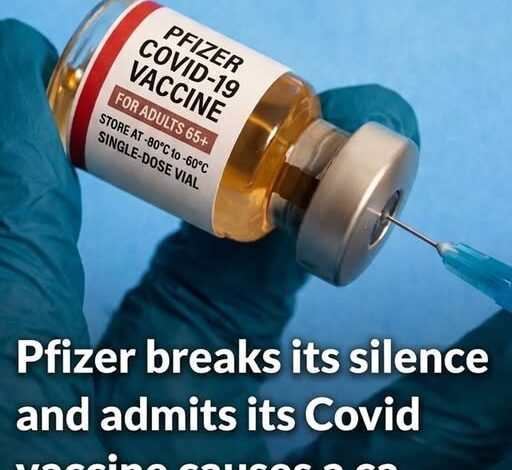
The conversation unfolding now is often misunderstood.
Too many people assume it is a battle between those who support vaccines and those who oppose them. Too many discussions immediately collapse into accusations, labels, and political tribalism before anyone has the chance to examine what is actually being said.
But something more complicated is happening.
Something more important.
What is emerging is not a wholesale rejection of vaccination. It is a growing demand for a fuller accounting of the pandemic years—an effort to reconcile the enormous benefits many people experienced with the very real harms a smaller number endured.
For some, this conversation feels uncomfortable because it refuses to fit neatly into familiar categories.
It asks society to hold multiple truths at the same time.
And that has never been easy.
During the darkest periods of the COVID-19 pandemic, vaccines arrived as a source of hope. Hospitals were overwhelmed. Families were losing loved ones. Healthcare workers faced exhaustion unlike anything many had experienced in their careers.
The urgency was undeniable.
For millions of people, vaccination reduced the risk of severe illness, hospitalization, and death. Particularly among older adults and those with underlying health conditions, the evidence consistently showed meaningful protection against the most dangerous consequences of infection.
Those benefits matter.
They mattered then, and they matter now.
Lives were preserved.
Hospital systems gained breathing room.
Communities slowly began reopening.
None of those realities disappear simply because time has passed or because later debates became more polarized.
Yet another reality exists alongside that one.
A smaller group of people experienced outcomes they never expected.
Some developed medical complications after vaccination.
Others experienced symptoms that disrupted their work, relationships, and daily lives.
Many found themselves searching for explanations in a healthcare environment that was still trying to understand a rapidly evolving situation.
For those individuals, the experience was often isolating.
Not only because they were struggling with health concerns, but because they frequently felt caught between competing narratives.
On one side were voices insisting that vaccines were dangerous for everyone.
On the other were voices so focused on promoting confidence that discussions about rare adverse events sometimes felt uncomfortable or unwelcome.
Many patients found themselves trapped in the middle.
Their experiences did not fit cleanly into either story.
And that is where trust began to fray.
Trust is not built solely through success.
It is built through transparency.
Most people understand that no medical intervention is completely risk-free.
People accept risks every day when they undergo surgery, take prescription medications, receive anesthesia, or even use common over-the-counter treatments.
What they often struggle to accept is the feeling that concerns are being dismissed rather than examined.
During the pandemic, public health officials faced extraordinary challenges.
They were attempting to encourage vaccination during a global emergency while simultaneously combating misinformation spreading at unprecedented speed.
In that environment, reassurance became a central communication strategy.
Sometimes that reassurance was necessary.
Sometimes it saved lives.
But reassurance can create unintended consequences when it becomes too broad.
If people experiencing unusual symptoms feel ignored, they may conclude that their concerns are not being taken seriously.
When that happens, confidence can erode even among individuals who generally trust science and medicine.
The lesson is not that public health officials acted with malicious intent.
The lesson is that communication becomes most effective when it acknowledges complexity rather than avoiding it.
Science has always advanced through questioning, investigation, and refinement.
It is not weakened by uncertainty.
It depends upon it.
The strongest scientific institutions are not those that claim perfection.
They are those willing to revise conclusions when evidence evolves.
They are those willing to investigate unexpected outcomes, even when those outcomes are rare.
And they are those willing to listen carefully to patients whose experiences fall outside the expected pattern.
That distinction matters.
Because listening is not the same thing as abandoning evidence.
Compassion is not the same thing as accepting every claim uncritically.
A person reporting a health problem deserves to be heard.
Their experience deserves investigation.
Their concerns deserve respect.
Those principles are not anti-science.
They are fundamental to good science.
One of the greatest mistakes in recent years has been the tendency to sort people into simplistic categories.
Believers and skeptics.
Responsible citizens and irresponsible ones.
Pro-science and anti-science.
Reality is rarely that simple.
Many people who have questions about vaccine safety are not rejecting science.
Many people who support vaccination still believe adverse events should be studied more carefully.
Many people who experienced complications continue to support vaccination while also advocating for better recognition and treatment of rare harms.
These positions are not contradictory.
They are nuanced.
And nuance is often where truth lives.
A healthier public conversation begins by acknowledging that benefits and risks can coexist.
Vaccines can save lives.
Rare adverse events can also occur.
Public health campaigns can achieve important goals.
Communication mistakes can still happen.
Scientific institutions can provide extraordinary value.
They can also learn from criticism.
Holding these truths simultaneously does not create confusion.
It creates accuracy.
For those who experienced serious health problems following vaccination, recognition matters.
Not because recognition proves causation in every case.
Not because every symptom can be directly linked to a vaccine.
But because people deserve care regardless of where they fall within statistical expectations.
Behind every data point is a human being.
A parent trying to care for children.
A worker struggling to return to a job.
A student attempting to continue school.
A spouse navigating uncertainty.
Numbers help researchers understand populations.
They do not eliminate the importance of individual suffering.
That is why robust monitoring systems matter.
That is why adverse-event reporting systems matter.
That is why continued research matters.
The public should understand not only the benefits associated with medical interventions but also how safety concerns are identified, studied, and addressed.
Transparency builds confidence because it demonstrates accountability.
People are more likely to trust institutions that openly discuss limitations than institutions that appear defensive when questions arise.
The future of public health depends heavily on this lesson.
Another pandemic will come someday.
Another crisis will require difficult decisions.
When that happens, trust will be one of society’s most valuable resources.
Trust cannot be demanded.
It cannot be manufactured through slogans.
And it cannot survive indefinitely if people believe uncomfortable experiences are being ignored.
It must be earned repeatedly through honesty, openness, and responsiveness.
That means communicating clearly about benefits.
It also means communicating honestly about risks.
It means updating guidance when evidence changes.
It means supporting individuals who experience uncommon outcomes.
And it means resisting the temptation to reduce complex issues into simple narratives designed for political convenience.
The goal should never be protecting a message.
The goal should be protecting people.
Including those who benefited.
Including those who struggled.
Including those whose experiences challenge existing assumptions.
The pandemic revealed remarkable scientific achievements.
It also revealed areas where institutions can improve.
Both observations can be true at the same time.
In fact, acknowledging both may be essential for moving forward.
Real progress does not come from denial.
Not denial of benefits.
Not denial of risks.
Not denial of uncertainty.
Progress comes from confronting reality in its entirety.
The path ahead is not less science.
It is better science.
Science that remains rigorous without becoming dismissive.
Science that welcomes investigation rather than fearing it.
Science that adapts as knowledge grows.
Science that recognizes every patient as worthy of attention, even when their experience is statistically uncommon.
Most importantly, it is science paired with humility.
Because trust is strongest when people believe they are being told the whole story.
Not the convenient story.
Not the simplified story.
The whole story.
And in the years ahead, that commitment to honesty may prove just as important as any medical breakthrough itself.