It wasn’t a celebrity scandal or a breaking news event that captured millions of people’s attention.
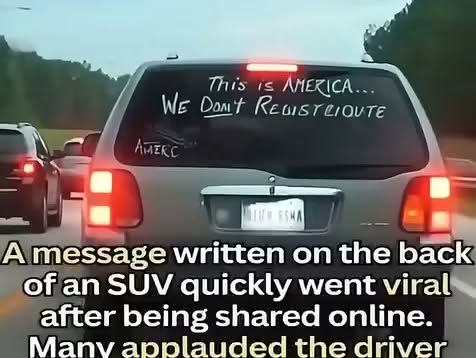
It was a dusty SUV.
Parked quietly on what appeared to be an ordinary suburban street, the vehicle looked like something thousands of drivers pass every day without a second glance. But someone had traced a short message across the dirt covering its rear window, and within hours, a photograph of that handwritten statement was spreading across social media at astonishing speed.
What began as a simple snapshot quickly became something much larger.
The conversation was no longer about the vehicle.
It became a nationwide debate about success, opportunity, privilege, personal responsibility, and one question that has divided people for generations: Is achieving the American Dream mainly the result of hard work, or does it depend just as much on circumstances beyond our control?
At first, the image seemed almost too ordinary to matter.
There were no flashing lights.
No dramatic confrontation.
No famous faces.
Just an anonymous SUV with a message written in the dust.
Yet the words struck a nerve.
Within hours, thousands of comments appeared beneath the photo. Before long, those comments had grown into hundreds of thousands, with people passionately defending completely different interpretations of the same sentence.
It was remarkable how one brief statement could inspire such different reactions.
Some readers immediately described it as inspiring.
To them, the message represented values they had relied on throughout their own lives—hard work, determination, discipline, and refusing to give up even when success seemed far away.
Many shared deeply personal stories.
One person described working two full-time jobs while attending night classes before eventually earning a college degree.
Another wrote about starting a business with little more than determination and borrowed equipment.
Others spoke of growing up with very little, saving every dollar they could, sacrificing comfort for years, and slowly building better lives through persistence.
For these individuals, the message wasn’t offensive.
It reflected their reality.
They believed effort matters.
They believed perseverance changes lives.
They believed that while success is never guaranteed, refusing to quit dramatically improves the odds.
To them, the words on the dusty SUV served as encouragement rather than criticism.
But many others viewed the exact same message through an entirely different lens.
They argued that determination is important—but rarely tells the whole story.
Hard work alone, they said, cannot erase every obstacle.
People responding from this perspective shared stories just as personal and just as powerful.
Some described losing everything because of unexpected medical bills.
Others talked about layoffs that erased years of financial progress overnight.
Many explained how growing up without stable housing, quality schools, reliable transportation, healthcare, or supportive mentors made opportunities much harder to reach.
Several pointed out that two people can work equally hard while facing completely different circumstances.
One may have family members able to provide financial support during difficult times.
Another may be supporting younger siblings, caring for aging parents, or recovering from illness.
One person may have access to excellent education and professional connections.
Another may never receive those opportunities despite putting in the same effort.
From this viewpoint, reducing success to hard work alone ignored the complexity of real life.
Neither side was inventing its experiences.
Each spoke from genuine personal history.
That was what made the conversation so compelling.
People weren’t simply debating an anonymous sentence.
They were defending the lessons life itself had taught them.
As the discussion grew, the photograph became almost secondary.
The SUV disappeared behind thousands of deeply personal stories.
Instead of arguing about a dirty rear window, people began talking about childhood poverty, scholarships, military service, entrepreneurship, discrimination, financial setbacks, family sacrifices, career breakthroughs, and unexpected opportunities.
The image had become a mirror.
Everyone looked into it and saw something different.
Social media amplified every emotion.
Years ago, a handwritten message on the back of a parked vehicle might have been noticed by only a handful of passing drivers before eventually washing away in the rain.
Today, one photograph can reach millions of people within a single afternoon.
Algorithms reward engagement.
Strong opinions spread quickly.
Ordinary moments become national conversations almost overnight.
In this case, the photograph touched on one of society’s oldest debates.
Why do some people succeed while others struggle?
The answer has never been simple.
Researchers have spent decades studying the factors that influence economic mobility and long-term success.
Education, health, family support, community resources, access to mentors, economic conditions, personal choices, timing, and persistence all play important roles.
Sometimes determination opens doors.
Sometimes circumstances close them before effort ever has a chance.
Often, success emerges from a complicated interaction between both.
That complexity is exactly why conversations like this remain so emotionally charged.
People naturally interpret broad statements through the experiences that shaped their own lives.
Someone who overcame enormous hardship through relentless determination may see encouragement.
Someone who worked just as hard but encountered barriers beyond their control may hear judgment instead.
Neither reaction is necessarily wrong.
Each reflects a different journey.
Perhaps that was the most fascinating part of the entire controversy.
The exact same words inspired hope in one person while causing frustration in another.
Some readers felt seen.
Others felt overlooked.
One individual found motivation.
Another found oversimplification.
The message itself never changed.
The lives reading it did.
In many ways, the dusty SUV simply reopened a conversation that has existed for generations.
Parents have debated it with their children.
Teachers have discussed it in classrooms.
Economists, historians, business leaders, and policymakers continue examining the balance between personal responsibility and structural opportunity.
The photograph didn’t create that discussion.
It simply gave millions of people a new reason to join it.
Long after the original image stopped trending, the questions remained.
How much does effort matter?
How much do opportunity and circumstance shape outcomes?
Where should society place responsibility, and where should it offer support?
There are no universal answers.
Every person’s story adds another piece to a puzzle too large for any single slogan to solve.
Perhaps that is the greatest lesson hidden inside such an ordinary photograph.
A few words written in dust became important not because they settled an argument, but because they reminded us that success means different things to different people.
For some, it is proof that perseverance can overcome extraordinary obstacles.
For others, it is a reminder that hard work deserves opportunities capable of rewarding it.
Both perspectives grow from real experiences.
Both deserve to be heard.
And that may explain why one dusty SUV captured the attention of an entire nation.
It wasn’t really about the vehicle.
It was about the millions of lives that recognized pieces of their own story in a single sentence—and discovered that sometimes the most ordinary image can spark the most extraordinary conversation.