For most of his life, David thought he understood fear.
He knew the quick jolt of panic that came when he lost sight of his daughter for a few seconds in a crowded store. He knew the nervous feeling that followed her as she climbed too high on playground equipment or sped downhill on her bicycle with more confidence than caution. Like many parents, he worried about scraped knees, broken bones, and the countless small dangers that come with growing up.
But none of those fears prepared him for what happened one rainy Thursday afternoon.
The call came shortly after lunch.
It was Lily’s school.
The nurse spoke calmly and professionally, explaining that seven-year-old Lily had suffered a minor injury during recess. According to the report, she had fallen while playing and sustained a bruise near her eye. She was awake, alert, and resting comfortably.
Everything about the conversation suggested there was no reason to panic.
Yet the moment David hung up, a knot formed in his stomach.
Something felt wrong.
Unable to shake the feeling, he informed his supervisor that he needed to leave and headed straight for the school.
Rain streaked across the windshield as he drove. He tried to reassure himself the entire way.
Kids fall.
Playground accidents happen.
It’s probably nothing.
But the uneasiness refused to leave.
By the time he pulled into the school parking lot, his concern had grown into something much heavier.
He hurried through the front entrance and made his way to the nurse’s office.
Lily was sitting quietly in a chair when he arrived.
An ice pack rested against the side of her face. The area around her eye was swollen, but it wasn’t the injury that immediately caught his attention.
It was her silence.
Normally energetic and talkative, Lily sat staring at the floor.
She barely looked up when he entered.
The spark that usually lit up her face seemed absent.
David knelt beside her.
“Hey, sweetheart. What happened?”
For a moment she said nothing.
Then she quietly repeated the same phrase.
“Playground trouble.”
The words sounded rehearsed.
Not natural.
Not like something a seven-year-old would normally say.
David glanced toward the nurse, who repeated the school’s explanation about a fall during recess.
Still, something didn’t sit right.
On the drive home, Lily remained unusually quiet.
She stared through the rain-covered window and responded to questions with little more than shrugs or one-word answers.
David offered to stop for ice cream.
Normally she would have been thrilled.
This time she shook her head.
“No thanks.”
The silence that followed felt unbearable.
That evening, he cooked her favorite dinner, hoping the familiar comfort would help her relax.
Instead, she pushed food around her plate.
When he asked if she was feeling sick, she said no.
When he asked if something happened at school, she said no.
When he asked if she wanted to talk, she said she was tired.
But none of the answers matched what he was seeing.
As the evening wore on, David found himself replaying every detail of the day.
The phone call.
The bruise.
The strange phrase.
The distant look in Lily’s eyes.
The more he thought about it, the stronger his instincts became.
Something was wrong.
Later that night, they followed their usual bedtime routine.
Ever since Lily’s mother had passed away several years earlier, those quiet moments before bed had become especially important.
After her bath, Lily sat on a small stool while David brushed her long blonde hair.
It was a simple ritual.
One they had shared for years.
One that always brought a sense of peace.
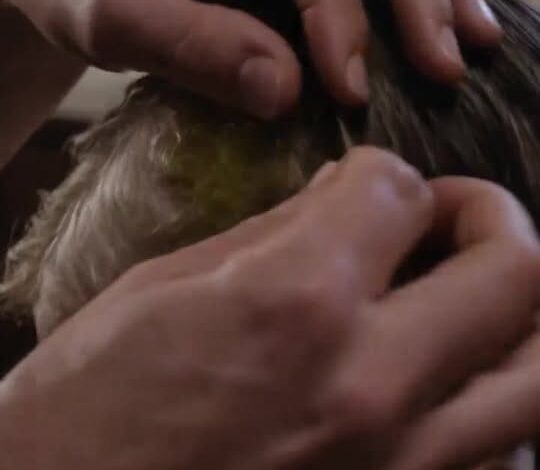
As he gently worked through a tangle near the back of her head, his fingers paused.
Something felt different.
At first he assumed it was another knot.
Then he parted her hair.
And froze.
Beneath the strands was a bruise.
Not near her eye.
Not fresh.
Older.
Fading.
His pulse quickened.
Carefully, he moved more hair aside.
Another bruise.
Then another.
Some had already begun turning yellow and green.
Others appeared newer.
None looked consistent with a simple fall.
A cold wave of dread washed over him.
His hands trembled slightly as he continued brushing.
“Lily,” he said softly. “Can you tell me about these bruises?”
Immediately her body stiffened.
She stared at the floor.
The silence stretched.
“It’s okay,” David whispered. “You’re safe. You can tell me anything.”
For several long moments, she didn’t speak.
Then tears filled her eyes.
And what he saw in her face shattered him.
Fear.
Real fear.
Finally, in a trembling voice, Lily spoke.
Someone had told her not to tell.
Someone had warned her that if she talked, bad things would happen.
Someone had convinced her that speaking up could separate her from her father.
The fear had become so overwhelming that she believed staying silent was the only way to protect the person she loved most.
Hearing those words broke David’s heart.
The next morning, he scheduled an appointment with a pediatrician.
He needed answers.
The doctor carefully examined the bruises and documented every mark.
While avoiding conclusions, the physician acknowledged that the injuries deserved closer attention.
As David reflected on the previous weeks, details he had overlooked suddenly resurfaced.
The headaches.
The reluctance to go to school.
The growing quietness.
The subtle changes in behavior.
At the time, they had seemed insignificant.
Now they formed a troubling pattern.
Determined to understand what had happened, David met with school administrators.
He asked questions.
Reviewed timelines.
Requested clarification about the reported accident.
School officials listened carefully and agreed to conduct a more thorough review of the circumstances surrounding the incident.
Additional conversations took place.
Records were examined.
Procedures were reviewed.
Although many questions remained unanswered, David appreciated that concerns were being taken seriously.
Most importantly, Lily began receiving support.
Gradually, she started opening up to trusted adults.
She talked about her fears.
She shared the worries she had been carrying alone.
Little by little, she began to understand something important:
She wasn’t alone.
She didn’t have to stay silent.
And she wasn’t responsible for protecting adults from the truth.
Recovery took time.
Some days were better than others.
There were setbacks.
Moments of anxiety.
Unexpected tears.
But there was also progress.
Slowly, Lily’s laughter returned.
She spent more time with friends.
She rediscovered activities she loved.
The confident little girl David knew began finding her way back.
The experience changed him too.
He learned that the most important signs are not always visible.
Sometimes they appear in silence.
In a child’s hesitation.
In a change of routine.
In the words left unsaid.
He learned that listening is often just as important as protecting.
Years later, one tradition remained unchanged.
Every night before bed, David still brushed Lily’s hair.
What had once been a simple routine had become something much deeper.
A reminder.
A promise.
A symbol of trust.
Because sometimes the smallest moments reveal the biggest truths.
And sometimes love means paying attention when something feels wrong, even when no one else can see it.
Looking back, David no longer defined their story by fear.
He defined it by courage.
The courage of a little girl who found her voice.
The courage of a father who trusted his instincts.
And the strength they discovered together through one of the most difficult chapters of their lives.
Today, whenever he sees Lily smile, he feels grateful.
Not because hardship never found them.
But because they faced it together.
And through patience, honesty, and unwavering love, they emerged stronger than either of them could have imagined.
No matter what challenges the future might bring, David knows one thing with certainty:
He will always listen.
He will always believe her.
And he will always be there.