My 13-Year-Old Daughter Brought a Starving Classmate Home for Dinner – What Slipped Out of Her Backpack Made My Blood Run Cold

For years I believed that if you worked hard enough, there would always be enough.
Enough food.
Enough warmth.
Enough security.
Enough love.
Reality taught me that “enough” is sometimes nothing more than careful budgeting, skipped luxuries, and endless mental calculations.
Every Tuesday I cooked the same dinner—rice, chicken thighs, onions, and whatever vegetables happened to be cheapest that week. While chopping carrots, I’d already be figuring out tomorrow’s lunches, wondering which bill could wait another few days.
That evening was no different.
Dan came through the back door, shoulders slumped after another long day at work.
“Smells good,” he sighed.
“It’ll be ready soon.”
He peeked into the pot.
“Enough for leftovers?”
“I think so.”
At least, I hoped so.
We weren’t struggling the way some families were, but there wasn’t much room for surprises either.
Just as I reached for the serving bowls, the front door flew open.
“Mom!”
Sam rushed inside.
She wasn’t alone.
Behind her stood a girl I’d never seen before.
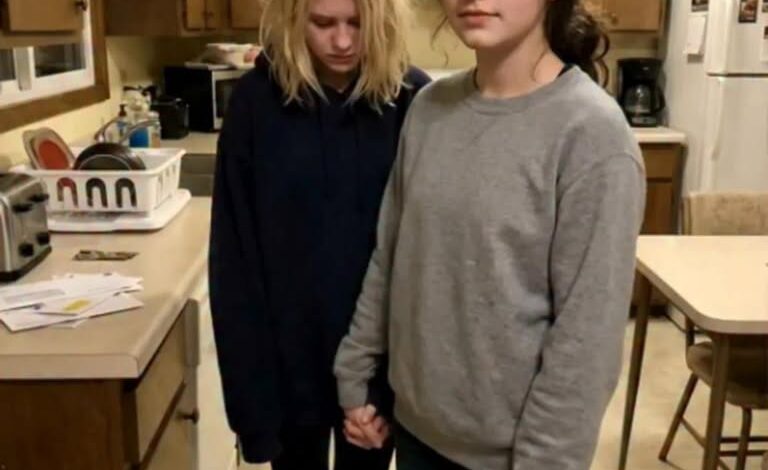
She wore an oversized gray hoodie despite the warm weather. Her sneakers were worn nearly smooth, and she held onto a faded purple backpack as though it contained everything she owned.
Sam smiled.
“Lizie’s staying for dinner.”
Not asking.
Simply informing me.
For one brief second I froze.
Another mouth meant less food for everyone else.
Then I looked at the girl.
She couldn’t have been more than fourteen.
Her shoulders were pulled inward.
She avoided eye contact completely.
And beneath the loose shirt, she looked painfully thin.
I forced a smile.
“Welcome, sweetheart.”
“Thank you.”
Her voice barely carried across the kitchen.
During dinner I couldn’t stop watching her.
She didn’t eat the way hungry teenagers usually do.
She calculated.
One spoonful.
Pause.
Another bite.
She glanced around after every clatter of silverware, almost apologizing with her eyes for existing at the table.
Dan tried making conversation.
“So, Lizie… Sam says you’re good at math.”
A tiny smile appeared.
“I like patterns.”
Sam laughed.
“She’s the only person alive who enjoys algebra.”
For just a second, Lizie laughed too.
It transformed her entire face.
When dinner ended, she quietly picked up her plate.
“I can wash this.”
“You don’t have to.”
“I’d like to.”
Before she left, Sam handed her a banana.
“You forgot dessert.”
Lizie stared.
“For me?”
“It’s a house rule.”
She accepted it like someone receiving an expensive gift.
After she left, I closed the front door and turned toward Sam.
“You can’t surprise us like that.”
Sam crossed her arms.
“She hadn’t eaten.”
“What?”
“Not today.”
I blinked.
“She almost fainted during gym.”
The room fell silent.
“She said her dad’s working all the time.”
Dan frowned.
“And?”
“They don’t always have food.”
My frustration disappeared so quickly it embarrassed me.
I’d been worrying about stretching chicken.
Meanwhile that little girl had been trying to stretch hunger.
“I already told her she could come back tomorrow,” Sam said quietly.
I looked at my daughter.
She hadn’t asked permission because helping someone hungry had never occurred to her as something needing approval.
I smiled.
“Tell her we’ll make extra.”
From that day forward Lizie became part of our evenings.
She arrived after school with Sam.
They did homework together.
She helped clear dishes.
Sometimes she’d fall asleep sitting at the kitchen counter before realizing it herself.
Whenever she apologized.
Always apologized.
“I’m sorry.”
“For what?”
“For…”
She never seemed sure.
Dan watched her one evening.
“Something’s wrong.”
“I know.”
“We should do something.”
“I don’t know what.”
We knew almost nothing about her home life.
Only scattered pieces.
Her father worked constantly.
Sometimes the electricity stopped working.
Sometimes she skipped meals.
Every question about home ended with a shrug.
“It’s okay.”
Clearly it wasn’t.
Then everything changed one Monday afternoon.
The girls were unpacking homework when Lizie’s backpack slipped off her chair.
Its zipper burst open.
Papers scattered across the kitchen floor.
I bent to help gather them.
Then I saw the first notice.
FINAL DISCONNECTION.
Another.
OVERDUE.
Then one sheet stopped me completely.
Across the top, written neatly in blue ink, were the words:
If we get evicted.
Below them sat a careful list.
Take photo albums first.
Dad’s medicine.
Mom’s necklace.
Blankets.
School books.
The handwriting belonged to a child making emergency plans.
My throat tightened.
“Lizie…”
She immediately rushed forward.
“I’m sorry.”
“No.”
I held the notebook gently.
“Sweetheart…”
Her hands shook.
“My dad said not to tell anybody.”
Sam stared at her.
“You’ve been carrying this around?”
Lizie nodded.
“If people know…”
She swallowed.
“…they’ll think we’re begging.”
Dan quietly joined us.
He crouched beside her.
“You’re not begging.”
“We’re just… trying.”
The words shattered something inside me.
“Call your dad.”
She hesitated.
“He’ll be upset.”
“Let me explain.”
Half an hour later there was a knock at the door.
A tired man stood outside.
Grease stained his work pants.
Dark circles framed exhausted eyes.
Yet he still managed an embarrassed smile.
“I’m Paul.”
He offered his hand.
“Thank you for feeding my daughter.”
We invited him inside.
The moment he noticed the papers spread across our table, his shoulders collapsed.
“I’m sorry she brought those.”
“I am not,” I answered softly.
He looked away.
“I promised after her mother died that I’d keep everything together.”
“You’ve been trying.”
“I failed.”
“No.”
Dan shook his head.
“You’re drowning.”
Those words finally broke him.
He sat down.
Covered his face.
And cried.
He’d been working two jobs.
Selling tools.
Skipping his own meals.
Doing everything possible to protect his daughter from seeing how desperate things had become.
Instead, she’d been carrying the fear alone.
That night became a whirlwind.
Calls to the school counselor.
The local food pantry.
Rental assistance programs.
A neighbor who knew someone at the housing office.
None of it solved everything overnight.
But suddenly they weren’t facing it alone.
The landlord agreed to postpone eviction if Paul completed maintenance work around the property.
The school enrolled Lizie in meal assistance.
A social worker connected them with additional resources.
Paul resisted accepting help.
“I should handle this myself.”
Dan looked him squarely in the eyes.
“Your pride isn’t feeding your daughter.”
For several seconds nobody spoke.
Then Lizie quietly reached for her father’s hand.
“I’m tired.”
That was enough.
He nodded.
Weeks slowly turned into months.
Lizie spent several evenings every week at our house.
Sam finally had someone who loved math almost as much as she hated it.
Dan taught Paul how to apply for assistance without feeling ashamed.
Little by little life became lighter.
One evening after dinner, Lizie lingered by the counter.
“I need to tell you something.”
“What is it?”
“When I first came here…”
She smiled shyly.
“I was scared.”
“Of us?”
“I thought eventually you’d tell me not to come back.”
I felt my heart ache.
“And now?”
She looked around our kitchen.
“It feels like home.”
I wrapped tomorrow’s lunch into a paper bag and handed it to her.
“For school.”
She hugged me tightly.
“Thank you… Aunt Helena.”
The words caught me completely off guard.
I hugged her back.
“You’re always welcome here.”
After she left, I noticed Sam watching me.
“You know,” I smiled.
“I’m really proud of you.”
She shrugged.
“You would’ve done the same.”
Maybe.
Maybe not.
Because the truth is, she’d taught me something first.
I’d spent years believing that having enough meant counting portions, balancing bills, and making careful sacrifices.
But real abundance wasn’t measured by what fit inside a grocery budget.
Sometimes it was measured by whether there was room at your table for one more person.
The following evening the front door burst open again.
“Mom!”
Sam and Lizie walked in laughing together.
“What’s for dinner?”
I smiled while reaching for another plate.
“Rice.”
I paused.
“And plenty to share.”
This time, I never bothered counting whether there would be enough.
Because somehow, whenever kindness was served first, there always seemed to be room for one more.