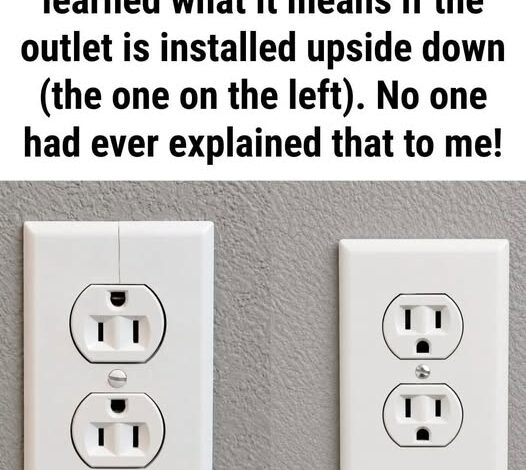
Most people never think twice about the way an electrical outlet is installed. Yet if you’ve ever noticed one with the ground hole on top instead of the bottom, you may have wondered whether it serves a special purpose or signals that something is different.
In many older homes, especially those built before ceiling lights became standard in every room, builders often relied on a switched wall outlet to provide the main source of lighting. Instead of flipping a ceiling fixture on and off, homeowners would plug a floor or table lamp into a designated outlet and control it with the wall switch near the door.
To make these outlets easier to recognize, some electricians chose to install them upside down, placing the ground slot at the top. The reversed orientation acted as a quick visual reminder that the outlet might be connected to a switch rather than supplying constant power.
In many cases, only one half of the receptacle is actually switch-controlled. One socket turns on and off with the wall switch, while the other remains permanently energized. This design lets you operate a lamp with the switch while still keeping another device—such as a clock, phone charger, router, or alarm—powered continuously.
However, many homeowners mistakenly assume that every upside-down outlet works this way, and that simply isn’t true.
The National Electrical Code does not require switched outlets to be installed with the ground pin facing upward. In fact, there is no nationwide rule dictating whether residential outlets should be installed with the ground hole at the top, bottom, or even sideways. Electricians, contractors, and local practices often determine the orientation, and personal preference frequently plays a role as well.
Some electricians intentionally install outlets with the ground slot on top for safety reasons. If a metal object, such as a loose picture frame or tool, were to fall between a partially inserted plug and the outlet, it would contact the grounded prong first rather than the energized blades, potentially reducing the risk of a short circuit.
Others simply follow the style they were taught during their apprenticeship, while homeowners occasionally rotate outlets during renovations because they prefer the appearance.
As a result, an upside-down outlet could indicate a switched receptacle, a safety preference, compliance with local conventions, or nothing more than the previous owner’s personal choice.
Because there is no universal standard, appearance alone should never be used to determine how an outlet functions.
The easiest way to find out is by performing a simple test.
Plug a lamp into the outlet, then operate every nearby wall switch one at a time. If the lamp turns on and off with one of the switches, you’ve identified a switched receptacle. If nothing changes, the outlet is likely continuously powered regardless of its orientation.
This simple check can also solve another common household mystery.
Many people believe an outlet has failed because one socket doesn’t seem to provide power. In reality, the outlet may simply be connected to a wall switch that happens to be turned off. Once you identify which switch controls it, what appeared to be a faulty outlet suddenly works exactly as designed.
Knowing which outlets are switch-controlled can also make daily life more convenient. You can intentionally connect floor lamps for easier room lighting, avoid accidentally unplugging devices that require continuous power, and eliminate unnecessary troubleshooting when an outlet appears inactive.
In the end, the direction an outlet faces may offer a clue, but it should never be treated as proof of how it’s wired. A quick test with a lamp and the surrounding switches is the only reliable way to determine whether an outlet is switch-controlled, permanently powered, or simply installed in a different orientation for reasons that have nothing to do with its function.