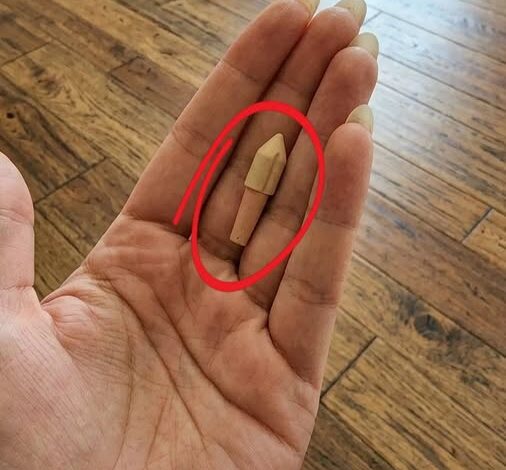
For almost an hour, I sat at the kitchen table staring at that tiny metal object like it had personally betrayed me.
It rested on a folded paper towel beneath the overhead light, harmless and still, while my imagination transformed it into something sinister over and over again.
A weapon attachment.
A hidden tool.
Some strange mechanical piece tied to a life I suddenly realized I might not fully know.
That was the unsettling part.
Not the object itself.
The possibility that the man I had shared a home with for seven years might have entire pieces of himself existing quietly outside my understanding.
The field point was small, sharp, perfectly machined. One end tapered into a smooth threaded base while the tip narrowed into clean steel precision. It looked purposeful in a way that immediately triggered fear. Modern fear, specifically—the kind shaped by internet rabbit holes, crime documentaries, late-night paranoia, and too many stories about people discovering terrible secrets accidentally.
I had found it beneath the passenger seat of his truck while searching for my missing earring.
At first I almost ignored it.
Then I picked it up.
And once I held it in my hand, something irrational began unfolding inside my head.
Because context shapes fear.
If I had found the same object inside a sporting goods store, I would have recognized it instantly as harmless equipment. But discovered alone in a dusty truck beside old receipts and electrical tape? Suddenly it became mysterious. Suspicious. Loaded with invisible narrative.
By the time he got home that evening, I had already constructed entire theories around it.
Maybe he owned weapons he never mentioned.
Maybe he was hiding some aggressive side of himself.
Maybe there was a version of his life existing parallel to mine that I had somehow failed to notice all these years.
The ridiculousness of those thoughts embarrasses me now.
But fear rarely feels ridiculous while you’re inside it.
Fear feels investigative.
Protective.
Necessary.
He stepped through the front door around six carrying groceries and smelling faintly of rain and sawdust from work.
“Hey,” he said easily. “You okay?”
I remember looking at him differently in that moment.
Not with warmth.
With evaluation.
It’s amazing how quickly suspicion alters someone’s face. Suddenly ordinary details start feeling coded. His quietness looked secretive. His exhaustion looked evasive. Even the way he loosened his boots by the door seemed strangely deliberate to me.
I hated that version of myself immediately.
But I couldn’t stop.
I held up the field point carefully between two fingers.
“What is this?”
He looked at it for one second.
Then blinked.
Then laughed softly in complete confusion.
“That’s a field point.”
I stared at him.
“A what?”
“For arrows,” he said. “Archery.”
The silence afterward felt absurd.
All day I had mentally prepared myself for confrontation, deception, revelation.
Instead:
archery.
He set the grocery bags down slowly while realization crossed his face.
“Oh,” he said carefully. “You thought it was something bad.”
“I didn’t know what it was.”
“That’s fair.”
But there was amusement in his eyes now. Not mocking exactly. More surprised by how dramatically my imagination had apparently sprinted away from reality.
“You do archery?” I asked.
“Sometimes.”
“Since when?”
“A couple years.”
“A couple years?”
That part genuinely stunned me.
Not because he needed permission to have hobbies.
Because I had somehow missed an entire piece of his life.
He noticed my expression immediately.
“It’s not some secret thing,” he said gently. “I just didn’t think it was interesting enough to talk about.”
That sentence lingered heavily between us.
Interesting enough to talk about.
How many quiet parts of the people we love go unspoken simply because they seem too small to mention?
Marriage and long relationships create dangerous assumptions sometimes. We begin believing proximity equals complete knowledge. We think living beside someone means we fully understand the architecture of their inner life.
But everyone maintains private landscapes.
Tiny rituals.
Silent escapes.
Apparently his involved arrows and targets and afternoons spent somewhere I had never even asked about.
“You’ve really been doing this for years?”
He nodded.
“There’s a range about twenty minutes outside town.”
“And you never told me?”
He leaned against the counter thoughtfully.
“I think…” He paused. “I think it became one of the only places where my brain got quiet.”
That changed the conversation instantly.
Not secrecy.
Not deception.
Relief.
I sat down slowly at the kitchen table while he unpacked groceries beside me.
“You go alone?”
“Usually.”
“What do you even do there for hours?”
He smiled faintly.
“The same thing over and over.”
“That sounds boring.”
“It’s kind of the point.”
Then, after a pause:
“You’d probably hate it.”
I watched him carefully.
“No,” I said slowly. “I think I just never imagined you needing something like that.”
His hands stopped briefly on the countertop.
“Everybody needs somewhere their thoughts stop yelling for a little while.”
The honesty of that landed deeper than I expected.
Because suddenly the field point stopped being an object entirely.
It became evidence of something tender:
the existence of a private emotional survival mechanism I never noticed.
Over dinner he told me about it properly for the first time.
The first time he went was after his father died.
A coworker invited him.
He discovered he liked the silence.
Not empty silence.
Focused silence.
The kind where your entire mind narrows down to breathing, distance, posture, release.
“No phones,” he explained. “No meetings. No notifications. You miss a shot, you adjust. That’s it.”
“And you’ve just been doing this quietly the whole time?”
He shrugged slightly.
“You have your gardening.”
“That’s different.”
“Why?”
I opened my mouth.
Then closed it again.
Because he was right.
Every Sunday morning I disappeared into the backyard for hours repotting herbs and trimming roses while insisting I was “just outside for a bit.” I never framed it as emotional necessity.
But maybe it was.
Maybe adulthood is simply the ongoing search for harmless things that return us gently to ourselves.
Later that night, he opened the garage cabinet and pulled out the bow.
I actually laughed when I saw it.
Not because it looked ridiculous.
Because it looked so profoundly him.
Simple.
Carefully maintained.
Functional rather than flashy.
There were practice arrows lined neatly in a case beside extra field points identical to the one that nearly launched me into a paranoid spiral.
“You really thought I was secretly dangerous?” he asked, smiling.
I leaned against the doorway.
“I thought maybe I didn’t know you as well as I should.”
That smile faded slightly then.
And his answer came softer.
“You probably don’t.”
Not cruelly.
Truthfully.
The garage grew quiet around us.
Then he added:
“I don’t know every part of you either.”
Something shifted inside me hearing that.
Because we often treat love as complete understanding when maybe real love is actually ongoing curiosity. The willingness to keep discovering someone instead of assuming they are already fully mapped.
Long-term relationships become fragile when curiosity dies.
We stop asking questions because we think we already know the answers.
But people continue evolving silently beside us all the time.
The next Saturday, I went with him to the range.
It sat at the edge of a wooded property outside town, quiet except for wind moving through trees and the occasional sharp thud of arrows hitting targets.
No crowds.
No loud conversations.
Just concentration.
I watched him string the bow with practiced ease while morning light filtered through the pines around us.
And suddenly I understood exactly why he loved it.
There was something almost meditative about the repetition.
Draw.
Anchor.
Breathe.
Release.
Again.
Again.
Again.
The world simplified itself there.
No emails.
No bills.
No pressure to perform personality.
Just motion and focus.
Eventually he handed me the bow.
“Oh no.”
“Try.”
“I’ll embarrass myself.”
“That’s part of learning.”
The first arrow flew wildly sideways into dirt nowhere near the target.
I burst out laughing immediately.
He grinned.
“See? Now you’re officially terrible. Takes the pressure off.”
By the fifth attempt, I hit the outer ring.
By the tenth, I finally understood what he meant about quiet.
Not silence around you.
Silence inside you.
For those few suspended seconds before release, everything unnecessary disappeared.
It felt strangely emotional.
Driving home afterward, I rested my hand against the center console and looked over at him differently than before.
Not because archery changed who he was.
Because discovering it reminded me he still contained unknown rooms.
And maybe that is healthy.
Maybe intimacy is not the destruction of mystery.
Maybe it is choosing to explore someone continuously instead of deciding you finished learning them years ago.
That tiny field point still sits in our kitchen junk drawer now.
Every time I see it, I think about how close fear came to inventing an entirely false story around something harmless.
But I also think about something else:
how many misunderstandings inside relationships begin not from malice, but from unasked questions.
I saw a sharp metal object and imagined danger.
What I actually found was solitude.
Grief.
Routine.
A quiet way the man I loved had been teaching himself to survive hard days without burdening anyone else with them.
And somehow, learning that felt more intimate than discovering any dramatic secret ever could have.
Because sometimes the things we fear most at first glance are simply unfamiliar pieces of someone’s inner life—
waiting patiently for us to stop assuming,
sit down beside them,
and finally ask the right question.