It often starts with something so ordinary that most people don’t think twice about it.
You walk outside one morning and notice sticky spots covering your patio furniture. Your car is speckled with mysterious droplets, your deck feels tacky underfoot, and the leaves on your favorite tree seem coated in a strange black film. Then your eyes drift upward, and you spot an unusual insect clinging to the trunk.
At first glance, it hardly looks threatening.
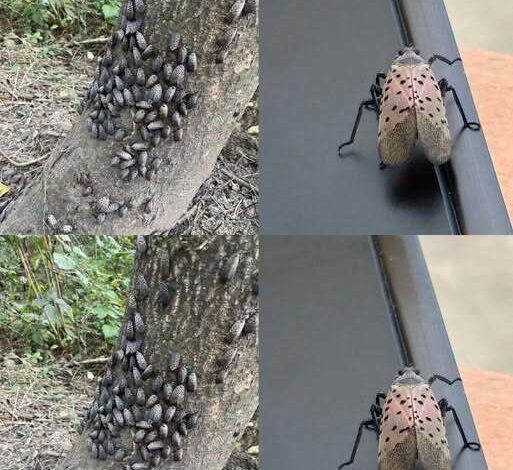
Its wings are decorated with black spots, and when it suddenly jumps into the air, flashes of brilliant red appear beneath them. It almost resembles an exotic butterfly.
Unfortunately, that striking appearance belongs to one of North America’s most destructive invasive insects: the spotted lanternfly.
Although these insects pose no direct danger to people—they don’t bite, sting, or damage homes—the threat they present to trees, gardens, vineyards, and agricultural crops is significant. Since first being identified in the United States in 2014 after arriving from Asia, the spotted lanternfly has steadily expanded into additional states, creating growing concerns for homeowners, landscapers, farmers, and environmental officials alike.
One reason this pest has become such a serious problem is its enormous appetite.
Spotted lanternflies feed by piercing plants and extracting their sap. Unfortunately, they aren’t picky eaters. Scientists have identified more than 70 different plant species they readily feed upon, including grapevines, maple trees, walnut trees, willows, fruit trees, ornamental plants, and many other valuable landscape and agricultural species.
A single insect rarely causes noticeable harm.
Large populations, however, can place tremendous stress on vegetation over time, weakening plants and leaving them increasingly vulnerable to disease, drought, and other environmental pressures.
Ironically, one of the first clues that lanternflies are nearby usually isn’t seeing the insects themselves.
Instead, many homeowners first notice a sticky coating covering everything beneath infested trees.
This sugary substance, known as honeydew, is a waste product produced while the insects feed on plant sap. As dozens—or even hundreds—of lanternflies gather in one location, they release astonishing amounts of this sticky liquid.
Before long, vehicles, decks, outdoor furniture, grills, sidewalks, playground equipment, and patios become coated in the unpleasant residue.
The problem doesn’t end there.
Honeydew acts like an open invitation for other insects.
Ants, bees, wasps, and numerous sugar-loving species quickly gather to feed on it, creating even more activity around affected areas.
Soon afterward, another issue begins to appear.
The sugary coating creates ideal conditions for sooty mold, a black fungus that spreads across leaves, branches, and nearby surfaces.
Although this fungus doesn’t directly infect trees, it blocks sunlight from reaching their leaves, reducing the plants’ ability to produce energy through photosynthesis. Trees already weakened by heavy sap feeding can become even more stressed as the mold continues spreading.
Over repeated seasons, these combined effects may reduce fruit production, slow growth, and leave valuable plants increasingly susceptible to other problems.
Recognizing spotted lanternflies during each stage of their life cycle can dramatically improve your chances of stopping an infestation before it becomes severe.
In spring, newly hatched nymphs are tiny black insects covered with bright white spots.
They cannot fly, but don’t underestimate them.
They’re incredibly active, moving rapidly from plant to plant in search of food.
As summer progresses, these immature insects grow larger and undergo a dramatic transformation.
Their bodies develop vivid red patches alongside their black-and-white markings, making them far more colorful than many people expect.
By late summer and early fall, the adult stage begins.
When resting, adult spotted lanternflies appear fairly plain, displaying gray wings decorated with black spots.
But once they jump or spread their wings, brilliant scarlet hindwings outlined in black become instantly visible, making them much easier to identify.
Adults typically grow to about one inch in length.
Although they aren’t powerful long-distance fliers, they excel at jumping and making short flights from tree to tree.
If you discover spotted lanternflies on your property, experts generally recommend acting quickly wherever the insect is considered invasive.
While removing one or two insects won’t eliminate an infestation, reducing local populations before they multiply can help protect nearby plants from larger outbreaks.
Autumn is particularly important because that’s when females begin laying eggs.
Rather than depositing them only on trees, spotted lanternflies use almost any suitable surface.
Tree trunks.
Fence posts.
Outdoor furniture.
Campers.
Trailers.
Firewood.
Rocks.
Landscaping equipment.
Even parked vehicles.
Their egg masses often resemble patches of dried gray mud or putty, measuring roughly one to two inches long. Each mass can contain dozens of eggs waiting to hatch the following spring.
If you find one, experts recommend carefully scraping it into a container filled with rubbing alcohol or hand sanitizer, which helps destroy the eggs before they emerge.
Simply knocking them onto the ground isn’t enough, as many eggs may survive if they aren’t properly destroyed.
Another key part of controlling lanternflies involves recognizing one of their favorite host plants.
The invasive Tree of Heaven (Ailanthus altissima) grows rapidly along roadsides, abandoned lots, woodland edges, and disturbed areas throughout many regions.
Although lanternflies feed on many different species, they show a strong preference for this tree during portions of their life cycle.
Where appropriate—and often with professional guidance—managing or removing Tree of Heaven can reduce attractive habitat and help slow local infestations.
Some homeowners also use sticky bands wrapped around tree trunks to trap climbing nymphs.
These traps can be effective, but they must be used responsibly.
Without protective coverings such as wire mesh or hardware cloth, birds, squirrels, reptiles, and other wildlife can become accidentally trapped. Protecting beneficial wildlife should always remain part of any pest management strategy.
One reason spotted lanternflies continue spreading so rapidly is their remarkable ability to hitchhike unnoticed.
Adults and egg masses can cling to vehicles, trailers, outdoor furniture, shipping pallets, recreational equipment, landscaping materials, and firewood.
People may unknowingly transport them hundreds of miles before realizing they’ve carried the insects into entirely new areas.
Carefully inspecting vehicles and outdoor equipment before leaving infested regions remains one of the simplest and most effective ways to reduce their spread.
If spotted lanternflies have recently appeared where you live, local agricultural agencies often encourage residents to report sightings as quickly as possible.
Early reports allow officials to monitor expanding populations and coordinate management efforts before infestations become firmly established.
Checking with your state’s Department of Agriculture or natural resource agency can provide recommendations tailored specifically to your location.
Researchers continue searching for long-term solutions as well.
Compared with their native Asian habitat, spotted lanternflies have relatively few effective natural predators in North America. Scientists are studying biological controls, improved management strategies, and environmentally responsible ways to reduce their impact while protecting native ecosystems.
Fortunately, homeowners aren’t powerless.
Learning to recognize every stage of the insect’s life cycle, inspecting trees regularly, removing egg masses, checking outdoor equipment before travel, and following local recommendations can significantly reduce the risk of larger infestations.
Community cooperation is especially important because these insects don’t recognize property lines. One neglected yard can quickly become everyone else’s problem.
Finding a spotted lanternfly in your backyard can certainly be unsettling, especially if you’ve spent years caring for trees, gardens, or landscaping.
The good news is that early action often prevents much more serious damage later.
By staying alert, responding quickly, and working alongside your neighbors and local officials, you help protect not only your own property but also nearby forests, vineyards, parks, farms, and natural spaces that depend on healthy trees.
Your backyard should be a place to relax—not another front line in the battle against invasive pests.
With knowledge, vigilance, and cooperation, every homeowner can play a valuable role in slowing the spread of the spotted lanternfly and helping preserve the landscapes we all enjoy.