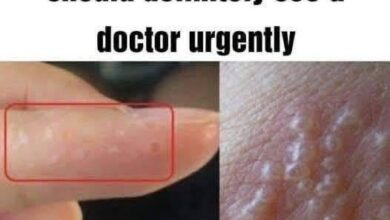
The Hidden Terror on Your Skin: Why Those Mysterious Red Welts Are a Warning You Can’t Afford to Ignore


You wake up in the middle of the night with an itch so intense it feels impossible to ignore. Your skin burns and tingles, and when you switch on the light, you discover raised red welts scattered across your arms, chest, or legs. They seem to have appeared without warning. Perhaps you assume it’s a mosquito bite, a reaction to something you ate, or irritation from a new detergent. For many people, that is exactly what it turns out to be. Yet sometimes these sudden skin changes are your body’s way of signaling that something deeper deserves attention.
These itchy welts are commonly known as hives, or urticaria. Although they often look alarming, hives are actually a common skin reaction that affects millions of people at some point in their lives. They can appear suddenly, disappear just as quickly, and vary dramatically in size and severity. Some people experience only a few isolated patches, while others develop widespread outbreaks that cover large portions of the body.
What makes hives particularly frustrating is their unpredictability.
One moment your skin appears completely normal. Hours later, raised red patches emerge seemingly out of nowhere. A welt on your shoulder may vanish by lunchtime, only for a new cluster to appear on your legs later that afternoon. This constantly shifting pattern often leaves people confused, searching for answers, and wondering what triggered the reaction in the first place.
At the center of this process is the immune system.
When certain cells in the body, known as mast cells, become activated, they release chemicals such as histamine into the surrounding tissues. Histamine causes tiny blood vessels beneath the skin to widen and leak fluid into nearby tissue. This creates the characteristic swelling, redness, and itching associated with hives. While the reaction is occurring on the skin’s surface, the process itself involves a complex series of immune responses taking place beneath the surface.
The appearance of hives can vary from person to person.
Some welts are small and isolated, while others merge together to form larger patches. They may be round, oval, or irregularly shaped. In lighter skin tones, they often appear red or pink. In darker skin tones, they may look darker than the surrounding skin or be identified more by their raised texture than by color.
Regardless of appearance, one symptom tends to unite almost everyone who experiences hives: itching.
For some people, the itch is mild and manageable. For others, it can become intensely distracting, interfering with sleep, concentration, and daily activities. The urge to scratch may be overwhelming, yet scratching often makes the irritation feel worse.
Another feature that distinguishes hives from many other skin conditions is their temporary nature.
Unlike rashes that remain in one location for days or weeks, individual hives typically fade within 24 hours. However, new welts may continue appearing elsewhere, creating the impression that the outbreak is constantly moving across the body.
In some cases, hives occur alongside a related condition called angioedema.
Angioedema involves swelling in deeper layers of tissue and commonly affects areas such as the lips, eyelids, hands, feet, or face. Rather than itching, this type of swelling often causes a sensation of tightness, pressure, or discomfort. While many cases resolve without serious complications, swelling involving the tongue, throat, or airways requires immediate medical attention because it can interfere with breathing.
Doctors generally classify hives according to how long they persist.
Acute urticaria refers to outbreaks that last less than six weeks. This is the most common form and is frequently linked to identifiable triggers such as infections, medications, foods, or environmental exposures.
Chronic urticaria, on the other hand, persists for longer than six weeks and can continue for months or even years. One of the most challenging aspects of chronic hives is that the exact cause often remains unknown despite extensive testing. In many cases, healthcare providers may classify the condition as chronic spontaneous urticaria, meaning that the outbreaks occur without a clearly identifiable trigger.
Certain forms of hives can also be triggered by physical conditions in the environment.
Some people develop welts after scratching or rubbing their skin, a condition known as dermographism. Others react to cold temperatures, sunlight, pressure from tight clothing, vibration, exercise, or sudden increases in body temperature. These reactions may seem unusual, but they demonstrate how sensitive the skin and immune system can sometimes become.
Potential triggers for hives are remarkably diverse.
Foods such as shellfish, nuts, eggs, or dairy products can sometimes provoke reactions in sensitive individuals. Certain medications, including antibiotics and nonsteroidal anti-inflammatory drugs, may also contribute. Viral infections, bacterial illnesses, insect stings, and environmental allergens are common culprits as well.
Stress does not directly cause hives in every case, but many people notice that emotional strain can worsen symptoms or make outbreaks more frequent. The relationship between stress and the immune system remains an active area of medical research, highlighting the powerful connection between emotional and physical health.
Because hives can have so many different triggers, identifying the cause often requires patience and careful observation.
Healthcare providers may ask detailed questions about recent foods, medications, illnesses, travel, environmental exposures, and lifestyle changes. Keeping a symptom journal can be surprisingly useful. Recording when hives appear, what you were doing beforehand, what you ate, and any unusual events can sometimes reveal patterns that might otherwise go unnoticed.
Treatment typically focuses on controlling symptoms while identifying and avoiding triggers whenever possible.
Antihistamines are often the first line of treatment because they help block the effects of histamine, reducing itching and swelling. Depending on the severity and persistence of symptoms, healthcare providers may recommend additional treatments or further evaluation.
Most cases of hives are not dangerous and eventually resolve. However, persistent, recurring, or severe symptoms deserve medical attention, particularly if they are accompanied by difficulty breathing, dizziness, facial swelling, or other concerning changes.
Perhaps the most important thing to remember is that your skin often provides valuable clues about what is happening inside your body. While not every rash signals a serious problem, sudden or recurring reactions should never be dismissed entirely. Paying attention to patterns, seeking medical advice when appropriate, and understanding the body’s signals can transform confusion into clarity.
Your skin is your body’s largest organ and often one of its earliest messengers. Sometimes an itchy welt is just an itchy welt. Sometimes it is your body’s way of asking you to look a little closer, listen a little more carefully, and take notice of what it may be trying to tell you.