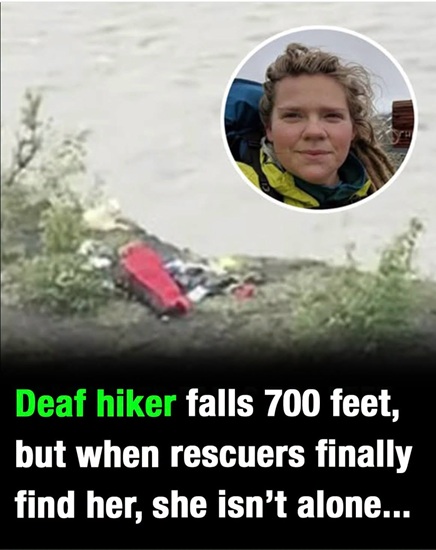
A deaf hiker fell from a steep height 700 feet — but when rescuers reached her, they discovered she wasn’t alone.

At twenty-one years old, Amelia Milling believed she was ready for almost anything.
Adventure had always called to her.
While many people her age were content with familiar trails and weekend outings, Amelia craved something bigger—something that would test her independence and push her beyond her comfort zone. Being deaf had never stopped her from pursuing challenges. If anything, it had strengthened her determination to prove that obstacles did not have to define a person’s limits.
So when she planned a solo hiking trip into the vast wilderness of Alaska, she saw it as an opportunity.
A chance to experience one of the most breathtaking landscapes in America.
A chance to rely on her own skills.
A chance to discover just how far she could go.
At first, everything unfolded exactly as she had imagined.
Towering mountains stretched across the horizon.
Fresh snow sparkled beneath the sunlight.
The silence of the wilderness felt peaceful rather than lonely.
Every step carried her deeper into a landscape so beautiful it seemed almost untouched by the modern world.
For Amelia, that isolation was part of the appeal.
Out there, far from crowded cities and constant distractions, life felt simpler.
The trail became her focus.
The mountains became her companions.
And for a while, the adventure felt perfect.
Then everything changed in an instant.
One misplaced step.
One patch of unstable snow.
One moment of lost balance.
Suddenly, Amelia’s feet disappeared beneath her.
The ground gave way.
Before she could react, she was sliding.
Fast.
Far faster than she could stop herself.
Snow and ice rushed around her as she tumbled down the mountainside.
Her heart pounded.
Her body slammed against the frozen terrain.
She fought desperately to regain control, but gravity had already taken over.
When she finally came to a stop, she lay motionless for several moments.
Breathing hard.
Trying to understand what had happened.
Pain shot through her body.
But somehow, miraculously, nothing seemed broken.
She was alive.
That realization brought immediate relief.
Yet a second, more frightening realization followed.
She had no idea where she was.
The fall had carried her far from the trail.
The landscape around her looked unfamiliar.
The mountains that had seemed so beautiful earlier now felt overwhelming.
She was injured.
Alone.
And lost.
At first, she tried to remain calm.
Panic, she knew, could be just as dangerous as the wilderness itself.
She carefully checked her supplies.
Assessed her injuries.
Studied the terrain.
Then she began trying to find her way back.
Hours passed.
Nothing looked familiar.
Every direction seemed the same.
The farther she moved, the more uncertain she became.
As daylight slowly faded, reality settled heavily onto her shoulders.
This was no longer a hiking mishap.
It was a survival situation.
The Alaskan wilderness is unforgiving.
Temperatures can drop rapidly.
Weather conditions can shift without warning.
Distances that appear manageable can become impossible when injury and exhaustion enter the equation.
Alone in that enormous landscape, Amelia felt the weight of those realities.
For the first time, fear truly arrived.
Not dramatic panic.
Not hysteria.
A quiet, creeping fear.
The kind that settles into your chest when you realize nobody knows exactly where you are.
As darkness approached, the loneliness became even harder to ignore.
Every survival expert emphasizes the importance of staying mentally strong.
But maintaining hope becomes difficult when you’re injured, lost, and surrounded by miles of wilderness.
Then something unusual happened.
At first, Amelia thought she was imagining it.
Far in the distance, a shape moved across the snow.
White against white.
Almost blending into the landscape.
She froze.
In Alaska, encountering wildlife can be dangerous.
A large animal approaching unexpectedly is not always good news.
The shape continued moving closer.
Slowly.
Purposefully.
Amelia watched carefully.
Her pulse quickened.
Then she noticed something unexpected.
A collar.
This wasn’t a wild predator.
It was a dog.
A large white husky.
As the animal approached, Amelia felt a wave of relief she could hardly describe.
The husky seemed calm.
Confident.
Comfortable in the wilderness.
Unlike her, he looked exactly where he belonged.
The dog’s name, she would later learn, was Nanook.
And he was already something of a local legend.
People familiar with the area knew him as an unusually intelligent trail dog that often appeared near hikers.
Over time, stories had spread about Nanook helping travelers navigate difficult conditions.
Some considered him a remarkable companion.
Others joked that he unofficially patrolled the wilderness.
Whatever the truth, his arrival couldn’t have come at a better moment.
Nanook stayed beside Amelia.
Not for a few minutes.
Not for a brief encounter.
He remained with her.
As darkness settled over the mountains, the husky refused to leave.
That simple presence made an enormous difference.
Being alone is one thing.
Feeling completely abandoned is another.
Nanook’s companionship gave Amelia something she desperately needed.
Hope.
The night was still cold.
The situation was still dangerous.
But she no longer felt completely isolated.
The following day brought another terrifying challenge.
As Amelia attempted to continue moving, she reached a stretch of cold, fast-moving water.
Crossing it would be risky.
Not crossing it could leave her stranded.
She had little choice.
The current was stronger than expected.
Almost immediately, she struggled to maintain her footing.
The freezing water stole her strength.
The current pushed relentlessly against her legs.
For a frightening moment, it seemed possible she might lose control completely.
Throughout the crossing, Nanook remained nearby.
According to Amelia’s later account, the husky’s presence helped her maintain direction and confidence during one of the most dangerous moments of the ordeal.
Whether through instinct, training, or simple loyalty, the dog never wandered far away.
By this point, Amelia knew she needed professional rescue.
The wilderness was simply too vast.
Her situation too uncertain.
Fortunately, she carried a GPS emergency beacon.
Activating it sent a distress signal containing her approximate location.
It was a small device.
But in remote regions, small devices can mean the difference between life and death.
Once the signal was received, rescue teams immediately began coordinating a response.
Search personnel reviewed the coordinates.
A helicopter was dispatched.
Experienced rescuers moved quickly to reach the area.
For Amelia, however, waiting felt endless.
Every minute stretched longer than the last.
The uncertainty remained.
Would rescuers find her in time?
Would weather conditions interfere?
Would the signal be accurate enough?
Eventually, the sound she had been hoping for finally arrived.
A helicopter.
Rescue crews had located her.
The relief was overwhelming.
After days of fear, exhaustion, and uncertainty, help had finally arrived.
Amelia was airlifted from the wilderness and transported to safety.
Medical evaluations confirmed what already felt miraculous.
Despite everything she had endured, she had survived.
And she was going home.
As news of the rescue spread, one detail captured people’s attention more than any other.
Not the technology.
Not the helicopter.
Not even the dangerous fall.
It was Nanook.
The white husky who appeared when Amelia needed companionship most.
The dog who stayed with her during one of the most frightening experiences of her life.
The dog who became an unexpected symbol of hope in the middle of a survival story.
Over time, the account spread across news outlets, social media, and outdoor communities around the world.
People were captivated not only by Amelia’s resilience but by the extraordinary role played by a dog who seemed to understand exactly when someone needed help.
Of course, the story carries larger lessons as well.
Nature is beautiful.
But nature can also be dangerous.
Even experienced adventurers can encounter unexpected challenges.
Preparation matters.
Emergency equipment matters.
Rescue services matter.
And sometimes survival depends upon a combination of skill, determination, and a little bit of luck.
For Amelia, that luck arrived on four paws.
Looking back, she would remember the fall.
The fear.
The uncertainty.
The long hours alone.
But she would also remember something else.
A white husky emerging from the snowy wilderness when she needed help most.
A silent companion in one of the loneliest moments of her life.
And a reminder that sometimes, in the most unexpected places, help finds its way to you.
In the vast, unforgiving wilderness of Alaska, Amelia Milling set out to prove her independence.
She succeeded.
But she also discovered something equally important:
Even the strongest people sometimes survive because they don’t face hardship alone.