I froze the moment I saw it.
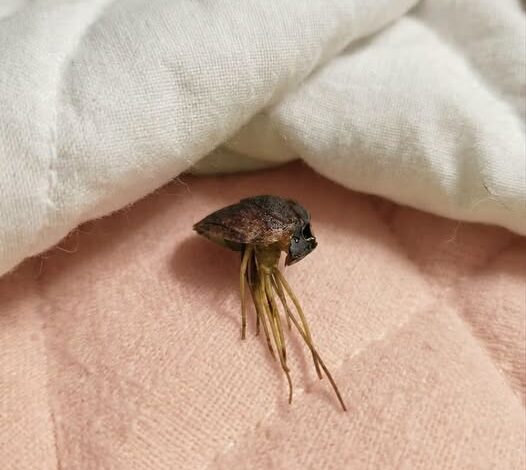
There, resting on the bedspread, was a tiny object with thin, spindly projections reaching out in every direction. At first glance, it looked unmistakably alive. The delicate, twisted “legs” seemed ready to move at any second, and I caught myself watching it far longer than I care to admit, half expecting it to crawl across the fabric.
I took one cautious step closer.
Then another step back.
My imagination had already filled in the gaps.
Was it some strange insect?
A spider I’d never seen before?
Something that had somehow found its way into the house overnight?
Suddenly every shadow in the room seemed suspicious. The quiet hum of the ceiling fan sounded louder than usual, and I found myself scanning the floor, the walls, even the corners of the ceiling, convinced there had to be more of whatever this was.
Fear has an incredible ability to invent stories before the facts have a chance to catch up.
Eventually, curiosity began to outweigh panic.
I switched on the brightest light in the room and crouched down for a closer look. I took several photographs, zooming in until the image filled my phone screen. The closer I looked, the stranger it seemed.
Those thin “legs” weren’t jointed.
There were no eyes.
No wings.
No antennae.
Still, I couldn’t make sense of it.
Like so many people would, I sent the pictures to a few friends.
The replies ranged from confidently wrong to wildly imaginative.
“Some kind of spider.”
“A weird beetle.”
“Definitely don’t touch it.”
Then someone noticed a detail the rest of us had missed.
“That’s a seed.”
I looked again.
And suddenly I saw it.
The rounded center wasn’t an insect’s body at all—it was a seed. The eerie “legs” that had frightened me were simply tiny white roots beginning to sprout as the seed searched for moisture. What I’d interpreted as something creeping toward life was actually a plant beginning its first quiet stage of growth.
The transformation happened entirely in my own mind.
Nothing about the object had changed.
Only my understanding of it.
Instead of recoiling, I picked it up gently between my fingers, amazed that something so ordinary had managed to convince me it belonged in a horror film. A seed carried indoors on a shoe, a pet’s fur, or a gust of wind had simply landed in the right conditions to begin germinating.
The experience left me laughing at myself.
But it also left me thinking.
Our brains are remarkably quick to recognize potential danger. Faced with something unfamiliar, we naturally imagine the possibilities that might protect us, even when those possibilities turn out to be wildly inaccurate. It’s an instinct that has helped humans survive for thousands of years, though in everyday life it often turns harmless mysteries into imagined emergencies.
Now, whenever I stumble across something strange, I try to remember that tiny sprouting seed.
Not every mystery hides a threat.
Not every unfamiliar shape is something to fear.
Sometimes the most unsettling discoveries are simply ordinary parts of nature seen from an unfamiliar angle.
What looked like a tiny creature waiting to spring to life was, in reality, life beginning in an entirely different way.
And that realization turned a moment of fear into something far better:
A reminder that curiosity, when given a little patience, often reveals wonder where imagination first saw monsters.