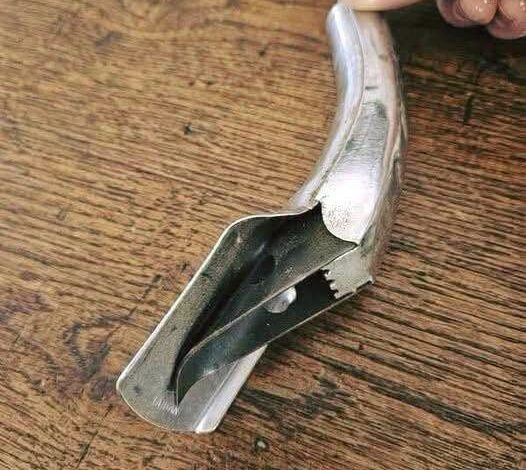
It sat quietly, heavy and unmoving, as though it had been waiting for someone to recognize it. The metal showed signs of age and use, yet its purpose was not immediately obvious. Its shape hinted at function, its construction suggested durability, and every curve seemed designed with intention. Still, without context, it remained a mystery.
Objects like this often spark curiosity because they occupy a space between the familiar and the forgotten. We can see that they were built for a specific task, yet the knowledge of that task may have faded with the generations who once used them daily. What was once an ordinary tool can become a puzzle simply because the world around it has changed.
Faced with an unfamiliar object, the mind naturally begins searching for answers. Some imagine it belonged in a workshop, assisting a mechanic or craftsman. Others picture it as part of an industrial process, attached to machinery long since dismantled. It may have served a practical purpose so common in its time that no one thought it worth documenting, only for that knowledge to gradually disappear as technology evolved.
This transformation from tool to mystery reveals something fascinating about the passage of time. Every era creates countless objects designed to solve everyday problems. Most perform their jobs quietly and efficiently, attracting little attention. Yet when their original context disappears, those same objects become artifacts capable of inspiring questions and stories.
The true significance of such discoveries often extends beyond identifying the object itself. Whether it ultimately proves to be a clamp, a bracket, a jig, or another specialized tool, the process of investigation becomes part of the experience. Each theory offers a glimpse into the industries, trades, and lives of people who depended on tools like it every day.
Historical objects remind us that entire worlds of knowledge can vanish surprisingly quickly. Skills that were once common become specialized. Professions disappear. Technologies evolve. Within a few generations, items that were once instantly recognizable can become completely unfamiliar to modern eyes.
There is also something deeply human about the desire to understand these forgotten artifacts. They connect us to the people who came before us—not through grand historical events, but through ordinary work. A worn tool may have been held thousands of times by someone earning a living, building a home, repairing equipment, or creating something useful. Its value lies not only in what it was, but in the lives it touched.
In many ways, rediscovery is as important as identification. The moment an object raises questions, it invites us to explore history, craftsmanship, and the evolution of everyday life. It transforms from a simple piece of metal into a tangible link with another time.
Perhaps that is why mysterious tools and forgotten objects continue to fascinate collectors, historians, and curious observers alike. They remind us that history is not only found in famous monuments or important documents. It is also preserved in the ordinary items people used without a second thought.
Whether the object’s purpose is eventually confirmed or remains uncertain, its greatest contribution may be the curiosity it inspires. In prompting us to ask questions and imagine the world it came from, it serves a purpose once again.
Sometimes the most ordinary object can tell an extraordinary story—not because of what it is, but because of what it helps us remember.