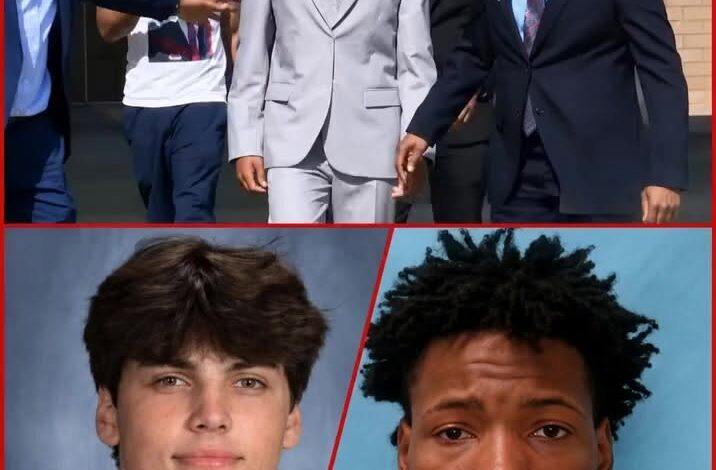
Inside the Frisco courtroom, every word seems to fall with unbearable weight.
The room is quiet, but the silence is not peaceful. Parents sit shoulder to shoulder, gripping tissues and staring ahead as if looking away might make the testimony harder to endure. Former classmates and teammates shift uneasily in their seats, caught between memory and disbelief.
At the center of it all is the absence no one can ignore.
Austin Metcalf.
His name hangs over the courtroom in photographs, testimony, and the aching pauses that follow whenever someone says it aloud.
His twin brother sits listening as prosecutors describe what they call a deliberate and deadly decision made beneath a rain-soaked team tent. They guide the jury through the confrontation piece by piece: the argument, the rising tension, the shove, the sudden appearance of a knife.
To the prosecution, Karmelo Anthony did not simply react to a chaotic moment. They argue that he escalated a teenage dispute into fatal violence, turning seconds of anger into a tragedy that ended another boy’s life.
Each photograph shown in court deepens the grief.
Austin in his track uniform.
Austin smiling.
Austin mid-stride, full of the confidence of a teenager who believed there would be more races, more school days, more ordinary mornings at home.
To his family, those images are not just evidence. They are fragments of a future that never arrived.
The prosecution leans heavily into that loss. A track meet, they remind jurors, should have been a place of competition, not violence. A team tent should have offered shelter from the rain, not become the setting for a fatal confrontation.
Whatever words were exchanged, they argue, whatever pride was wounded, nothing justified a knife.
In their version of events, Austin’s death was not a tragic misunderstanding. It was the result of a choice.
Across the aisle, the defense asks the jury to see the same moment differently.
They urge jurors to look not only at what happened, but at what led up to it. They describe Karmelo as a frightened 17-year-old who felt trapped, overwhelmed, and threatened as tempers rose and bodies closed in around him.
To them, the scene beneath the tent was not calculated.
It was chaotic.
Crowded.
Emotional.
A collision of fear, adrenaline, and teenage panic moving faster than judgment.
The defense insists this was not an ambush.
It was a moment that spiraled out of control.
They remind the jury that although Texas may try Karmelo as an adult, he is still a teenager—a young person sitting at the defense table with the posture of someone who might otherwise be waiting outside a principal’s office.
They point to his age, his fear, and the speed of the confrontation, asking whether a split-second decision made in terror should be judged the same way as a planned act of violence.
The two narratives could not be more different.
For prosecutors, Austin’s death was a deliberate escalation.
For the defense, it was the devastating result of panic in a moment that moved too fast to stop.
Between those arguments sits a jury tasked with deciding what happened in seconds—knowing their decision will shape lives forever.
They must weigh testimony, photographs, timelines, and witness credibility. They must consider not only what happened beneath that tent, but what Karmelo believed was happening when the blade appeared.
Intent becomes the question no image can fully answer.
Outside the courthouse, Frisco waits.
The track where Austin once ran now sits quiet, its lanes fading beneath the sun. What used to be a place of whistles, cheers, pounding footsteps, and finish lines now carries a different kind of silence.
Students still pass by.
Parents still drive past.
But for many, the space no longer feels ordinary. It has become tied forever to what happened there—and to everything that can never be undone.
No verdict can bring Austin home.
No sentence, no acquittal, no legal argument can restore the future that disappeared that day. A ruling can assign responsibility. It can punish. It can recognize fear. It can answer certain legal questions.
But it cannot give a mother back her son.
It cannot give a brother back his twin.
It cannot return a community to the belief that something like this could never happen there.
That is why the courtroom feels so heavy.
Everyone inside understands that the law can decide who must carry the consequences. But it cannot erase the grief.
The questions will remain.
The sorrow will remain.
The memory of rain, a team tent, an argument, and a blade will remain.
And as the case moves closer to a verdict, Frisco is left suspended between two painful truths.
One teenager is gone forever.
Another may spend the rest of his life defined by what happened in those few terrible moments.