Mine.
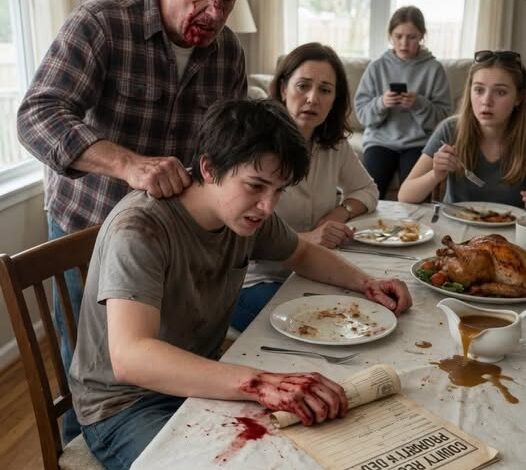
For a second, nobody understood what they were looking at. Dad’s hand was still on my collar, but his grip loosened one finger at a time. Mom leaned forward like the letters might rearrange themselves if she stared hard enough. Madison stopped breathing through her nose and whispered, “What is this?”
I did not answer her right away. I pressed two fingers to my lip, looked at the blood on them, and set my hand flat beside the deed so the red smear stayed on the tablecloth, right next to the county recorder stamp. Then I opened the Records folder again.
There was another page behind it.
Not a deed this time. A receipt from the county recorder’s office, printed at 9:12 that morning, clipped to an inspection report and a wire confirmation. I had not brought it because I wanted a fight. I brought it because I had known, deep down, that if I said no one more time, my father would need proof that he could not scare me into obedience anymore.
Lily made a sound from the couch.
It was not a sob at first. It was smaller than that, the kind of breath a person makes when years of pretending finally crack. Her phone slipped from both hands onto the cushion, still glowing, and she covered her mouth like she had just realized she was not the only witness in the room anymore.
Mom’s face changed when she saw the next document.
Madison looked from the paper to me, then to Dad, and her voice broke for the first time all afternoon. “You knew?”
Dad stared at the top line, and all the rage drained out of him, replaced by something much colder.
I slid the second page across the chicken grease and cooling gravy, looked straight at my mother, and said—
Dad stared at it.
For the first time in my life, Richard Carter looked confused.
Not angry.
Not offended.
Not disappointed.
Confused.
As if reality had suddenly stepped outside the script he had spent years forcing everyone else to follow.
“What is this?” he asked.
His voice sounded smaller.
I reached into my bag again.
Another document.
Then another.
The papers slid across the table one after another.
Property tax records.
Closing disclosures.
Business registration documents.
Bank statements.
Contracts.
Receipts.
Proof.
Years of proof.
Paper has a different kind of weight when it carries truth.
Mom grabbed one before Dad could.
Her eyes moved quickly.
Then slowed.
Then stopped.
“No,” she whispered.
I almost laughed.
Not because it was funny.
Because denial was always her first language.
Madison finally put her phone down.
“What is all this?” she asked.
“It’s my life,” I said.
The room fell silent.
A silence different from before.
Not the silence of control.
The silence of discovery.
The silence people make when they realize they have badly misunderstood someone.
Dad picked up the property deed.
His eyes scanned it again.
Then again.
“You bought a house?”
I nodded.
“Six months ago.”
“Why didn’t you tell us?”
The question landed so hard I almost admired it.
Why didn’t you tell us?
As if every conversation we’d ever had wasn’t evidence enough.
As if every request for money hadn’t come with guilt attached.
As if every achievement hadn’t immediately been treated as a resource to be redistributed.
“You never asked,” I said.
Mom looked wounded.
Genuinely wounded.
“Of course we asked about your life.”
“No,” I replied. “You asked about my paycheck.”
Nobody answered.
Because nobody could.
The distinction sat there between us.
Sharp as broken glass.
Dad flipped through another document.
The LLC paperwork.
His eyebrows pulled together.
“You own the company?”
“Yes.”
“How much is it worth?”
There it was.
Not congratulations.
Not pride.
Not happiness.
The first question that actually interested him.
I felt something inside me settle.
Not anger.
Clarity.
The kind that arrives after years of waiting for people to become someone they were never going to be.
“That’s not your business.”
His face darkened instantly.
“I’m your father.”
“No,” I said quietly.
“You’re the man who taught me to keep records.”
The room froze.
Dad blinked.
Mom stared.
Even Madison looked confused.
I pointed at the papers.
“You taught me every promise needed proof.”
Nobody moved.
“When I was seventeen and paying bills with tip money, you called it family responsibility.”
I looked at Mom.
“When I bought my first laptop, you called me selfish.”
Then at Madison.
“When you needed money, everyone called it support.”
I let the words hang there.
“But whenever I needed something, it was called independence.”
Madison crossed her arms.
“You’re being dramatic.”
I laughed.
Actually laughed.
Because some people can watch a bridge collapse and still complain about the weather.
“No,” I said.
“I think I’m finally being honest.”
The ceiling fan clicked overhead.
Once.
Twice.
Three times.
Nobody touched the food.
The roast chicken sat cooling in the center of the table like evidence from another life.
Dad stared at the stack of papers.
Years of assumptions dissolving in front of him.
“You hid all of this.”
“Yes.”
“From family.”
“No.”
I met his eyes.
“From people who treated me like an ATM.”
The words landed hard.
Mom gasped.
Madison looked offended.
Dad looked furious.
But none of them looked surprised.
Because deep down, every one of them knew exactly what I meant.
Across the room, Lily lowered her phone.
For the first time all afternoon, she smiled.
A small smile.
The kind that appears when someone finally says the thing everyone else was too afraid to admit.
Dad stood there for several seconds.
Then he dropped the deed onto the table.
The paper slid across the tablecloth and stopped beside the gravy boat.
The same place where he had pinned me only minutes earlier.
Funny how quickly power changes shape.
“You think this makes you better than us?” he asked.
I shook my head.
“No.”
Then I stood.
My lip still hurt.
The taste of blood still lingered.
But the fear was gone.
“All it proves,” I said, gathering the papers, “is that I finally stopped asking permission.”
Nobody stopped me as I packed the documents away.
Nobody apologized.
Nobody admitted anything.
Families like mine rarely change in a single afternoon.
But something else had changed.
For years, I had walked into that house hoping they would see me differently.
Respect me.
Value me.
Understand me.
Standing there with my bag over my shoulder, I finally realized I didn’t need any of it.
The proof had never been for them.
It was for me.
I walked toward the front door.
Behind me, the dining room remained frozen.
The good plates.
The untouched food.
The cooling gravy.
The silence.
Just before I stepped outside, Lily spoke.
“Hey, Mike.”
I turned.
She looked at me for a moment.
Then she nodded.
Not dramatically.
Not emotionally.
Just enough.
The kind of nod people give when they know exactly how much something cost.
“I’m proud of you.”
The words hit harder than everything else combined.
Harder than Dad’s hand.
Harder than Mom’s insults.
Harder than years of being treated like I was never enough.
Because it was the first time anyone in that house had ever said it.
I smiled.
A real one.
Then I opened the door and walked out.
And for the first time in my life, I didn’t feel like I was leaving home.
I felt like I was leaving debt.
The strange thing about power is that most people think it arrives all at once.
A promotion.
A fortune.
A title.
A victory.
But real power usually arrives quietly.
It arrives the moment you stop needing permission.
Three weeks after that Sunday dinner, I sat alone in my office reviewing lease documents while rain tapped softly against the windows.
The building wasn’t glamorous.
No marble lobby.
No expensive artwork.
No receptionist announcing visitors.
Just clean floors, working lights, and a business I had built one contract at a time.
My phone buzzed.
Dad.
Again.
I let it ring.
Then it buzzed a second time.
A text.
For the first time, the message wasn’t a demand.
It wasn’t an order.
It wasn’t a lecture.
It simply said:
“Can we talk?”
I stared at those three words longer than I expected.
Not because they fixed anything.
They didn’t.
Because they were new.
My father had spent sixty-two years telling people what to do.
Asking was unfamiliar territory.
I didn’t answer immediately.
The old version of me would have rushed to.
The old version of me spent years trying to earn moments that should have been given freely.
Approval.
Respect.
Affection.
Basic kindness.
I had mistaken survival for love so many times that I no longer trusted my own instincts.
So I waited.
Not to punish him.
To think.
There is a difference.
That evening Lily called.
Not texted.
Called.
We talked for nearly an hour.
Mostly about ordinary things.
Work.
Movies.
The neighbor’s dog that kept escaping its fence.
Normal conversation.
The kind families are supposed to have.
Near the end of the call, she got quiet.
“You know Mom cries a lot now.”
I looked out at the rain.
“I know.”
“She keeps saying she doesn’t understand how everything got this bad.”
I smiled sadly.
“People rarely notice a bridge collapsing when they’re the ones removing the bolts.”
Lily laughed softly.
Then she sighed.
“I think they’re scared.”
That part I believed.
For years, fear had belonged to me.
Fear of disappointing them.
Fear of conflict.
Fear of being called selfish.
Fear of losing family.
Now the fear had moved.
Not because I threatened them.
Because boundaries feel like abandonment to people who benefited from having none.
A month later, I agreed to meet my parents.
Public place.
Coffee shop.
Middle of the afternoon.
No audience.
No dining room table.
No home-field advantage.
Dad looked older.
That surprised me.
Not because he had aged.
Because I had finally seen him without fear standing between us.
Fear had always made him seem larger than he was.
Without it, he looked like a tired man carrying habits that no longer worked.
Mom spent most of the meeting staring into her coffee.
Nobody apologized immediately.
Families almost never begin with the important part.
They circle it.
They stall.
They discuss weather and traffic and television shows as if those things matter.
Finally Dad cleared his throat.
“I shouldn’t have hit you.”
The words landed awkwardly.
Heavy.
Incomplete.
But real.
I nodded.
“No.”
He looked down.
For several seconds nobody spoke.
Then Mom surprised me.
“We thought if we pushed, you’d stay.”
I frowned.
“What?”
She twisted a paper napkin between her fingers.
“You were always the responsible one.”
The sentence sounded ridiculous.
Then heartbreaking.
“We thought if we demanded enough, you’d keep coming back.”
I sat there staring at them.
All those years.
All those manipulations.
All those guilt trips.
And underneath it was fear.
Not an excuse.
An explanation.
The two are not the same thing.
“You made me feel used,” I said quietly.
Mom started crying.
Not dramatically.
Not performatively.
Just tired.
Honest.
“I know.”
For the first time in my life, she sounded like she actually did.
Healing didn’t happen that day.
Trust didn’t magically return.
Nobody hugged.
Nobody made speeches.
Real reconciliation is usually less cinematic than people imagine.
It’s awkward.
Uneven.
Slow.
Built from dozens of small choices instead of one dramatic moment.
Months passed.
Dad stopped demanding.
Mom stopped keeping score.
Madison remained Madison.
Some people change slower than others.
Some never do.
That was her journey to figure out.
Not mine.
Lily visited my office regularly.
Sometimes she helped organize files.
Sometimes she just sat and talked.
One afternoon she pointed toward the framed county deed hanging on the wall behind my desk.
“You know what’s funny?”
“What?”
“It was never really about the house.”
I looked at the frame.
The paper that had changed everything.
The paper I once thought represented victory.
She was right.
It wasn’t about ownership.
It wasn’t about money.
It wasn’t even about leverage.
The deed simply forced everyone to confront a truth that had existed long before the ink dried.
I had spent years building a life they refused to see.
And eventually that life became too real to ignore.
The house was only evidence.
The real story was everything that came before it.
The late nights.
The sacrifices.
The boundaries.
The quiet determination.
The thousands of times I chose myself after being taught not to.
That evening, after Lily left, I locked the office and stood alone in the parking lot.
The sun was setting.
Traffic moved steadily along the road.
People hurried home to families, dinners, responsibilities, and ordinary lives.
I thought about that Sunday afternoon.
The chicken.
The gravy.
The blood on the tablecloth.
The deed.
The silence.
For years, I believed freedom would feel dramatic.
Like a door slamming.
Like fireworks.
Like winning.
Instead, it felt surprisingly simple.
Like breathing without asking permission.
Like saying no and surviving.
Like understanding that love and access are not the same thing.
And maybe most importantly, it felt like finally knowing the difference between being valued and being useful.
The Carter family spent years confusing the two.
I spent years believing them.
Not anymore.
The records were complete.
The evidence was clear.
And for the first time in my life, the story belonged to me.