What began as an argument inside a moving car became, over time, something far heavier than a traffic investigation.
By the end, there would be hospital machines breathing beside a broken man, families divided by grief and accusation, a child born into uncertainty, and a courtroom struggling to untangle love, rage, responsibility, and loss.
But at the beginning, it was only Super Bowl Sunday.
A day Americans usually associate with noise and celebration:
crowded living rooms,
food trays balanced on coffee tables,
friends arguing about quarterbacks,
music and commercials and ordinary distraction.
Somewhere along that same highway rhythm, Daniel and the woman carrying his child were driving together through Florida, tension building quietly inside the car. Whatever words passed between them during those final moments before impact now exist only through fragments:
memories,
later testimony,
partial accounts reconstructed after catastrophe.
Then came the crash.
Violent enough to alter multiple lives instantly.
Sudden enough that nobody involved fully understood yet how permanent the consequences would become.
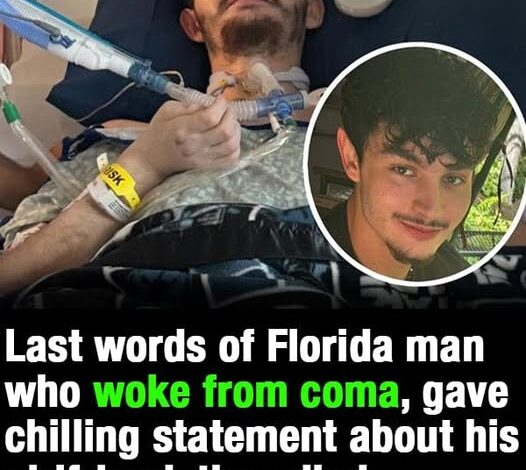
Emergency responders arrived to twisted metal, shattered glass, and confusion. Daniel was critically injured — injuries so severe they would pull him into months of medical uncertainty, suspended somewhere between survival and disappearance.
Back in New York, his family entered the strange emotional reality trauma creates for people forced to love from a distance.
Hospitals become worlds unto themselves during crises like this:
monitors blinking endlessly,
doctors speaking in careful percentages,
phone calls arriving at unbearable hours,
hope shrinking and expanding unpredictably from one update to the next.
His relatives clung to every sign:
a movement,
a change in breathing,
a slight improvement.
Because when someone you love falls into a coma, time itself changes shape. Days lose structure. Life becomes organized around waiting for consciousness to return — waiting for eyes to open, for memory to surface, for one recognizable sentence proving the person you love still exists somewhere beneath machines and medication.
For months, Daniel remained trapped in that uncertain territory.
Meanwhile, the questions surrounding the crash deepened.
At first, outsiders may have seen only another tragic collision — the kind of devastating but ultimately ordinary event that flashes briefly across local headlines before disappearing beneath newer tragedies.
But the story shifted once Daniel regained consciousness.
Because when he finally spoke, his account transformed the emotional landscape entirely.
According to relatives and later legal claims, Daniel described more than an accident caused by distraction or panic. He allegedly described intent — an argument escalating into something weaponized, a moment where anger inside the car became inseparable from violence itself.
The accusation changed everything.
Suddenly the case no longer centered only on survival.
It centered on accountability.
And yet even then, life remained painfully unresolved.
Daniel was still alive.
Still recovering.
Still trying to emerge physically and emotionally from catastrophic trauma.
Families on both sides entered the exhausting territory where criminal suspicion, medical uncertainty, and personal grief overlap messily. Every update carried legal implications. Every conversation became emotionally loaded. Hope itself grew complicated because survival now meant future court battles waiting on the other side of recovery.
Then came October 2025.
And with it, finality.
Daniel’s death transformed the case permanently. What once existed as a devastating crash investigation evolved into a homicide prosecution. Legal language hardened. Consequences sharpened. Public attention intensified.
But inside the family, grief moved differently than headlines did.
Because while outsiders focused on charges and courtroom developments, relatives were mourning someone far more specific:
a son,
a brother,
a father who never truly got the chance to become one fully.
And at the center of everything stood the child.
A newborn now carrying the emotional gravity of two fractured futures simultaneously.
Children born into tragedy often become symbols publicly, but privately they remain heartbreakingly ordinary:
tiny hands,
late-night feedings,
small breaths sleeping against someone’s chest.
Yet around this child swirled enormous adult questions:
custody,
legacy,
belonging,
memory,
who gets to shape the story the child eventually hears about the father now gone.
Daniel’s relatives insist one wish became clear during his final months:
that his child remain connected to his side of the family, rooted in the people and place that formed him long before the crash ever happened.
That desire transformed custody proceedings into something emotionally larger than legal procedure alone.
Every filing now carries layered meaning.
Every hearing becomes about more than guardianship.
It becomes about preserving continuity for someone too young to remember the man whose absence already defines their life.
That is what makes cases like this so painfully complicated.
Courts can distribute custody.
They can assign legal responsibility.
They can issue rulings and sentences.
But they cannot reconstruct the future that existed before violence entered the car that day.
They cannot restore first birthdays with both parents present.
Cannot return ordinary arguments that end safely instead of catastrophically.
Cannot answer the child’s future questions completely:
Who was my father?
What really happened?
Did he love me?
Families become the keepers of those answers eventually.
And grief ensures they will not all tell the story the same way.
One side remembers Daniel as a victim whose final words deserve justice and whose child deserves connection to his roots.
The other side may carry entirely different memories, fears, explanations, or defenses shaped by their own understanding of the relationship and crash.
Meanwhile, the child grows quietly beneath all of it, inheriting consequences created long before they could speak.
Perhaps that is the deepest tragedy buried beneath the legal case itself.
Not only that one life ended.
But that an entire family structure collapsed before it fully began.
A child now enters the world through court documents, accusations, memorial photos, and contested narratives instead of shared celebration.
Still, Daniel’s family continues showing up.
To hearings.
To lawyers’ offices.
To long conversations about custody, memory, and what kind of life they believe he would have wanted for his child.
Because when someone dies after fighting that long to survive, surviving relatives often feel they inherit unfinished responsibilities automatically.
To remember.
To protect.
To speak when the dead no longer can.
And somewhere beneath every legal motion sits a quieter emotional truth impossible for any courtroom to settle fully:
a family loved someone deeply,
lost him slowly,
and now fights to ensure at least part of him continues forward in the life of the child he left behind.