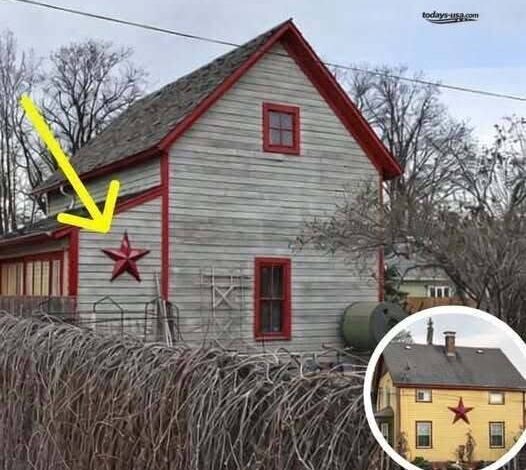
The stars are everywhere.
They watch from weathered barn walls, rusted tin siding, porch gables, fences, sheds, and aging wooden beams. Quiet and unmoving, they have become such a familiar part of the rural landscape that many people hardly notice them anymore. Yet every so often, a traveler on a country road catches sight of one and wonders.
Why is it there?
What does it mean?
The stars offer no answer. They simply remain.
For generations, they have stood witness to the rhythms of rural life. They have watched harvests come and go, storms roll across open fields, and families gather for celebrations and farewells. They have seen children grow up, leave home, and return with families of their own. They have survived changing owners, changing fashions, and changing times.
Many have outlived the people who first placed them there.
Yet the stars endure.
Their story traces back to German-speaking settlers who carried with them traditions rooted in craftsmanship, order, faith, and practicality. These communities often found meaning in simple things done well. They believed that beauty belonged not only in churches or grand buildings, but also in the ordinary places where daily life unfolded.
Barns were not merely structures.
They sheltered animals, stored harvests, protected tools, and stood at the center of family livelihoods. A barn represented work, stability, and survival. Because of that, it deserved care.
The stars became part of that care.
Whether painted directly onto wood or crafted from metal and mounted with intention, each star carried a sense of identity. Some featured five points. Others displayed six or eight. Their shapes varied, but their purpose was often the same: to mark a place as valued and tended.
They were not simply decorations.
They were declarations.
Without saying a word, they communicated something important:
This place matters.
The people who work here matter.
The labor performed here deserves respect.
Over time, stories and interpretations grew around the stars. Some people believed they offered protection. Others viewed them as symbols of luck, faith, or family heritage. In many communities, they became linked to traditions passed quietly from one generation to the next.
Yet perhaps their greatest strength lies in the fact that they never belonged to a single explanation.
The barn star survives because it can mean different things to different people.
For some, it evokes memories of grandparents and family farms. For others, it represents resilience, craftsmanship, or connection to rural roots. Many simply appreciate its balance and beauty.
Regardless of interpretation, the shape continues to resonate.
As decades passed, the stars migrated beyond the countryside. They appeared on suburban homes, storefronts, gardens, and restored historic buildings. Their original meanings sometimes faded, blurred by time and commercialization.
Still, the symbol endured.
That endurance tells its own story.
In a world that often values speed, novelty, and constant change, the barn star represents continuity. It reminds us that not everything meaningful needs to be new. Some traditions survive because they quietly fulfill a human need for connection, memory, and belonging.
The star’s true legacy may not be found in folklore or symbolism alone.
It may be found in the idea that beauty belongs in ordinary places.
That a building used for work can still inspire pride.
That everyday life deserves dignity.
That simple things, thoughtfully made, can carry meaning long after their creators are gone.
When a barn star catches the sunlight today, it does more than decorate a wall. It connects the present to generations of people who believed in craftsmanship, stewardship, and the value of honest labor.
It reminds us that memory can be built into the landscape.
That symbols can outlive their makers.
That traditions do not always survive because they are explained.
Sometimes they survive because they continue to feel true.
Perhaps that is why these stars still capture attention from passing roadsides and quiet country lanes.
In a noisy world filled with endless messages, they offer something rare.
They ask nothing.
They announce nothing.
They simply remain—steady, familiar, and enduring—inviting us to pause for a moment and remember that some of the deepest meanings are the ones that never needed to be spoken aloud.