The constant rattling in our wall drove us crazy — then breaking through revealed a shocking secret.

The first sound was so faint I almost convinced myself it wasn’t real.
A soft scratching somewhere inside the walls.
Not loud enough to wake the entire house. Not dramatic enough to demand immediate attention. Just a subtle noise that appeared in the early hours before dawn, then vanished before I could fully identify it.
At first, I blamed the house.
Our home was old—nearly seventy years old, in fact—and old houses have a language of their own. They creak when temperatures change. They groan when the wind shifts. Pipes rattle. Floorboards complain.
Strange noises come with the territory.
So I ignored it.
For a while.
But some instincts refuse to stay quiet.
And deep down, something kept telling me that whatever was making those sounds wasn’t part of the house.
It was living inside it.
The noises became part of my nightly routine.
Every evening I would settle into bed, turn off the lights, and listen.
Sometimes it was scratching.
Sometimes a faint buzzing.
Other nights it sounded like tiny fingers tapping rhythmically against wood.
Tap.
Scratch.
Buzz.
Then silence.
Then again.
The pattern repeated often enough that I started anticipating it.
My husband, Mark, dismissed my concerns immediately.
“It’s probably a squirrel,” he said one night.
“Squirrels don’t buzz.”
“Then it’s something else.”
His answer sounded reasonable.
Until the sounds grew louder.
Three weeks later, they were impossible to ignore.
The guest bedroom seemed to be the center of whatever was happening.
The noises weren’t occasional anymore.
They were constant.
Standing in that room felt strange, as though the walls themselves were vibrating.
One morning I walked inside carrying a basket of laundry and froze.
The sound was coming from directly behind the far wall.
Not beside it.
Not near it.
Inside it.
I placed my hand against the drywall.
A pulse answered me.
Not a literal heartbeat.
But something close enough to make my stomach tighten.
The wall vibrated beneath my palm.
Tiny.
Steady.
Alive.
I pulled my hand back immediately.
Mark came upstairs when he heard me call.
For the first time, he didn’t laugh.
For several seconds he stood beside me listening.
Then his expression changed.
“I hear it.”
That was the moment everything shifted.
Before that morning, we had been dealing with an annoyance.
Now we were dealing with a mystery.
And mysteries inside your walls rarely end well.
Over the next few days, we became amateur investigators.
We researched every possibility we could think of.
Mice.
Rats.
Birds.
Squirrels.
Raccoons.
Every video we found sounded wrong.
Rodents scurry.
Birds flutter.
Squirrels scratch in bursts.
None of those noises matched what we heard.
The buzzing was too consistent.
The vibrations too strong.
Whatever lived behind that wall wasn’t simply passing through.
It was building something.
Growing.
Expanding.
The realization settled heavily over the house.
Neither of us said it out loud, but we both knew.
If the sound was increasing, then so was whatever caused it.
And if we waited too long, the situation could become dangerous.
By the fourth week, sleep had become nearly impossible.
Every noise jolted me awake.
Every creak made me imagine something crawling through the walls.
I found myself staring at the guest-room wall whenever I walked past it.
Listening.
Waiting.
Wondering.
Finally, on a rainy Saturday morning, Mark had enough.
“We’re opening it.”
The words filled me with both relief and dread.
Part of me desperately wanted answers.
Another part worried about what those answers might be.
Armed with protective glasses, gloves, and far more courage than either of us actually felt, we stood inside the guest room staring at the wall.
The house felt unusually quiet.
Almost expectant.
Mark raised the axe.
The first strike landed with a dull crack.
Instantly, the buzzing exploded.
The sound that emerged from inside the wall was unlike anything I’d heard before.
It wasn’t one buzz.
It was thousands.
A living vibration.
A collective roar.
The drywall trembled.
I stepped backward.
Mark swung again.
Another crack.
The buzzing intensified.
By the third strike, I could feel it in my chest.
Like standing beside a massive electrical transformer.
The wall finally split open.
And then we saw it.
For a moment neither of us moved.
Neither of us spoke.
We simply stared.
The cavity behind the drywall was completely filled.
Not partially.
Not in one corner.
Filled.
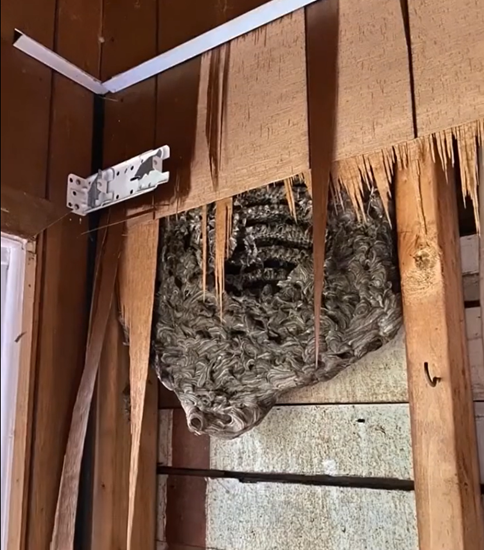
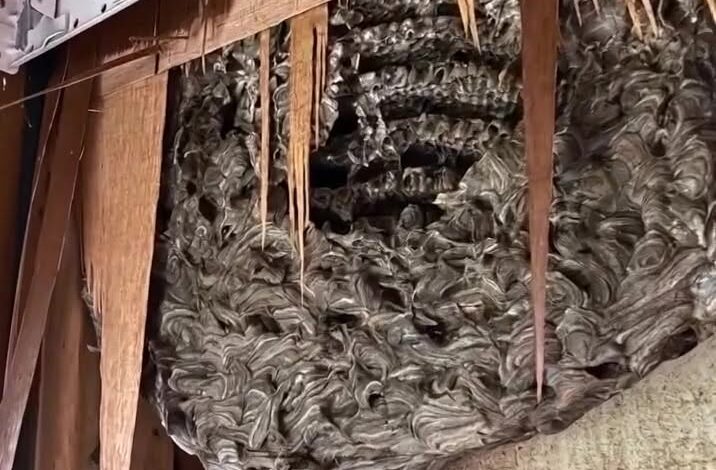
A massive wasp nest stretched between the wooden studs.
Layer upon layer of gray, papery structures climbed from floor to ceiling.
Thousands upon thousands of wasps crawled across its surface.
The entire colony moved as one enormous living organism.
Wings vibrated.
Bodies shifted.
The nest pulsed.
The sight was horrifying.
Beautiful in a strange way.
And utterly terrifying.
I stumbled backward until I hit the opposite wall.
My heart hammered against my ribs.
For weeks we had slept twenty feet away from this.
Walked past it every day.
Lived beside it without knowing.
The realization made my knees weak.
One crack in the drywall.
One disturbance.
One wrong move.
And thousands of angry wasps could have flooded directly into our home.
The thought turned my stomach.
We retreated immediately and called professionals.
No heroics.
No DIY solutions.
No internet tutorials.
Just experts.
Several hours later, a pest-control specialist arrived.
The moment he saw the nest, he whistled softly.
“That’s one of the largest wall colonies I’ve seen this year.”
His words did nothing to calm me.
As he suited up, he explained what had likely happened.
A queen had found a small opening outside months earlier.
She built a tiny starter nest.
Workers emerged.
The colony expanded.
Then expanded again.
And again.
Protected inside the wall cavity, hidden from weather and predators, the nest had flourished.
Unchecked.
Undetected.
Until the buzzing became impossible to ignore.
The specialist pointed toward the structure.
“Another month,” he said, “and this could have doubled.”
I felt cold despite the summer heat.
He continued.
“If the drywall had failed naturally, you’d have had thousands of wasps inside the house.”
Neither Mark nor I said anything.
We didn’t need to.
The image was terrifying enough.
The removal process took most of the day.
By evening, the colony was gone.
The wall cavity stood empty.
Silent.
For the first time in weeks, the house felt normal.
Or at least it should have.
But the experience stayed with me.
Long after the repairs were completed.
Long after fresh drywall replaced the damaged section.
Long after new paint covered every trace of what had happened.
I still listen.
Every unusual sound catches my attention.
Every unexpected buzz makes me pause.
Not because I’m afraid.
Because I’m aware.
That’s the lesson the nest taught us.
Danger rarely announces itself dramatically.
Most threats begin quietly.
A faint sound.
A small crack.
A subtle warning that feels easy to dismiss.
Until it isn’t.
We learned that homes require attention.
That strange noises deserve investigation.
That instincts exist for a reason.
Most importantly, we learned that waiting rarely improves a problem hidden behind walls.
Today, the guest room looks completely ordinary.
Sunlight spills across the floor each morning.
Fresh paint covers the repaired section.
Visitors would never guess what once existed there.
But I know.
And sometimes, when the house grows completely silent at night, I remember standing in front of that broken wall, staring at a living colony that had been thriving inches away from our lives.
It reminds me how fragile certainty can be.
How easily danger can hide behind familiar surroundings.
And how important it is to pay attention when something feels wrong.
Because the scratching, the tapping, and the buzzing weren’t random noises.
They were warnings.
Small signals from a hidden world growing quietly beyond our sight.
Fortunately, we listened.
And that decision may have saved us from a disaster we never saw coming.
Now, whenever friends tell me they’re hearing strange sounds in their walls, I give them the same advice:
Don’t ignore it.
Don’t assume it will disappear.
Listen carefully.
Investigate early.
And if your instincts tell you something isn’t right, trust them.
Sometimes the smallest sounds carry the biggest warnings.
And sometimes, the difference between a harmless mystery and a serious danger is simply whether you choose to pay attention.