His Dad Went To Jail For Being A Hitman And He Had A Tough Childhood, Today He’s World Famous

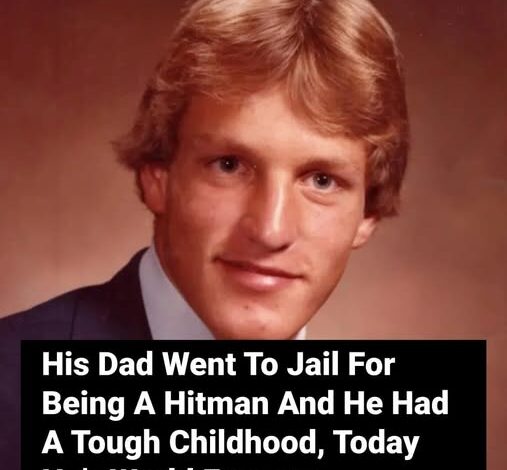
Woody Harrelson’s life has never followed the clean, polished arc people often expect from Hollywood success stories.
There is no simple line running from childhood ambition to fame.
No easy myth about a boy who dreamed of stardom, found his way to the stage, and rose steadily into beloved celebrity.
His story is rougher than that.
More complicated.
More human.
It is a story shaped by absence, contradiction, anger, talent, discipline, and a lifelong determination not to become imprisoned by the darkest parts of his inheritance.
Long before audiences knew him as the charming bartender on Cheers, before the Oscar nominations, before the risky film roles, before the environmental activism, before the image of an actor equally at home in comedy, drama, satire, and menace, Woody Harrelson was a child trying to understand a family story that did not make sense.
His father was not simply absent.
He was infamous.
Charles Harrelson became known as a contract killer, a man whose crimes would cast a long shadow over the family name. For a child, that kind of legacy is almost impossible to process. Most children inherit ordinary complications from their parents: habits, expectations, family arguments, financial struggles, emotional wounds. Woody inherited questions that had no comforting answers.
How do you carry a name tied to violence?
How do you separate yourself from a father whose actions the world remembers for all the wrong reasons?
How do you grow into your own identity when part of your history feels like something you must either explain, outrun, or survive?
Those questions did not disappear when he became famous.
If anything, fame made them harder to avoid.
Public success often gives people the illusion that a person has escaped their past. But the past does not vanish simply because the world starts applauding. It follows quietly. It waits inside interviews, memories, reactions, and private moments when no camera is present.
For Harrelson, the work of becoming himself began early.
As a boy, he learned resourcefulness before glamour ever entered the picture. He resold newspapers for pocket change, hustling in small ways that hinted at the restless energy he would later bring to performance. That early instinct mattered. It suggested movement. Survival. A refusal to sit passively beneath circumstances he had not chosen.
Acting eventually gave that energy a direction.
In New York, before fame arrived, he lived the familiar life of a young performer trying to turn desire into opportunity. Small apartments. Uncertain income. Auditions. Rejection. Hope. The grind of trying to be seen in a city filled with people chasing the same impossible dream.
Then came Cheers.
To the public, Woody Boyd seemed almost effortless.
Warm.
Naive.
Funny.
Sweet.
A character who entered one of television’s most beloved ensembles and somehow fit immediately. Harrelson’s easy charm made him feel familiar almost overnight. Viewers responded to his natural comic timing and open-hearted presence. He brought lightness to the screen, the kind of energy that made people want to root for him.
But charm can hide complexity.
The audience saw the smile.
They did not always see the history behind it.
They saw the actor becoming famous.
They did not necessarily understand the emotional weight he had carried into that fame.
That contrast became one of the most fascinating parts of Harrelson’s career. He could radiate looseness and humor while also suggesting something darker beneath the surface. As he moved beyond sitcom success, filmmakers began recognizing that he was capable of far more than likability.
His career widened.
Then deepened.
He took risks.
He chose roles that complicated his image rather than protecting it.
He could be funny, dangerous, tender, reckless, wounded, absurd, or terrifying. He could play men driven by ego, guilt, rage, confusion, idealism, or moral collapse. His best performances often seemed to draw from some private understanding of contradiction.
That may be why his work has endured.
Harrelson has never felt like an actor interested only in being admired. He seems more interested in being truthful, even when the truth is uncomfortable. His characters often carry tension inside them. They can be charming and destructive, gentle and volatile, comic and tragic. That duality gives his work its force.
Yet the volatility was not limited to the screen.
In his own life, Harrelson has had to confront anger, impulsiveness, and choices that could have narrowed his future if he had refused to examine them. Brushes with the law, reckless moments, and the emotional residue of childhood all became part of a larger reckoning.
Some people spend their lives insisting they are nothing like where they came from.
Others do the harder work of asking what parts of the past still live inside them.
Harrelson’s story suggests that he had to do the second.
The wounds of childhood do not always announce themselves clearly. Sometimes they appear as anger. Sometimes as risk-taking. Sometimes as mistrust. Sometimes as a hunger for escape. Sometimes as a refusal to be controlled by anyone or anything.
For Harrelson, the process of maturing seems to have involved recognizing those forces without surrendering to them.
Family became part of that transformation.
So did work.
So did introspection.
So did the discipline of acting itself.
The best acting demands honesty. Not politeness. Not performance in the shallow sense. Real acting asks a person to look closely at fear, weakness, desire, shame, tenderness, and rage. It asks the performer to understand human behavior without flinching.
For someone carrying a complicated past, that kind of work can become more than a profession.
It can become a way of survival.
Over time, Harrelson’s career became almost impossible to categorize. He moved from network comedy to controversial films, from indie dramas to blockbuster franchises, from political satire to prestige television. He never stayed in one lane long enough for audiences to fully trap him there.
That adaptability became its own kind of freedom.
Many actors are defined by their first great success.
Harrelson kept refusing that limitation.
He was not only Woody Boyd.
Not only the wild man.
Not only the character actor.
Not only the leading man.
Not only the activist.
Not only the son of a notorious father.
He became all of these things and none of them completely.
That refusal to be reduced may be the clearest thread running through his life.
The world loves simple labels.
It likes clean explanations.
It prefers people to remain legible.
But Harrelson’s life resists that. He is funny and intense, relaxed and serious, playful and political, beloved and unpredictable. His story contains darkness, but it is not governed by darkness. It contains fame, but it is not only about fame. It contains inheritance, but it is not trapped by inheritance.
That is what makes his journey compelling.
He did not erase his origins.
He outlived their power to define him.
There is a difference.
Escaping the past often implies running from it. Rewriting a life requires something harder. It means facing what happened, understanding what it did to you, and choosing again anyway. It means building a self strong enough to hold pain without becoming pain.
Harrelson’s enduring career feels like that kind of choice repeated over decades.
Every performance.
Every reinvention.
Every unexpected role.
Every moment of public honesty.
Every return after missteps.
Together, they form a portrait of a man who refused to let the worst part of his family story become the final word on his own.
The boy with the infamous last name became an artist with a name recognized for something else entirely.
Not perfection.
Not purity.
Not a life untouched by trouble.
Something more meaningful.
Transformation.
Woody Harrelson’s story is not powerful because he escaped contradiction.
It is powerful because he learned how to live beyond it.
And in doing so, he turned a legacy he never asked for into a life unmistakably his own.